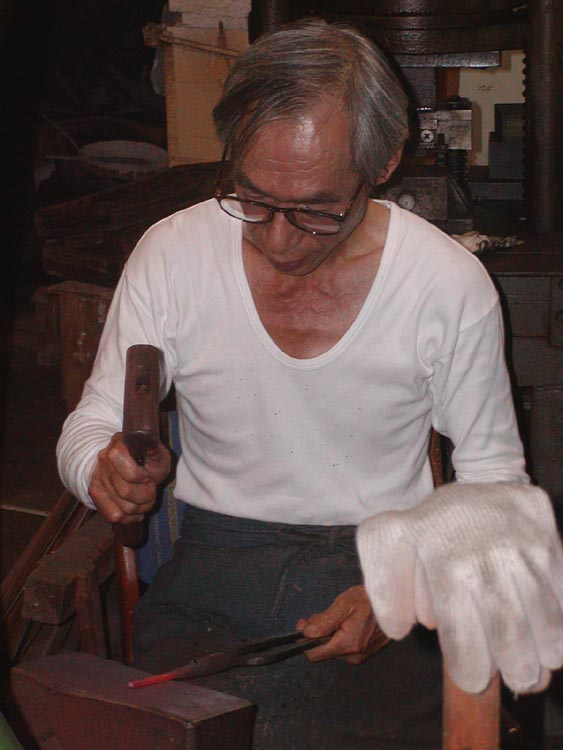
3 year wait for these chisels finally over!
Derek Cohen (in Perth, Australia)
I received a package from Japan today (via So Yamashita in Sydney). I must share this with you all as I am thrilled, absolutely thrilled.
7 Kiyohisa paring chisels were ordered for my birthday 3 years ago. The wait was longer than I anticipated, but shorter than others have been waiting, so I understand.
You cannot disguise the Japanese packaging ...
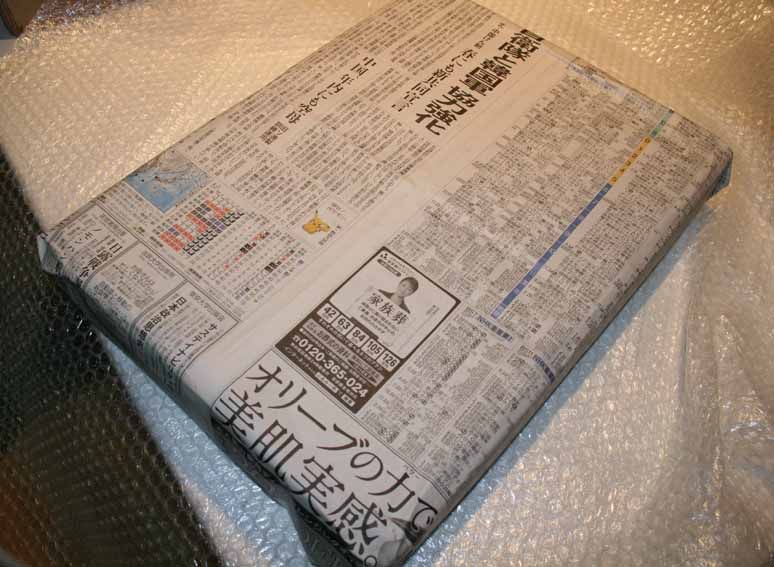
But under that was a really friendly touch ...


Then a box made of Kiri (Paulownia) ...


So had written to me about the box ...
First of all kiri is generally considered in Japan to be the best material for making boxes/cases to store objects that doesn't like moisture. Also, it is very light in weight as you know. So in Japan, any super expensive stuffs were/are always stored in kiri boxes, from national treasures to private collections. For instance, various tea ceremony equipments, ceramics, porcelains, and bamboo made tools, sword and related equipments, etc. etc. are ALWAYS stored in kiri boxes. Now, what's specifically great about Kiyohisa-san's box is that, it is made by a kiri tansu (the most expensive cabinet in J, which cost about 1,000,000JPY for a simple drawers of three~! No mistake in the numbers of zeros here, so in AUD about $12,000) maker as his side business. Normally kiri boxes are made by kiri box specialized makers using less expensive Taiwanese kiri material. Anyway, this box..., the lid is made so accurately, when you place the lid on the box and let it go, it slo~~~~~wly sinks down. This is the traditional way of making the kiri boxes, a way to show off the craftsman's skill as well, but not too many kiri boxes are made in this manner anymore. In fact, this is the only one that I know that's made this way. Because of such precise fitting, the box is basically airtight, so a kiri box that's already very rust preventing is even more so with these.
When opening this box, one can feel the air sucking the lid back. And then when replacing the lid it sinks ... floats downward on a cushion of air.
So finally this was revealed (actually, each chisel was wrapped separately. I have set these out) ...
7 Kiyohisa paring chisels in 6, 9, 12, 18, 24, 30, and 42mm. These are the sizes I most commonly use when paring.


A few close ups ..


I'm really pleased I went with white oak for the handles. Kiyohisa-san's chisels have a gentleness about them, and the white oak complements this, unlike a darker wood.
So had written, (The handles are) White Oak with Core material. The branch part of Japanese white oak. If you already have high quality white oak handled chisels or kanna dai, you should know that these are very different from European white oak. J oak is much denser and harder. But these days even the most expensive tools (chisels and kannas) are using less expensive less dense Niigata oak, rather than Kyoto oak, so you might be surprised to see Kiyohisa-san's white oak quality.

The finish to the steel is superb, and the handles are smooth and warm to the touch.
And finally (for now), the angle of the handle to the blade ..

I do hope that Wiley is following the forum. He would be excited by these chisels, waiting as he is for his own.
Thanks all for sharing this with me.
Regards from Perth
Derek