Re: Dean, How Did You Get . . .
Wiley Horne--So. Calif.
Hi Pam,
A Tasai 15mm veri-thin is approx. 1/8" thick at the middle of the hard steel cutting end.
Dean's 1/16" chisels are thin indeed!
Wiley
Knowledge You Can Build On — Est. 1998
Re: Dean, How Did You Get . . .
Wiley Horne--So. Calif.
Hi Pam,
A Tasai 15mm veri-thin is approx. 1/8" thick at the middle of the hard steel cutting end.
Dean's 1/16" chisels are thin indeed!
Wiley
Aha! Thanks, Marv.
Pam Niedermayer - Austin, TX
Re: Dean, How Did You Get . . .
Pam Niedermayer - Austin, TX
Thanks, Wiley; however, I was much more interested in performance metrics.
Pam, who does know how to mic her Tasai's 
Re: Dean, How Did You Get . . .
Thomd
It is called music wire because it is what you would buy if you bought your trebble guitar strings by the pound, or piano strings. Whether this stuff is ever used that way or it is just the name that has attached itself to an industrial commodity, I don't know.
Pam are you saying you don't own a dial caliper, or a digital caliper. I don't know what I would do if I couldn't measure to the thou, and I am thinking of woodworking here. Metal working would be impossible, and since the tolerances are pretty much the same...
Re: Dean, How Did You Get . . .
Pam Niedermayer - Austin, TX
Thanks, Thom.
I do have a dial caliper, quite old and good, although it's not such an integral part of my toolkit as it sounds like yours are. Normally I don't use a ruler of any sort for woodworking, preferring to measure with the tools themselves. Metal working is not exactly one of my favorite things, so I do little of it.
I knew that my Tasai ultra thins were about 1/8" thick (i normally also work in mm rather than inches); but I was more interested in how Dean's and the Tasai (or other Japanese ultra thin) performed, how they felt, the balance, etc.
Pam
Here's an idea ...
Derek Cohen (in Perth, Australia)
Several years ago I was inspired by a video of Tage Frid to make the following "chisel". Tage was making half-blind dovetails, had sawed the sides, then took a piece of bandsaw and hammered it into the saw kerf to deepen it prior to chiseling out the waste.
I thought that this was a great idea but, in my usual excessive manner, proceded to make a tool specially for this purpose. Here it is ...

This is the current version, which is not quite what you are looking for. But just wait a moment, as I will get there.
The blade is about 1/16" thick (thin enough to get into a saw kerf) and about 1" wide. The end of the blade is square, not bevelled. My first version was bevelled and - you guessed it - that simply split the board along the grain. So I removed the bevel. What you want is one with the bevel.
The material for this "chisel" came from a trowel. I think it is HSS, perhaps SS. In any event it did take a decent edge .. I did not attempt to sharpen it like a real chisel, but is certainly would be sharp enough to remove the remnants of corner waste.
Here are some early pictures, so you can see how it was shaped (and this one is bevelled) ...
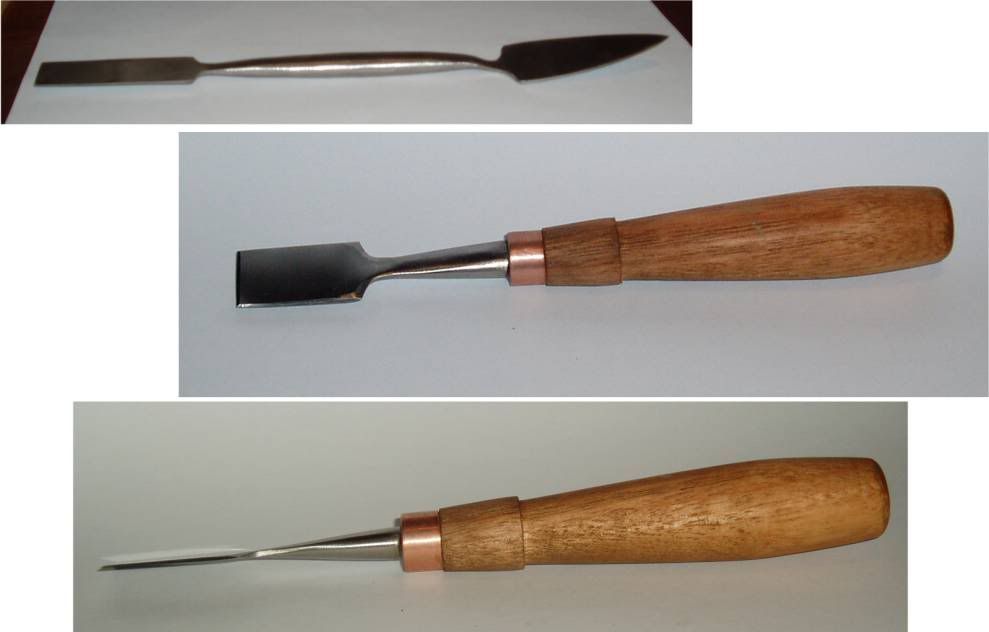
Perhaps that may help.
Regards from Perth
Derek
Easiest way I know of
Bob Hackett
Take an old circular saw blade and cut a strip from it with a plasma cutter or a cut off disc,or even a cheap tile saw with a water cooled diamond blade can be rented for a day if you don`t want to have to retemper after cutting.
Shape to fit your purpose and then use epoxy to glue on the wood scales on either side and shape those to fit your hand.
If you want to get fancy,buy a carbide drill bit that is the same size as the brazing rods a few aisles down at the hardware store.Take the brazing rod(tig welding rod will work too) and the bit home and cut up the rod into rivet sized pieces.Drill thru the whole shebang with your new carbide drill(use a slow speed for the metal part)and drive the rivets thru, hammer them over and file them down.
You don`t even have to grind a bevel onto the edge if you don`t want to.If you hone the edge after grinding it square you can use it like a scraper chisel,plane maker`s float,etc.If left square it can even be used to scrape high spots on metals softer than itself.Things like mild steel and cast iron will be a breeze to cut with it.
For the non-scroungers out there you could also buy a cabinet scraper of the needed thickness and use that for raw material.
Easy-peasy,as my grankids say.
Even easier
Bob Hackett
Email Dom and see if he can hook you up with some of that way cool spring steel stock he can get.
After it comes in the mail,you and your buddies arrange to spend a Saturday at the shop of the resident metalhead in your WWing club/guild.
Bring a pot luck lunch or see if the local pizza place delivers.I guarantee you`ll have a GREAT day and everybody will go home with a least one new tool.
Even easy-peasey-er!
Re: Dean, How Did You Get . . .
Dean J in MN
Pam,
The chisels have 7" blades (from the bolster to the cutting edge). They are all quite light in hand, even the 2" wide chisel feels quite agile.
The thin cross section, combined with the low bezel angle (roughly 20 degree, hone angles vary, depending on chisel width) seem to add their utility. Part of the motivation of making these tools was to answer the same question you are asking; how do these older designs function.
I'm learning that the older tools require a different touch that the more modern thick chisels. I'd would not want to pry on these tools, but at the same time I have no qualms about using a mallet with the appropriate touch.
It is a bit early for me to say much more than this: The tools have meet my early expectations; they are light, agile, and a pleasure to use. Their length is well suited to the "moxon-esque" push-with-your-shoulder technique. Chopping DT waste is a pleasure, thin cross sections are a bonus and their lightness, despite their overall length, seems to mitigate any fatigue from holding them low on their blade while cutting the baselines.
I'm sure there is much more to learn, but that requires time to let the tools speak.
-Dean
Re: Dean, How Did You Get . . .
ThomD
That sounds great. I was only worried that you hadn't one even in the kit. I don't use it a lot for woodworking, but I do use it at times when it solves specific problems. Like you I would rather work from fits be they story boards or the tools themselves, but there are time when having some numbers will make a big difference in sorting out particular problems.
Many thanks, Dean, very informative.
Pam Niedermayer - Austin, TX
Re: What gauge wire?
R Payne
This evening I had a couple of my homemade chisels out and remembering this thread I decided to measure them.
What I got was from a piece of 1/8" diameter rod I have a chisel about 1/32" thick (real thin) by a bit over 5/32" wide. I seem to recall grinding this on narrower to fit what I needed.
The other one started as 3/16" diameter rod. The business end of this one is a bit over 1/32" thick by 1/4" wide.
I used a regular hammer face on both of these. I could have gotten wider if I'd used a cross peen.
ron
Methods for clearing waste from dovetails
Derek Cohen (in Perth, Australia)
Hi again Les
I had a look at DCs' DVD.
David's method includes paring out the waste in the centre section first, then removing that at the edges. The reason for this is that he argues that the shoulders of the chisel are not thin enough to avoid bruising the sides of the dovetail.
He uses a chisel to undercut the waste at the corner, driving it down the face of the sidewall and into the baseline. Later this is removed with the edge of a chisel held at a skew.
Now here are the issues.
This method is only possible if the gap at the top of the chisel is wide enough to pass a chisel blade (that's why you were asking for a thin blade). However this method will not suit anyone wishing to cut "London Pins" as even a thin blade is unlikely to ever be thin enough. London Pins are the width of a saw blade at the top. Generally I use an 1/8" wide chisel for the baseline. There is not much room to work in this situation. You could sharpen a scraper to do this task.
I have no difficulty clearing waste with a chisel that is sharp at the shoulder. I may use a skew chisel or a thin-bladed knife to get out the last vestige of waste.
David cuts dovetails (or was doing so in the DVD) on a bandsaw. I do not know how he was removing the majorty of the waste. He may have used a bandsaw as well (I am not sure how - never tried it). Perhaps this is why his dovetails are wide enough at the ends for a chisel to pass through.
I tried this method on London Pins using my skinny chisel (that fits a saw kerf). It was frustrating. The gap (a saw kerf wide) was too narrow when the chisel was held at an angle. I think that I will stick to my existing methods.

Making Better Dovetails: http://www.inthewoodshop.com/Furniture/MakingBetter%20Dovetails.html
Regards from Perth
Derek
Re: Methods for clearing waste from dovetails
ThomD
There is the scientist part of me that likes to try out different methods, or parallel crafts. But on the performance side of things I think that staying with the method you know is normally better if it worked in the first place than trying all kinds of other things. As they say "beware of the man with only one rifle", or consider the Judo master who relies mostly on one completely mastered throw. Not only is practice better spent on one thing, not only is one's own method possible better suited to one's own body or method of work, but unless you are willing to actually live in the other person's shoes for the decades they have spent sorting out their methods, then it is probably delusional to imagine that one is really testing their methods. In golf they say it takes 20 000 repetitions to engrain a new method. And that is something as "simple" as a stroke, where paring a dovetail is many individual actions.
This is why tests in general annoy me so much. You get one person with a single method of doing things evaluating meriad tools that all came from rich working environments the tester hardly knows.
Of course if we are talking about mickey mouse methods or tools then improvement is doubtless easy to find. But as Ben Hogan said, "the answer is in the dirt". Meaning spend lots of time making divots at the driving range, and less time making pronouncements about the clubs.
Re: Methods for clearing waste from dovetails
les winter
What a great thread. Thanks for all the good info


