Home Articles Forums Gallery Marketplace Videos

WoodCentral Forums

Knowledge You Can Build On — Est. 1998

Fast and affordable laser cutting – so you can make the parts you can’t find anywhere else

Chisel Handles

Posts

Chisel Handles

#1

scott grandstaff

Chisel Handles

scott grandstaff

Well, a week with a nasty ear infection wasted. I hate that!!

So anyway, chisel handles.

Well, honestly you can get by just fine on a piece of broomstick. Just look at the Japanese handles!

Otherwise, you just pick your logical favorite and make a few of those.

Then try another style and a few of those.

Eventually you will come up with what you think is your favorite pattern.

But you won't be right. You'll find another you like better if you keep at it.

Its all so personal. My hand is close to the size of yours but it isn't really. So my very favorite won't be yours.

Chopping handles aren't the same as delicate paring handles either. Obviously you need lots of chisels. But never fear, as soon as you are making your own handles you can get chisels for a dime-a-dozen because not enough people have the chops to make even one. So as soon as you start, round up plenty. I once bought about 40 chisels in a box from Martin Donnelly for like, 20 bucks, because they all needed work and nobody else was going to face it.

Then you need to decide if you prefer plain or the fancy just on aesthetics. Some guys like them as plain as possible to show off the wood. I understand that!

But, I like fancy myself. A stick just doesn't do much for me.

So then you have a whole adventure of making curves and beads and keeping it all workable (not raising blisters) for your desired jobs.

The only real actual advise I can give is simple.

Try an oval barrel shape for your pigstickers. Nice and fat in the middle. You can always shave it down later if its too big. Gives a real solid feel in your hand.


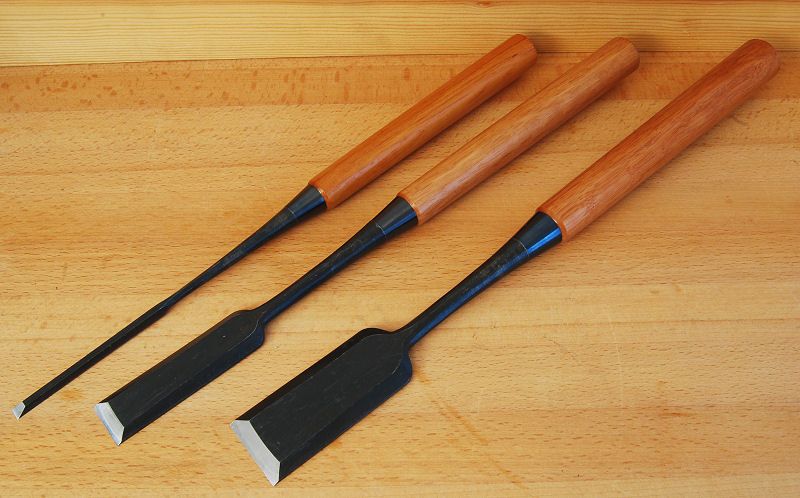
Make some med length tapers with a fat cushy end for palm pushing. Here are three.


Try using compression nuts or old garden hose fittings for the pounding chisels you want to use top rings on. If you turn the tenon tight but not too tight you can screw them on and they won't slip. The garden hose fittings only come in one size, but fortunately, for your big chisels, its a very good size. Besides you get 100 different patterns of the things to choose from since nobody copies anybody else exactly.


Try making them distinctive from each other so you don't have to look very close everytime you want one. Sets are a factory shortcut you don't have to suffer if you don't want to. The world is wide open when you make your own.

and.....................

Make lots of racks. I like mine portable and free standing so I can just grab a rack and go. Also lets me use otherwise wasted shop space in the windowsill.


And make lots of them!! When you get to have great chisels cheap just because you can make you own handles?? Hey, dig in!


yours Scott

Re: Chisel Handles

#2

Two things please Scott

Bob Hackett

Could you post a step by step on those way cool pewter rings so we can try the trick at home?

Second,can you come to Maine and slap me around till I learn how to post pics here?

We have herbs that fix ear infections and special candles to draw out the wax!

My wife won`t use the candles on me.She`s afraid I`ll lose what few brain cells I have left. :b

MB

Re: Chisel Handles

#3

scott grandstaff

Re: Two things please Scott *LINK*

scott grandstaff

Oh sure

It was already posted, the story of the pewter rings, so that's easy. See the link.

Not just chisel handle rings, but how to make and install new rings for the center handle of a brace! You know, the ones that are always damaged or missing??

Plus you can get creative just for fun. Love this part!


Hey, I am open to any suggestion for ear infection. I live on a 50/50 mix of rubbing alcohol and vinegar but I'll try anything.

Its not a wax problem, I just have extra deep ear canals that trap water. Got it from my mother (thanks Mom). So me and one of my sisters have it too.

My favorite is oily antibiotic ear drops from Bausch and Lomb that they make for infants. But my current doctor is a crank (needs to be shot soon), plus they are expensive, so I am out, again!!!

Oh, posting pictures is not so hard but you have to upload them to your own server and link to them there. You're right though, I need to drop over and give a personal lesson in that. Its actually easy (or I wouldn't be doing it) but it takes a long time to write out!

yours Scott


Pewter Rings and a Brace

Re: Chisel Handles

#4

Re: Chisel Handles

Mark Salomon

I used to get ear infections fairly frequently--at least once a year. Doc said it was because my ear canals were narrow. What I do now is start taking Sudafed when I get a cold that starts putting pressure on my eardrums(real pseudoephidrine, not the fake stuff they're starting to sell, at least in Calif). The sudafed reduces the pressure and keeps me from getting an infection. Unlike antihistamine, there is no rebound effect for sudafed. Good luck, I know exactly how it feels.

Re: Chisel Handles

#5

Re: Two things please Scott

Wiley Horne--So. Calif.

Scott,

You're an artist, my friend. Every one of those tools looks just right, and yet every one is absolutely unique-never-to-be-replicated.

One thing I know about ear infections: Tresaderm is the bomb. Course, it's only prescribed by vets. Caveat: got my medical degree in the engineering department.

Wiley

Re: Chisel Handles

#6

para medical advice

Bob Hackett

Some of the best medical advice/help I ever got was thru a former special forces medic.He used to help those of us who were low income and had no insurance.

He explained that most simple medications(like antibiotics) are made by a company in one facility and then had different packaging for human and veterinary use.He would tell us what drugs to get from the feed & grain or Ag store and what dosage to follow.

When I had a 104 degree temp and was turned away from the hospitals because of no insurance he was the one who showed up at my house and gave me a shot of antibiotics that broke the fever and saved my life.It was not the first time he had done that for people like me and some of the illegal aliens working he oilfield.I got to return the favor by helping him do simple surgery on another person that came to him.

I can`t tell you his name for obvious reasons but I`m just glad there are people like him out there who are willing to stick their necks out and put their training to use.

He was what inspired me to take the combat lifesaver`s school when I was in the Army reserves and why I steered my son to be a medic when he joined up.

His unofficial motto;"I`ll worry about the law after I help this person".

Re: Chisel Handles

#7

Re: Chisel Handles

ThomD

"Well, honestly you can get by just fine on a piece of broomstick. Just look at the Japanese handles!"

You should pick one of those chisels you gave the rings to and marry it...

Japanese chisel handles beat any of those pictured. They have both tangs and sockets, not easy, and they have just the right taper for pushing, and when hit they don't transfer energy to the holding hand but one remains in control. Best design there is. Aesthetically they have a few simple tensioned curves rather than one one of those bead turning exercises on sees on so many western chisels.

Re: Chisel Handles

#8

Ergonomics versus aesthetics

Derek Cohen (in Perth, Australia)

Hi Scott

I hope you are well again!

Thanks for posting your wonderful chisels. I do not recallif anyone else has done so since I made this request a couple of weeks ago.

I am interested in the ergonomics of chisel design. There are just so many factors to account for that I thought it may be useful to limit it to paring chisels, which are pushed rather than struck. This way we may have a discussion of handles, how you prefer to hold a chisel for paring, and the style of blade you like.

Would you comment on what you like about your chisels, especially the handles. Or perhaps this does not hold much importance to you and you just prefer making something interesting to look at (they certainly are that!).

Of course this is open to the whole forum.

What I'd like to do is toss into the thread a bunch of chisel designs, both for comment and for inspiring one's own thoughts.

My favourite paring chisel type is a Japanese style ..


This is one of the reasons I prefer a longer handle. I swapped out the stubby handles on my Bergs, finding the originals were better for chopping. A longer handle made them less blade-heavy, and as the balance more rearwards so they felt lighter and more controllable.

Here is an original Berg with a Witherby ..


The modified Bergs may be seen on the lower right, with Japanese parers in the middle to the left. That will give one an idea of the scale ...


More recently I began thinking about what I could do to improve the Stanley #750 (as I posted recently). The #750 is very similar to the Berg and Witherby. The Blue Spruce dovetail chisel has a longer handle (than the LN) ...


... and this is the one I copied, but making them longer still. I really like this design.


In the process I considered another design, one somewhat similar to a Japanese, made by Harold & Saxon (an Australian manufacturer) ..


My version was lengthened to somewhat replicate a Japanese paring handle ..


The problem is that the little downward angle at the front of the handle did not provide the same grip as either the BS-type or a Japanese handle, the latter being straight in this section.

Now Thom, you commented that the Japanese handles were the best around. What is it that lends you to say this?

Over to all of you ...

Regards from Perth

Derek

Re: Chisel Handles

#9

scott grandstaff

Re: Ergonomics versus aesthetics

scott grandstaff

This is a tough ask.

Since not all jobs require the same posture, there is plenty of room for lots of different styles. Best for one job, is ludicrous for another job.

If all your work is inlay, I have seen pairs looking like nothing so much as knitting needles, employed with skill and high speed. The timber framers would be squinting and scratching their heads!

I have one chisel, a sluice gate chisel, with a foot long handle and an 18" long blade!!

For standing well back and paring lightly, it is delightful as a classy walking cane,..... with spats!

A 1/2" wide slick!

For really small close up work you can't beat a short butt chisel with a short blade, short shank, short handle.

Get you all the way down to your work.

The Chinese use interesting chisels.

If you think Japanese chisels have stubby little blades you ought to see the Chinese! Practically no blade at all! Really, really short!

And usually a fishtail pattern to boot!

They use unwelded sockets at the end of long thin shanks. The unwelded sockets are spring tempered so they barely open when a handle is pounded in and man do they bite down on that handle! Really hard to get one back out. Handles used are both short and long. Or actually, handles come from the craftsman. They are never sold with handles as far as I've seen. So long or short, is the craftsman's choice.

And the selection of carving blades is unlike anything else I have ever seen, ever!! Picture a bent, fistail, gouge, .......with the blade ground 22 degrees skewed! A point like a needle out there on the one side!


Then of course there is what you like. What appeals to you and your eye. Since you can honestly get by on a Stanley #60 plastic handle chisel, or even Monkey Wards same pattern (hey, they built Disneyland with suchlike before the cast plastic industry took over)

What fits your hand and fits your range of work and appeals to your style is really all that counts.

yours Scott

Re: Chisel Handles

#10

Re: Ergonomics versus aesthetics

Wiley Horne--So. Calif.

Hi Derek and all,

I hadn't given chisel handle ergonomics much thought till Derek brought it up. So I did some chiseling just to verify what I do (sometimes the picture in my head isn't actually what I do, so I checked).

Result of the groundtruthing: I never use a tight grip, and very rarely do any strong hand pushing on the chisel. Some things do require a little force--like paring dovetail endgrain at the scribe line. This paring is done with one hand around the top of the handle, the thumb over the end of the handle and placed right under my collarbone or against my jaw. I lean on the chisel to make the cut. The offhand guides the blade; the holding hand is fairly relaxed; only the thumb/jaw or collarbone combination is feeling any pressure.

For horizontal paring that requires much pressure, I arrange to use my leg or belt buckle to push on the haft. There's more force and much more control than with arm pushing.

Another typical one is using a wide chisel to pare a plug. The holding hand's only job is to get the blade at the right elevation against the work--a slicing action is gotten by pushing against the side of the blade with thumb and forefinger of the guiding hand. Controlled force, meaning you can feel the fibers slicing, and you can stop the cut at any point to correct or get a new start.

It's about controlled force, achieved through various kinds of leverage. The holding hand is never exerting much force, or rarely even a tight grip, on the handle.

I do think there is an ergonomics of chisels. It has to do with feedback and positioning. Start with feedback�..I picked up one of Dave Jeske's detail chisels, which has a small bulb ahead of the blade. Many chisels have this feature--LN's for example, but many others as well. That little bulb is talking back, telling me my thumb and forefinger are where they always are, relative to the blade. Some people carve flats on chisel handles, so the handle will tell them where vertical is. I am seeing these various indentations, bulbs, flats as being like old friends that confirm to us that the world is in good order, that we are doing the same thing in the same way as always.

The handle can also help position the cutting edge. For example, Japanese chisels, esp. paring chisels, have angled handles which provide clearance for paring out into the middle of a panel. Also, the length of the handle provides fine tuning of how close the cutting edge is skimming the surface. The length of a timber slick--western or Japanese--allows the user to push with their body, not their hands and arms.

Derek spoke of balance. The handle is part of this, and so is the heft of the metal. It's been mentioned on this forum before, the observation that older iron tends to be lighter in the metal. Here are a couple of Japanese chisels which bear that out:


Wiley

Re: Chisel Handles

#11

Re: Ergonomics versus aesthetics

Wiley Horne--So. Calif.

Hi Scott,

You're amazing! Where in the world did those Chinese carving tools come from? Is that current production??

Question: What does 'spring tempered' mean? How is it done?

Thanks,

Wiley

Re: Chisel Handles

#12

Re: Ergonomics versus aesthetics

Bob Hackett

This ergonomics has really come to the front since my hand problem came into play but even before that my grip on the handles of the chisels were more for guidance than power.What brought the change in thinking and technique about was working with joiners who did yacht work and watching how they did things.

As Wiley said,it`s all about control.That control and being able to apply power over an eight hour day or 40+ hour week without blowing your hands out came from using either leverage or weight(as in body weight) to your advantage rather than just relying on arm strength.

Many of the chisels used up here when wooden boats were the norm could be had without handles and most craftsmen made their own to fit their favored techniques(this is proven by the tools seen for sale up here and those found in joiner`s tool chests).I didn`t know why anyone would favor a socket chisel till I came to Maine.They favor them here because you can have more than one handle for a particular chisel.With a socket chisel it`s a quick and easy thing to pull and replace a handle to allow you do use that chisel in a way that a factory handle would not allow.

BTW-I also learned the habit of bracing my body against a power tool when hand feeding work thru it by watching joiners.In a boatyard the work can be rather large in scale and the wood being processed is large and requires some effort to feed.

If something happens and the resistance drops off to next to nothing when you have your back into feeding wood into a blade then the next thing you know you could lose your footing/balance and feed flesh into the blade rather than wood.Bracing your body against the machine limits how far forward you can fall/slide and can save digits if not hands.

I also learned that you can pull something thru a blade as well as push and that having your hands behind the blade while pulling is several orders of magnitude safer.

I now brace my upper body against the table of my bandsaw and pull the work thru as soon as I can safely grip it in back of the blade.Almost zero chance of getting cut that way.

Re: Chisel Handles

#13

scott grandstaff

Re: Ergonomics versus aesthetics

scott grandstaff

Hey Wiley

My friend Matthew taught school in central china for a few years. There was a lot of historic restoration and some new high grade work being done, architectural sized, as well as regular domestic work, so a top smith was banging them out daily.

Not just one smith in one town either, they are the standard fare all across central China.

Those tools were some he brought home. Patterns in the dozens of shapes, available by the bushell.

But absolutely unfinished. This is how they use them.

Matthew wanted to import and distribute them. I tried to help him spread the word at the time. Western tastes require more finishing though.

Even though very expertly forged when you get them in your hand, and high quality steel, the style and posture required to use them are, well, different from Western norms.

I have a few, I sent a few around to some experienced carvers.

We all concluded finishing them, handling them, and putting them up in "sets" for the current market was too daunting, unless an upscale image was attached to boost the price high.

The sockets are one of the coolest parts of the tools.

They are forged sockets, but instead of forge welding them up solid like usual, they are overlapped and left this way.

After hardening the shank and socket are tempered back to a spring temper.

So they are actually, well, very strong springs.

A handle tenon banged in will spread them open ever so slightly and they bite down and grip that tenon like a crocodile on a zebra leg. Not like a western chisel where you have to fit the tenon very carefully because the socket has no give to it.

yours Scott

Re: Chisel Handles

#14

Chris Scholz

matching handels

Chris Scholz


Re: Chisel Handles

#15

Re: matching handels

Pam Niedermayer - Austin, TX

Scott & Chris, many thanks for posting those photos, very appealing looking chisels. How does the steel perform? Are these available in the US, Chris?

Pam

Re: Chisel Handles

#16

There it is!

Bob Hackett

Excellent examples of an assortment of handles I was trying to describe.

They range from a simple ball which allows you to get into tight places.The ball can become a mushroom in order to allow a larger platform to push from(like an oversized engraver`s handle).To a longer section of branch(with bark still on it,gotta love that!) that can be used in say a center section of a larger panel and still allow the chisel to be held flat and pushed by the body from outside the edge of the work.

The socket is really the key to being able to quickly change the handles and makes you more prone to adjust the tool to you rather than the other way round.

Thanks for the pics Chris. :)

Re: Chisel Handles

#17

scott grandstaff

Yankee Handle on a Chinachiz

scott grandstaff

Well, here is my current favorite handle size/shape for these.

Not identical of course. I don't even copy myself much. heh heh

Like I say, I'll probably change my mind about being the perfect handle again, but at least for now, these nestle in real close and I like the big flat on the back so I can get real down flat and close to the work. They won't roll off the bench either, which is no great loss. :)

I mostly use these with my primary hand around the butt of the handle (there's nothing like holding a nice butt) and my other fingers perched right near the edge of the tool.

Dig in and remove waste as desired.

Then, a kind of semi-sideways slicing motion shaves extremely precise and leaves a finish.

Tiny details would be superbly easy, if I was better at carving tiny details heeheheheehh

If these Chinese style chisels were better known and more widely accepted? Dozens of shapes, take and hold a plenty good enough edge???

Personally, I want some more.

yours Scott


yours Scott

Re: Chisel Handles

#18

Don't get me started

Patrick Gibbons

I'm using my L-N mortise chisel for something I'm putting together today and I keep thinking how much I wish I had bought this size in the Ray Iles chisel. The one RI chisel I have gives so much feedback, doesn't twist in the mortise and doesn't make my hand cramp like the L-N does (I hold it tighter to keep it from twisting). Both steels are good and quite frankly could be not so good and still make the handle the overriding consideration. The time has come to make a new handle for my L-N mortise chisel.

Re: Chisel Handles

#19

Scott, you obviously do not sharpen much ...

Derek Cohen (in Perth, Australia)

... because you still have hair on the back of your hands! :)

Picture of you holding those Chinese chisels? Either you have very broad mitts or the chisels are smaller than they appear. They look like detail/carving chisels, which I agree would be more comfortable pushing with the palm (unlike skew paring chisels for dovetails, which benefit from a longer handle for leverage when slicing).

Regards from Perth

Derek

Re: Chisel Handles

#20

scott grandstaff

Re: Scott, you obviously do not sharpen much ...

scott grandstaff

Nice try Derek heehehehe

Naaaa, I'm a southpaw so the missing fur is always on the other side.

If I tried it with my right hand, there would be missing skin!

The short pudgy handles make it feel like a lot of power for pushing.

I only use them pushing, so far that is. So like a very large wood graver I suppose.

The Chinese actually hit these chisels with the side of a hammer! Exactly like a stoneman's mashing hammer, with flat sides. And its the flat side they use to drive their chisels. Chris showed one in his pix if you look close.

Might seem odd but you can't argue the results! Big league architectural carving, some of it. And some of the most highly evolved furniture ever created. I have seen some of it made me feel like a child.

But then Tom Chippendale, elder or younger either one, has the same effect.

yours Scott

Re: Chisel Handles

#21

Chris Scholz

Re: matching handels

Chris Scholz

These type of chisels show up on e-bay occasionally.

The first three photographs were taken in Lijiang, Yunnan province

http://en.wikipedia.org/wiki/Old_Town_of_Lijiang

The last photograph was taken at the foot of Hengshan

http://en.wikipedia.org/wiki/Sacred_Mountains_of_China

Few thousand miles distance between these two places. The first is used by artisans that produce junk for (mostly Chinese, few Westerners make it to Lijiang) tourists, the second is a temple carver (I have never seen so many Buddhist and Taoist temples in one place as on Hengshan).

Re: Chisel Handles

#22

Chris Scholz

Re: Scott, you obviously do not sharpen much ...

Chris Scholz

Side of hammer for fine work, face of the hammer for rough work, it all depends.


A bit more on Chinese hammers on this website:

http://chinesewoodworker.com/hammer.html

Re: Chisel Handles

#23

Hammer ergonomics

Bill Houghton, Sebastopol, CA

Chris, you said, "Side of hammer for fine work, face of the hammer for rough work, it all depends."

I do the same thing with Western nail hammers (sorry, no pictures at hand), and I believe a lot of other folks do too. I gave Harrison Ford major points for knowing his tools from the scene in "Witness" in which he's driving in trunnels during a barn raising with the side of a claw hammer.

Perhaps this indicates that there's some physics occurring that makes it a universally useful technique. I do find that, when I'm using the side of the hammer, my hand position also changes in a way that wouldn't support full-on, driving blows - perhaps it is simply a matter, then, of the hand position, and how the "soft" position fits better on an oval handle.

Re: Chisel Handles

#24

Chris Scholz

Re: Hammer ergonomics

Chris Scholz

How interesting! I did not know that you are allowed to do that with Western hammers!

Many years ago, I had the distinct pleasure to go through a "mini-apprenticeship" (aka. Grundpraktikum) at the MTU Headquarters in Friedrichshafen http://en.wikipedia.org/wiki/MTU_Friedrichshafen.

I am absolutely certain that if the Schlossermeister would see you hitting anything with the side of the hammer you would be banned from the shop for life.

Chris

Re: Chisel Handles

#25

Using the side approach

Bob Hackett

One trick I learned from an old timer(how come new timers never know any tricks?) was if you needed to start a nail while supporting something with one hand you used the side of your hammer(in the pre-nail groove,rare earth magnet embedded in the head days).It went like this;

Grasp your hammer by the head with your fingers wrapped in a U shape over the top of the head.Place the nail(needs to be longer than your finger diameter) between the 2nd and 3rd fingers,head against the side of the hammer head.Reach out with your hand containing the hammer head/nail assembly and start the nail.Give the hammer a slight toss and spin and re-catch in the proper orientation to drive the nail and,Bob`s your uncle.

Handy thing to know if you only have a no magnet,obsolete,antique hammer hanging from your belt. :D