Or curly Purple Heart....
Scott Burr in Ben Lomond CA
Knowledge You Can Build On — Est. 1998
Or curly Purple Heart....
Scott Burr in Ben Lomond CA
Red Gum is my nemesis
Paul M.
I have a beautiful board of red gum. Everything that has touched that board has become immediately dull.
It still remains in my woodpile, but I'm done sacrificing blades to it. It stays there just to annoy me and let me know that I can be beaten.
Re: Difficult woods (timbers)
Tom Colligan
Would anyone know how to convert the Specific Gravity scale shown in Derek's table to our decimal scale? The scale shown is kg/m3 and I'm lost how to convert it to our numbers. TIA, Tom.
Re: Difficult woods (timbers) *LINK*
Wiley Horne--So. Calif.
Hi Tom,
Quick Answer: Divide Derek's density figures (expressed in kg/m3) by 16 to get an approximate equivalent in lb/ft3.
Derivation:
Metric density on Derek's table is expressed as kg/m3.
Imperial density is usually lb/ft3.
Basic conversions:
1 kg = 2.2046 lb
1 m = 3.2808 ft.
so 1 m3 = 35.31 ft3
Therefore:
1 kg/m3 = 2.2046 lb/35.31 ft3 = 0.0624 lb/ft3.
It's hard to remember a number like 0.0624, so if we turn the thing around, we get
1 lb/ft3 = 16.03 kg/m3.
For working purposes, 1 lb/ft3 = 16 kg/m3.
So divide Derek's densities by 16 to get the Imperial equivalent.
EXAMPLE: American White Oak, listed at 750 kg/m3
Dividing by 16: 750/16 =46.8, say 47 lb/ft3.
Wiley (that kid who sometimes used to have his hand up real fast waving at teacher  )
Reference to conversion constants
I like mesquite too...
John in NM
But if you use much, you'll quickly find tear out to be a huge problem. Its a wood that rarely has more than a foot or so of straight grain (at least our smaller Sonoran trees are this way), and its tensile strength is under whelming, so power planers especially tend to pluck little bits out where it planes against the grain.
I've had good results with a freshly honed hand plane, and when mesquite is behaving well it's one of my favorites. Next time I'm in Tucson I'm going to try to scrounge up some more scrap.
Re: The obvious question
Andrew F in Australia
HI Wiley,
Most of our woods are a lot harder than Birds-Eye Maple. I find Birds-eye maple a joy to work.
As Derek said, Jarrah's hard (it's a eucalypt,) but easy enough to work, and a specialty timber over here on the eastern seaboard although readily available - personal taste, but I use it more for accents as it's a very deep red and can overpower things easily. It's also a good outdoor timber (hence its use in railway sleepers = US railway ties.)
Wilbur - we sharpened a lot. I bought M2 blades for my handtools when I had to build an item out of Red Ironbark (Called ironbark because it's as tough as old nails - literally, that's why it's called ironbark)
I got about 15 lineal FEET out of a sharp Stanley/Record plane blade before it was completely blunt. Embedded silica in the timber. The M2 lasted about 15 minutes of solid work.
The other thing you need to know is how to use a marking knife/cutting gauge - Eucalypt tears out/spelches fairly easily.
The Lyptus hybrid sold in the US is similar to a middle of the road Eucalypt, albeit a brittle/stringy one - Rose Gum, used in stairmaking here.
Cheers,
Andrew
Followup question
Wiley Horne--So. Calif.
Hello Andrew (and everyone else),
Wonderfully detailed answer, and thanks for stopping in! Always a pleasure to hear from you!
I have one followup. I am planning a small writing desk (to occupy me for probably the next 18 months  ). The top of this desk will have a crossbanded border of lace sheoak. I already have the chunk of she oak in hand, so there's no turning back.
How is this wood to work? Does it plane well, or tend to tearout?
More important, is it particularly hard or silica laden, etc? I am trying to decide which saw to use to saw (rip) veneer from the block I have.
Thanks! Wiley
Re: Followup question
andrew f in australia
Hi Wiley,
You've picked a "really" hard timber, tends to blunt tools quickly.
All sheoaks are hard (casuarina sp.) The ray figure tends to pull out easily, so sharp plane, finely set & skewed in the direction of travel.
A better option is a card scraper or a drum sander.
Let us know how you get on.
CHeers,
Andrew F
Images and observations
Derek Cohen (in Perth, Australia)
You've picked a "really" hard timber, tends to blunt tools quickly.
Hi Wiley
Andrew said it!
She-oak is one of my local timbers so I get a chance to pick some up at a reasonable price. It is still pricy.
It is hard and interlocked. Here is an example of a board I was preparing (with handplanes) for resawing ...
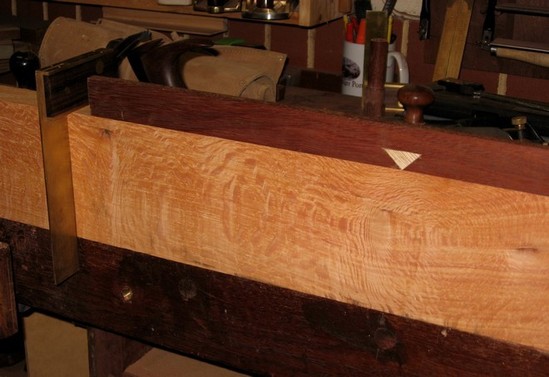
Article: http://www.inthewoodshop.com/Furniture/Preparing%20a%20board%20without%20a%20thicknesser.html
You will recall the box I built out of that chunk ...

It is a tremendously tough wood, which is why I could use it when I made another brace. Glorious colour and figure ..

When planing, a high cutting angle is essential. As you can see from my examples, it does finish well. I used an oil and wax finish on the above.
Regards from Perth
Derek
Thanks very much Andrew and Derek!
Wiley Horne--So. Calif.
When I start preparing the banding, I'll let you know how I make out. The look of the wood that Derek prepared for his box and brace will be an acid test for me to shoot for--absolutely brilliant! I am envious of that amazing half-log of Derek's--I am working from a high-figure block, but it is about 6" x 7" x 8", which means I will need to splice my banding, and try to make it look seamless.
As a matter of curiosity, do you guys (or anyone else) happen to know why Australia has so many 'ironwood' types of timbers? It seems to be a singular event on the planet!
Thanks again,
Wiley
We call a spade a spade
Andrew F in Australia
Hi WIley,
It's got to do with our preferences for naming things, I suppose.
We have Green Snakes, Brown Snakes and Black Snakes. If the Black Snake has a red underside, it's called a Red-Bellied Black Snake.
Brown Snakes are called, well, Brown Snakes.
Big Brown Snakes are called King Brown Snakes.
If the snake is brown with Black Stripes, it's called a Tiger Snake.
Green Snakes are called,...yes, you guessed it, Green Snakes.
If the wood is hard as the hobs of the proverbial (I'm typing this at work and the firewall would send this to the boss,) then it's called ironwood.
Cooktown Ironwood, comes from the region near Cooktown, Qld.
Iron Bark has really hard bark.
Turpentine Gum yields gum turpentine in some form or other.
It's nice to be literal.
Cheers,
Andrew F
Cool!
Scott Burr in Ben Lomond CA
Glad to see somewhere people speak the same language. So to speak 


