Home Articles Forums Gallery Marketplace Videos

WoodCentral Forums

Knowledge You Can Build On — Est. 1998

Reach the woodworkers who ACTUALLY BUY

Does anyone NOT use a plane to trim tenons to fit?

Posts

Does anyone NOT use a plane to trim tenons to fit?

#1

Does anyone NOT use a plane to trim tenons to fit?

wilbur

>I've got mortise and tenon joints on the mind, since I've been making a bunch of them over the past couple of weeks. After a couple of joints, I found that the fastest way for me to trim tenons to make the final fit was to use a wide chisel, and a small square to check the squareness of the face and shoulders. I have a 2" chisel that seemed to be perfect for this job. I found it much easier to use that to trim the shoulders and face of the tenon than it was to use a shoulder plane or router plane.

This seems to go against most of what I've read, where shoulder, rabbet block, and router planes are often recommended for trimming the faces and shoulders of tenons, and I was wondering if I was missing something here.
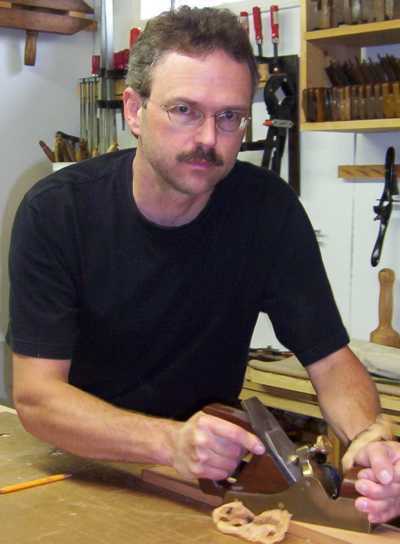
Re: Does anyone NOT use a plane to trim tenons to fit?

#2

Re: Does anyone NOT use a plane to trim tenons to

Dean J in MN

>Nope, you aren't missing anything. I too use chisels for tenon shoulders and cheeks. Count me as one who doesn't use planes for this work.

-Dean

Re: Does anyone NOT use a plane to trim tenons to fit?

#3

Re: Does anyone NOT use a plane to trim tenons to

Warren in Lancaster, PA

>I have used a chisel for 35 years. I think a lot of the techniques you have read about were developed for people who lacked skill with a chisel.

Re: Does anyone NOT use a plane to trim tenons to fit?

#4

Face Float

Thomas Skaggs, Foothills of Mount Level

>For me it depends on the size of the tenon and sometimes other factors. I do use planes and chisels but for some tenons I use a face float. Works rather well for me.

Tom

Re: Does anyone NOT use a plane to trim tenons to fit?

#5

Re: Does anyone NOT use a plane to trim tenons to

Hank Knight

>Wilbur,

I use a wide chisel most of the time, especially for tenon cheeks. I find a chisel faster and at least as accurate as a plane. I bought a set of the LN 140 skew block planes thinking they would be easier for tuning cheeks; but they're not, at least not for me. I have about equal success with a chisel or a shoulder plane when it comes to shoulders.

Your bench is looking good. Keep on it.

Hank

Re: Does anyone NOT use a plane to trim tenons to fit?

#6

I use a shoulder plane

Bill Tindall

>About the only thing I use it for is trimming tenon faces. Hey, I already own it and it removes controlled amounts of material from a cheek leading to a perfect fit. The quality of my tenon fits rose to a new standard with the availability of this plane.

If I became proficient with a chisel at removing a few thousandths of an inch of wood from a tenon and I didn't already own a shoulder plane I would not buy a shoulder plane for the job. Cheaper still, I would use a file if I could file straight, but I can't. If I already owned a rabbit plane I would use it. But I am into multitasking and if something I already own works, that's what gets used.

I think it is not generally recognized that the difference between a perfect fit and one either too tight or too loose is about 0.005" for a hard wood. For those of us that don't fit tenons very often a reliable means of shaving 0.005" of wood from a tenon reliably enables good fits and lasting joints.

The bottom line is that the joint is to be judged by the fit and not the means to achieve it.

Re: Does anyone NOT use a plane to trim tenons to fit?

#7

I agree

Bill Tindall

>As an amateur woodworker I make tenons at most a few times a year. I need to use techniques that are reliable and don't take undo practice to attain and remain proficient. I'm in this to make furniture as best I can and as much as I can. It is a no brainer removing a few thou. from a tenon with a plane of any sort and this capability removes one more thing I need to worry about in constructing a fine piece of furniture.

I like to keep in mind that it is the result that counts in making a joint and not the means of achieving it. In the end the piece will be judged by how it looks and whether it lasts.

That said, there is great value in knowing what can be done by professionals with this or that tool. It can inspire someone try techniques they otherwise would not. I have encountered this situation many times after participating on this Forum and the tools and techniques I bring to bear on making things has broadened. Some day I may face needing to remove a whisker off a tenon and I'll pick up my newly acquired ($5) 2" chisel and try it . Right now I am faced with making 15 doors and by damn the M&T's will be made by the most expeditious means consistent with a good fit. Maybe it would be a good opportunity to practice with the chisel.

Re: Does anyone NOT use a plane to trim tenons to fit?

#8

What Garrett Hack has to say on the subject......

Bill Tindall

>Whilst fretting over how to file my collection of FWW 1- 160, I spied the cover of Vol 150 with Garrett Hack paring the face of a tenon. I thought I would refresh my knowledge of this article, since the subject was current, and proceeded to read it. The part on tenon paring begins, "Given a choice, I prefer the control of a plane to shave a [tenon] surface." He goes on to say that at times a chisel can be more convenient.

Re: Does anyone NOT use a plane to trim tenons to fit?

#9

Re: Does anyone NOT use a plane to trim tenons to

Pam Niedermayer - Austin, TX

>I started out using a wide chisel for this job, bevel down usually; but several years ago, most likely prompted by the people here and on Badger Pond, I was convinced to try the LN wide shoulder plane. This turned out to be much faster and more controllable. I've also tried the LN 140, which would be great if I felt like buying a left hand version, and for the next set I'll try using the LN 60-1/2 rebate plane.

What I found using the chisel is that it was a little time consuming getting the cheeks flat, often I'd get enough tearout to destroy level over the entire cheek. Now I could still use these tenons; but as an only partially reformed perfectionist, it was not satisfying and not the best I could do with another tool.

Pam

Re: Does anyone NOT use a plane to trim tenons to fit?

#10

I'm with you, Pam

Bruce, a MN Galoot

>I've tried chisels, files, rasps and planes, and the most satisfying to me has been planes. By satisfying, I mean I'm able to get more consistent results and have much less damage to repair, but on the tenon and also on the chisel after I get mad and do something stupid.

Re: Does anyone NOT use a plane to trim tenons to fit?

#11

Re: Does anyone NOT use a plane to trim tenons to

Dean Lapinel

>I use whatever tool I'm in the mood for at the time. I do prefer a single bevel knife for small tenons though.

Re: Does anyone NOT use a plane to trim tenons to fit?

#12

I have a question

Adam Cherubini

>Do those of you who use and love block or shoulder planes for trimming tenon cheeks cut those cheeks with a hand saw? Are the planes being used to fix the irregulaity of a hand sawn cheek or a machine cut cheek?

Historically,guys in the 18th c didn't seem to have shoulder planes or skew rabbet block planes. I'm pretty sure the planes we use now for these operations were developed with machine cut tenons in mind. As such, they may fit into another woodworking context. Shoulder planes and table saws. Chisels and hand saws. This isn't to say planes cant be used on hand cut surfaces or that they are not a good idea.

The other issue here is fit-up requirements and glue. I've made more than a few planed, piston-fit tenons that simply pushed the hide glue out, starving the joint of it's strength. Removing a thou or two maybe neccessary for PVA. Planing may not be the best idea for hide glue.

Re: Does anyone NOT use a plane to trim tenons to fit?

#13

Re: I have a question

ThomD

>I don't know about the table saw thing for two reasons, first historically I wonder whether the TS preceded these small planes, just don't know. Second, when using a TS. I wouldn't need to fit the tenons at all, and if I did, I probably wouldn't use a hand plane to do it.

As to the OT...

When making say 30 tenons by power I bandsaw them, then run them over a router table. There is normally a tiny amount left over I take out with a chisel using the flat from the router as a guide. I saw the shoulders on a radial arm. This is the fastest way I know for doing one off projects, if not true production. Part of the reason being that it can be used with non-square joints that don't work in the tenon jig for the TS. On larger pieces I bandsaw them and run them over the jointer.

By hand, I try to go straight from the saw. If I blow that I tend to use the chisel to relieve the area near the shoulder and cut the rest with a block plane. I like the BP because it is lower and easy to control. It is really bad news though, since one is chasing stuff and the tenon can quickly go out of lateral position with the rest of the work. If I was doing the 30 tenons in a hand tool production setting, say in the jungle somewhere, I would probably make a table mounted router plane. That method works. Idexing the corrective cut off the tenon itself, doesn't make much sense. One is indexing off the goof.

Re: Does anyone NOT use a plane to trim tenons to fit?

#14

Re: I have a question

Pam Niedermayer - Austin, TX

>I always hand saw tenons and try to make the first cut to fit; however, it seems there's always a bit to clean up.

Pam

Re: Does anyone NOT use a plane to trim tenons to fit?

#15

Good Point Adam

David Miller from Iowa

>For me, it depends not upon what I am making, rather WHY I am making it. If I need to knock out a stepstool or coffee table at the behest of a relative, electrons die and no final trimming is necessary. If, however, I am making a piece for me (i.e. for therapy) I'll use shoulder planes, chisels, razor blades (don't knock it for final trimming) or anything that isn't buried under the huge pile of flotsam I generate when I am recharging the soul. There is no right way - whatever works.

Re: Does anyone NOT use a plane to trim tenons to fit?

#16

Darrell in Oakville

Re: I have a question

Darrell in Oakville

>

Do those of you who use and love block or shoulder planes for trimming tenon cheeks cut those cheeks with a hand saw?

I don't generally saw the cheeks, I split off the waste with a chisel and then clean up the cheeks with the same chisel. The shoulders are sawn. And I will use a shoulder plane to fit the joint if it doesn't go together right from the start.

Darrell

Wood Hoarder, Blade Sharpener, and Occasional Tool User

Re: Does anyone NOT use a plane to trim tenons to fit?

#17

0.005" with a chisel

wilbur

>Hi Bill,

I think that you might underestimate what you can do with a sharp chisel. I just cut a sample tenon in a scrap piece of cherry, and was able to use a paring chisel as if I was adjusting the face and cheeks to fit a mortise. I was able to take shavings that were consistently in the 0.005-0.008" range, measured with a dial caliper, and I don't think that I am any sort of chisel wizard. As a matter of fact, my guess is that if I can consistently take 0.005-0.008" with a chisel, anyone can do it.

I was able to take a look at Garrett Hack's article, and as I said above, I know that there are a lot of articles recommending a shoulder plane for this task. That's why I found it a bit weird that for me, using a wide paring chisel was easier and quicker than my shoulder plane.

I was planning to do more mucking about with this tonight, but we had a minor plumbing emergency at our house tonight. >(

Re: Does anyone NOT use a plane to trim tenons to fit?

#18

Re: I have a question

wilbur

>Hi Adam,

For the record, the tenons I was making were cut with a hand saw. A 210mm ryoba, if it matters.

This was my process, in a nutshell:

-- Cut the tenon with a hand saw. I was consistently too careful to not be undersize, leaving me with tenons that were oversize.

-- Find that the tenon won't fit into the mortise.

-- Bevel the end of the tenon so at least the very end will go into the mortise.

-- Test fit again, and look for the marks showing where the tenon binds up in the mortise as it was inserted.

-- Use those marks as a guide for where to start paring the tenon. I also used a small square to see how square the tenon was with the shoulder. I used a 2" wide chisel, bevel up, paring with the grain, towards the shoulder.

-- Repeat until the tenon fits well. Usually this would take a max of 3, maybe 4 rounds of the above. Total time: 5 minutes or less of fitting.

-- Use the fit and a square to check the shoulder, and use the chisel to pare down the shoulder where it needed it.

I have no idea if this is historically accurate, but from my brief scan of magazine articles today, it struck me that most articles about using chisels for fitting tenons seemed to show a picture of the chisel being used across the grain of the tenon, not with the grain as I did.

Re: Does anyone NOT use a plane to trim tenons to fit?

#19

Re: I have a question

Pam Niedermayer - Austin, TX

>I'm with you on the shoulder mods, chisel every time.

Pam

Re: Does anyone NOT use a plane to trim tenons to fit?

#20

Footnote--OT

Wiley Horne--So. Calif.

>There are very, very few "minor" plumbing emergencies. IMO/IME. YMMV. DAMHIKT.

Wiley

Re: Does anyone NOT use a plane to trim tenons to fit?

#21

Re: Face Float

Robin Corell in Atascadero

>I Have been known to use an aluminum file which looks prettey much exactly like a face float. I find this method works really well with difficult grain.

Re: Does anyone NOT use a plane to trim tenons to fit?

#22

I have a few questions as well

Derek Cohen (in Perth, Australia)

>Historically,guys in the 18th c didn't seem to have shoulder planes or skew rabbet block planes. I'm pretty sure the planes we use now for these operations were developed with machine cut tenons in mind.

Hi Adam

Two points ...

Firstly, that planes were developed for shoulder and cheeks since the 18C does not mean that they are irrelevant to handwork or that they should be seen as assistant to machine work. I don't understand your logic in coming up with the latter conclusion. These are planes ... tools ... for joinery.

Second point. What have not been mentioned is the drawbore joint. Drawboring essentially reduced the need for precision. Close enough is good enough. Saw and chisel will do just fine. Now, what percentage of 18C furniture used drawbored M&T joints?

Here's a third question - think of it as a bonus :) Why are there "shoulder planes" and no "tenon" or "tenon cheek" planes? What do you think this says?

And lastly. No one has mentioned the router plane for tenon cheeks. This is the most accurate method of tuning cheeks of all. Now I could see this as a possible method used in the 18C as it is a very basic tool. Any mention of this anywhere?

Regards from Perth

Derek

Re: Does anyone NOT use a plane to trim tenons to fit?

#23

Chisel...the multitasker

Bill Tindall

>When I took a class in the Mack Headley and Sons shop (builders of period furniture for 4 generations) the most used hand tool in the shop was a 2" chisel. A plane, especially a shoulder plane, is a chisel with training wheels. Some of us still require or prefer the security of training wheels.

I am under no illusions of what a chisel can do; I just know my limitations using one. A get it made and got on to the next project attitude coupled with modest hand skills limits my enthusiasm for abandoning the training wheels.

I find other's success with this or than hand tool operation inspirational and on occasion I find the motivation to acquire the skill. So keep up the inspiring reports.

Re: Does anyone NOT use a plane to trim tenons to fit?

#24

you got that right, plumbing rant....

Bill Tindall

>And the main reason is the crappy materials one has to deal with. In another life I regularly assembled fluid systems operating up to 5000 psi, vacuum systems operating to near zero and gas systems to 100 psi. I never had leaks in an assembled system. But the fittings were precision machined and robust enough to withstand the torque required to seal them. Nothing was made in China. The fittings I stole and used in the house performed equivalently. The junk from Lowes on the other hand often leaked or broke. Most of the last ball valves (China) I bought for the sheep watering system have failed. All the plastic parts on my toilets have failed over the past few years. I had problems assembling most of the joints when I installed a water filtering system, including pipe threads that apparently had been improperly machined(in China). Does anyone remember when plumbing involved brass?

Re: Does anyone NOT use a plane to trim tenons to fit?

#25

M&T fit criteria according to Headley shop

Bill Tindall

>One of the most useful things I learned in the class at Headley's was tightness of fit criteria. When a shop with its legacy frets over something it was time to take notice, and they fretted over fitting. The criteria was simple. A joint such as a mortise and tenon or any similar make/female joint must go together with hand pressure and be snug enough to hold itself together by friction. Such a joint would not present any problems in assembly and it would be optimumly strong. I have adapted this fit criteria and have not had a panic assembling a joint since.