Home Articles Forums Gallery Marketplace Videos

WoodCentral Forums

Knowledge You Can Build On — Est. 1998

Veritas - Innovation in Tools

Using nails

Posts

Using nails

#1

Using nails

Derek Cohen (in Perth, Australia)

>This wardrobe/armoire is only the second time I�ve used nails to attach a frame to a carcase. Interestingly, the other time was also a wardrobe. For years I have resorted to either biscuits or dowels. I hate biscuits (noisy machine .. yuk!) and dowels are finicky.

So the issues are, who else nails on frames and what spacing for the nails?

I used both nails and glue in attaching the frames for the doors. The nails are 8� apart over a frame of 42�.

Tools of the trade ..


I use a Japanese hammer, which has a flat and a domed end. The flat side is for hammering to the edge of the surface of the wood, and then the domed end is use to tap it gently to the surface without marring the surrounding wood.

The frame was partly pre-drilled for the nails, mainly to prevent splitting and also to ensure that they went where I wanted them to go!


[IMG]http://i13.photobucket.com/albums/a262/Derek50/Furniture/Dovetail%20Cabinet/Nailing/Drilling.jpg[/IMG]

The nails are the thinnest I felt I could use, approximately 1/32� diameter and 1 �� long. The frame is a little under �� thick.


Frankly, I am not sure if the nails are doing anything structural, or whether it is the glue that holds it all together. I need to know if this area must be beefed up.

A sequence of nailing (self explanatory)..


The nail holes are filed with wax. I mixed up a colour that matched the darker figure.


How well does the wax disguise the holes? Here is a sequence of views �


And here is an update on the WIP: frames-and-doors and base attached .. total height is 51" ... still to do is the drawer, handles and top.
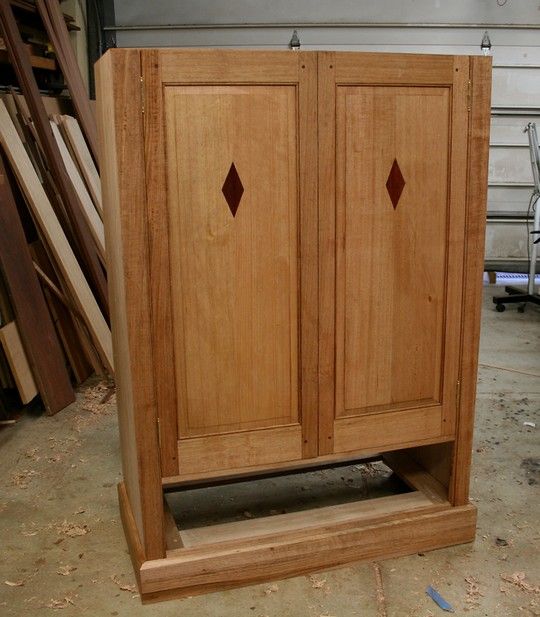

Regards from Perth

Derek

Re: Using nails

#2

perfectly respectable.

Ron Bauman

>As a former restorer I ran across many pieces of furniture constructed with nails. There is also a sneaky way of hiding them: using a narrow chisel, you pry up a sliver of wood without breaking it free and nail under the curl. Then you glue the curl back in place and viola! no trace. It works best in wood with a busy grain such as the one shown in your pics.

Re: Using nails

#3

I use a dado

Bill Tindall

>Shown in the picture is the frame corner of an ash kitchen cabinet upper unit. The frame has a dado that fits over the side of the cabinet. The dado is inset on the frame about 1/18". Several cabinet makers in this area use this construction as well.

It is simple to do, provides acres of glue surface and looks acceptable.

The problem with filled nails on a natural finish cabinet is that the natural finish will change color over time. These cabinets were white 14 years ago and now they are brown. Any place I filled with a matching patch 14 years ago is now an obvious white patch. Had I nailed the faces on the white nail patches would be visible from across the room.

On a painted frame, over time the filler seems to usually crack or otherwise pull away from the wood in places revealing the presence of the nail beneath.

However, on a "country piece", I would nail with cut nails and the nails would become part of the style.


img

Re: Using nails

#4

Re: I use nails

Patrick Gibbons, Katy, TX

>I finished a shoe rack before Christmas and used cut nails to reinfore the dados. I used gun bluing to "age" the nail heads and did not try to hide them. The wood was shellacked and the whole effect was to make the piece look much older than it really was. If I did hide the nails with some "goop" the shellac would insure that all would look the same over time.

Re: Using nails

#5

Jack Guzman from Maine

Re: Using nails

Jack Guzman from Maine

>Derek,I use cut nails and don't fill. I use the tiny ones. They don't have much of a head so it doesn't show much.The only time I use round nails is when I'm doing carpentry.---Jack

Re: Using nails

#6

Re: Using nails

Warren in Lancaster, PA

>Derek, our traditional work has either tapered pins or nails and also no glue. Sometimes the frame is removed for restoration work. On old work you would see much bigger nails than you use, cut nails that are more like 1 3/4 inches long and more stout. I don't think the nails you have offer much strength. On old work we see both visible nail heads and nails that are sunk and filled.

Today's kitchen cabinet makers tend to glue the face frames on with no nails. They are junked when the get old. I know guys who have made replacements for cabinets they themselves had made just twenty years earlier.

Re: Using nails

#7

Re: Using nails

ThomD

>You can relatively quickly insert biscuits using an appropriate chisel. I first did it when making a scarph joint that needed biscuits for alignment, but there wasn't space for the machine. In essence the cut is all the easy excavations of a mortice with none of the nasty bits because it is such a sloping cut.

I prefer not to use face frames on quality cabinets. Any time one is pulling out the filler to hide something it says there was something to hide. Same thing as filling the wobbly dovetails. People will support either, your work is too nice. The problem with colour matches is that if the wood or finish changes at all from the filler they eventually stand out in a quite ugly way.

Nails are basically there for the shear loading. In this case, you need something to hold the frame into the face both during glue up, and should there ever be any separation of the face frame. Little wire finishing nails don't really add much that clamps or glue won't do. The reason nails are used for face frames is that often the body of the cabinet is built in, therefore clamps can't be used, and because people doing kitchens, etc... are in a rush.

Re: Using nails

#8

Stephen Shepherd

Next time...

Stephen Shepherd

>just use cut nails, they look great and hold much better than those new fancy French wire nails. I use an awl for the holes, so as not to remove any wood, then line the nails up with the wedge with the grain, hold them with pincers to keep them from twisting and drive them home. Tip the head of the nail away from you at a slight angle before striking.

I also dip them in the grease cup first to give them a lube of 75% beeswax and 25% tallow. Also by not drilling away the wood it will swell back up around the nail making it nearly invisible, if you use the fine cut headless brads.

Stephen

Re: Using nails

#9

Re: Using nails

Pam Niedermayer, Austin, TX

>I used both nails and glue in attaching the frames for the doors.

I don't think I understand exactly what you mean by this, so I'll assume, based on the rest of the post, you mean the face frames to which you attach the frames of the doors with hinges.

If this is correct, I've thought about this a lot. For the two kitchen type cabinets I made 8 years ago (in class at the community college, all power tools, etc.) and installed in my shop, I used nails to attach the face frames to the plywood carcasses; but I didn't like it. But I also couldn't find another good solution. (Note that I also used nails and glue to assemble the parts of the carcass that wouldn't show.)

If you use glue for the face frame, you've got to clamp all around the frame/carcass, very slow and unwieldy. If you use that iron on stuff you get that iron on stuff, with probably incomplete mating with the plywood.

Bill's dados, even though "only" 1/8", would be awkward for a kitchen since you could no longer mate the plywood properly.

I think an interesting solution would be to build the carcass using frame and panel; but that's a little expensive for kitchen cabinets (I have thought seriously about doing this for the end cabinets); and for good stuff I'm not sure I like the result as much as a flat, solid wood carcass made with good joinery for which a face frame is unnecessary. Maybe that's a solution for your wardrobe, no face frames needed?

Pam

Re: Using nails

#10

What?

Bill Tindall

>Bill's dados, even though "only" 1/8", would be awkward for a kitchen since you could no longer mate the plywood properly.

Did you miss the fact that this is a kitchen cabinet and that it is a common construction for kitchen cabinets in this area? The dado isn't 1/8", the part beyond the dado is 1/8"....see picture.

Re: Using nails

#11

Re: What?

Bill Houghton, Sebastopol, CA

>I presume that this inset applies only at the end of a cabinet run, Bill, with any intermediate stiles having no inset.

Re: Using nails

#12

Re: What?

Pam Niedermayer, Austin, TX

>Sorry, left out the word "reveal." My bad, but not my stupid. If you have a 1/8" overhang, you can't mate up the pieces. So what am I really missing?

Pam

Re: Using nails

#13

secret nailing

Andrew F in Australia

>Hi Ron,

This is usually done with a really small gouge. THe edges are feathered and a lot easier to hide.

CHeers,

Andrew

Re: Using nails

#14

No

Bill Tindall

>In every cabinet unit the face frame joins to the sides with a 3/4" x 3/8" dado in the frame to accommodate the 3/4" side. The 1/8" or so that sticks out beyond the side enables the units to be joined tightly together because the side doesn't get in the way. Where the units touch a wall the dado is inset more than 1/8" to enable the side to be scribed to the wall. There are other kitchen situations that also call for the dado to be inset more than 1/8".

Re: Using nails

#15

I'm not explaining something clearly....

Bill Tindall

>The picture is taken from beneath an upper cabinet unit (standing on my head). The dado is in the face frame. The flat surface is the bottom of the cabinet. This joinery presents no problem assembling units and in fact it solves many problems like scribing to a wall or joining units together tightly.


img

Re: Using nails

#16

Re: I'm not explaining something clearly....

wilbur

>That picture sure helped me figure out what you were describing.

So suppose you have two cabinets side by side, each with the dado attaching the face frame as you describe. That would leave a 1/4" gap between the main parts of the cabinets. In installation, my understanding is that you would use screws to attach side by side cabinets to each other. Would you then put a 1/4" spacer between the cabinets if you were to screw the sides together?

Re: Using nails

#17

Ah yes

Bill Houghton, Sebastopol, CA

>As I think back, our kitchen cabinets were made in a similar fashion, although they didn't have the extra detail of the dado. So there are gaps between adjacent cabinet units.

Wilbur asks, below, whether spacers are needed - in our kitchen installation, I just used long enough trim head screws to join adjacent face frames together, and let that and the screws at the backs of the cabinets (holding them to the wall) be enough.

Whether these conventions for kitchen cabinets would work for the kind of furniture Derek's been illustrating is another question - but certainly, the different trades can teach each other.

Re: Using nails

#18

spacer not necessary

Bill Tindall

>the cabinets are butted and two screws installed top and bottom through the sides just inside the face frame. These screws pull the frame edges together to make a tight joint as viewed from the front, the only view that is important.

In a practical case there are few of this kind of joint in a custom cabinet and I try to avoid them when ever possible because I don't like to see the double stile. Commercial cabinets come in small units to make shipping easier but for a custom job it is entirely practical, and cheaper, to make a 10' unit if it avoids butting two units together in the same wall.

Corners are assemble as described above except it may be advantageous to increase the amount that sticks out beyond the dado in some cases.

Re: Using nails

#19

Re: spacer not necessary

wilbur

>Hi Bill,

I am really being dense here and I'm sure that I'm missing something obvious. If you screw the cabinets together at the front to pull the face frames together, how do you make sure that the back corners of the cabinets stay parallel with each other, given the 1/4" gap that the 1/8" face frame overhang makes between the sides of the cabinets?

I do see what you mean by wanting to avoid the double stile effect.

Here's a diagram to show what I mean.


img

Re: Using nails

#20

Not the same Bill, but I'll try an answer

Bill Houghton, Sebastopol, CA

>The wall against which the cabinets are placed keeps them from distorting.

When I did our kitchen cabinets, I was more willing to have screws showing, so I used long enough trim head screws to screw adjacent face frames together, avoiding any of the twisting stress that you're wondering about, Wilbur - but, in practical terms, if you don't get carried away with tightening the screws, it's probably not an issue.

Re: Using nails

#21

Re: Not the same Bill, but I'll try an answer

wilbur

>I think I see my problem: you're talking about putting up the cabinets one at a time, where I'm thinking of installing a bank of cabinets all at once.

I watched some This Old House over the weekend, and they were doing a kitchen cabinet install where they screwed the cabinets side by side together as a unit on the floor, and then hoisted them into place all at once. These cabinets did not have the face frame overhang that Bill T. is describing. If you were to do the same thing with cabinets with a face frame overhang, I would think you would need some way to stabilize the back corners of the cabinets as you screwed them together side by side before lifting them up as a unit.

Re: Using nails

#22

what is missing......

Bill Tindall

>In your diagram there will be screws holding the back of the cabinet to the wall. The back wall and the front face determine what the sides do, which is the beauty of the face frame projection beyond the side. If the lack-of-flat wall wants to pull the back of the side together to get the front tight, it can because there is clearance between the sides.

I hang cabinets one unit at a time. That said, my units are typically designed to not need a joint as you diagram. Most of the time a unit as long as required can be made in the shop without having to joint to adjacent units together. More common, the joining is at right angles and in this case the overhangs need to be designed to accommodate door, and door knob, clearance and wall scribing.

Re: Using nails

#23

Thanks, Wilbur, that's what I was trying to say.

Pam Niedermayer, Austin, TX

>

Re: Using nails

#24

I've seen installers do all sorts of goofy things

John in NM

>I hang boxes one at a time too, that's why they're built that way (small and manageable). The only viable reason to hang a huge box all at once is when the box is constructed with a single face frame for aesthetic reasons - which I have also done. Screwing a bunch of factory boxes together and lifting the whole mess at once sounds like more work than necessary to me.

Re: Using nails

#25

Re: I use a dado

Charles

>Agree.... I can't find much of a reason to nail a piece that when glued is all long grain to long grain. The filled nail holes will show eventually for the reasons you mentioned and aren't worth the bother - the glue area is enormous and the face frame to carcase glue joint essentially bombproof.

I've nailed them on before, but it didn't make any sense then either.

That said, the cabinet is quite lovely.
