Re: Various widths
Pam Niedermayer, Austin, TX
>Good points, Joel, but I still don't want to worry about getting a precise 3/8" thickness.
Pam
Knowledge You Can Build On — Est. 1998
Re: Various widths
Pam Niedermayer, Austin, TX
>Good points, Joel, but I still don't want to worry about getting a precise 3/8" thickness.
Pam
Re: Trade practice for cutting dadoes?
Catharine Kennedy
>Let's see if this'll work- it's a video on using dodo planes:
http://www.youtube.com/my_videos?pi=0&ps=20&sf=viewcount&sa=0&sq=&dm=1
Re: The router plane is too slow at the beginning.
James Watriss
>Nahhh... You just have to take really huge bites. Once the ends are sawn out, it should all be pretty quick work. Remember, the waste doesn't have to come out in a clean or pretty fashion... the sides of the dadoes are already cut. So if there's a little tearout in the dado... so what? The only cut that matters is the last one.
Re: I don't know...
James Watriss
>I think individual pieces to be let in would be trimmed to fit. I'm thinking (and I could be wrong) that a precise depth is only necessary if you're trying to fit in a piece as it was cut from the table saw. But, before table saws, I'm sure that the work would be done with a plane.
Even now, when North Bennet Students do their tool boxes, the drawer frames are planed to width to slide into the case. Sure, the TS is precise and repeatable. But things happen... wood moves in weird ways. So I think "deep enough" dadoes are probably acceptable in a hand-tool world.
Re: Various widths
Patrick Gibbons, Katy, TX
>Joel is right about the thickness of the wood being inconsistent. In the 19th century they would make the dado a specific size that was less than the thickness of the wood and then rabbet the ends of the board to fit the dado. I would assume this was done also earlier. So a 3/4" dado would have been too big and a 3/8" dado sounds like a good size to use.
Re: Various widths
Warren in Lancaster, PA
>I think you miss the idea, Pam. If you want to make a 27/32 dado, for example, you use the 3/8 dado plane for two cuts and then have a little 3/32 strip in the middle to chisel out in one sweep.
Even in my hybrid handtool/electron burning method
Bruce, a MN Galoot
>"deep enough" is the approach I take almost all the time. Measurement has taken a back seat to working with the wood in hand.
bruce
Can't resist...
Bill Houghton, Sebastopol, CA
>I've heard of rabbit planes, but dodo planes? Doesn't seem like a plane you would find use for very often, at least not since the 17th century.
Re: Trade practice for cutting dadoes?
Bill Houghton, Sebastopol, CA
>Your link was somehow tied to your login, so I got the main Youtube page; but searching on "dado plane" got me a couple of nice short videos that left me wanting one of these planes.
But what if I want to make a 16/32" dado?
Pam Niedermayer, Austin, TX
>
Re: The router plane is too slow at the beginning.
Pam Niedermayer, Austin, TX
>Granted that most of my methods were formed 28 or so years ago, when I had a very, very basic toolkit; but there's no way that crummy Stanley 071, even with the dagger blade, would cut deeply in a single pass. Maybe I'm just not strong enough.
Pam
Re: Can't resist...
James Watriss
>I think they're actually extinct.
; )
Re: Trade practice for cutting dadoes?
Dean J in MN
>I agree Joel, the saw & chisel is a serviceable method, especially for smaller dados. Longer case dados are where the plane shines.
If you want to get really crazy , one could use a pair of snipe's bills and sink the edges on the longer dados and remove the waste with a narrow rabbet plane or chisel. (Pretty much what a dado plane is anyway with its nickers, though the nickers don't cut the profile a snipe's bill does.)
-Dean
Easier yet
Warren in Lancaster, PA
>Then there is no strip in the middle to remove.
One thing to remember
Bob Hackett
>When you`re talking about the "TRADES" is that they focused on getting the work done quickly with an acceptable level of quality.
The tools being used would depend on who the man apprenticed under and what his personal idea of "good enough" was.Many things influence how and to what level a man works when money is involved.
What was done back then(or today for that matter)for wages may have little to do with what you are striving for.Keep an open mind and find the path that best suits the way YOU work .That`s the one lesson we can always take from the trades.
Mainely,Bob
OK, got my fractions mixed up for a minute.
Pam Niedermayer, Austin, TX
>
Re: Trade practice for cutting dadoes?------WebKit
Marc Waldbillig------WebKitFormBoundary2kOHXpBg2YI
>Wiley,
In the German sentence,first thing, Greber doesn't speak of predrawn lines, but of markings. Second, "to cut in" in German means a deep cut. One one cannot make with a knife. Grooving saws were common tools and even today Geman Woodorkers often rely on saw, chisel and router plane to make dadoes. I'd translate "to cut in" with "sawing in".
Marc in Luxembourg
------WebKitFormBoundary2kOHXpBg2YINyX+7
Aha! moment and a bit of a confession
wilbur
>That's interesting -- the distinction between sawing and knifing a line.
I have to make a bit of a confession: I originally asked this question partly because I was trying to figure out how dadoes were made in the Japanese woodworking tradition. I did ask this question first on the Japanese tools forum, but got pretty much no response. So I thought I'd try the more general question of dado cutting here.
I think that the way Japanese woodworkers did this was to saw the sides of a dado. There's a type of Japanese saw called an azebiki, which is a short two sided saw with a convex shape on both sides, and this saw can easily be used to cut the sides of a dado.

There also happens to be a Japanese version of a dado plane, complete with nickers and an adjustable fence. You could certainly remove the fence and use it against a batten, as Catharine does in her video.
But there are some differences between this plane and a western dado plane. First of all, there's no adjustable depth stop. The stop is built into the body of the plane and is set to a fixed depth.
Second, there seems to be a very narrow range of sizes: 1/8", 1/4", and 3/8" (actually, 3 mm, 6 mm, and 9 mm) are typical. I've never seen a Japanese dado plane wider than 9 mm, whereas a quick search of eBay turned up examples of 1/2" and 5/8" dado planes.
There are Japanese "groove planes", that look somewhat like a shoulder plane, but were really used for cleaning up the bottom of a dado/groove that are wider than 9 mm, and they typically come in 1/2", 3/4", and 1" sizes (12 mm, 18 mm, and 24 mm). But these planes don't have nickers, and so could not really be used alone to make a dado as in Catharine's video.
(I don't have a picture of these types of Japanese planes handy, but I could take some photos of the ones that I have at home tonight, if anyone is interested.)
So Marc's comment about Greber perhaps meaning a sawn line as opposed to a knifed line turned on the light bulb in my head, especially knowing about what the azebiki was used for. I'm not sure what type of saw a German woodworker following this method would have used, though. Any ideas?
So my guess (only a guess) is that Japanese woodworkers probably sawed the sides of the dado, and used chiseling and a groove plane to clear out the waste. It seems that wider dado planes were probably used more in the western woodworking world. I'm not sure why this would be the case, as Japanese woodworkers could certainly have made wider versions of their dado planes, or added nickers to the wider groove planes.
I love all this discussion, by the way. It's been great!
Convergent and parallel evolution
Bill Houghton, Sebastopol, CA
>It's interesting to see how a handful of solutions get combined in different traditions to solve problems common to all the traditions. You can cut wood at this scale with a single sharp edge held freehand (chisel), a single sharp edge held in a block (plane) or frame (router plane, or electron-powered tools), or a bunch of tiny sharp edges (saw, hand or electron powered); what other techniques am I forgetting?
Re: Aha! moment and a bit of a confession
Marc Waldbillig
>Wilbur,
The German would typically have used a grooving saw, often called a stair saw. It has the advantage of a depth stop. I have seen woodworkers using a back saw too.
The picture from fine tools shows an ECE model...
Marc
Re: Aha! moment and a bit of a confession
Pam Niedermayer, Austin, TX
>I'd love to see photos of a Japanese dado plane equivalent. The closest I've been able to come is a dovetail plane at Hida.
As to the azebiki, that's what I use to cut in the dado sides, then switch to a cross cut single side Japanese saw for the finish. My depth gauge is a huge rubber band on the saw as well as markings on the board edges.
Pam
Re: Trade practice for cutting dadoes?------WebKit
Wiley Horne--So. Calif.
>Marc,
Sorry to be so late arriving. Thank you very much for the improved German translation, which indicates that the dado channels were sawn in traditional German practice. Then chiseled and routed.
I'll be in touch shortly.
Wiley
Japanese dado and groove planes *PICS*
wilbur
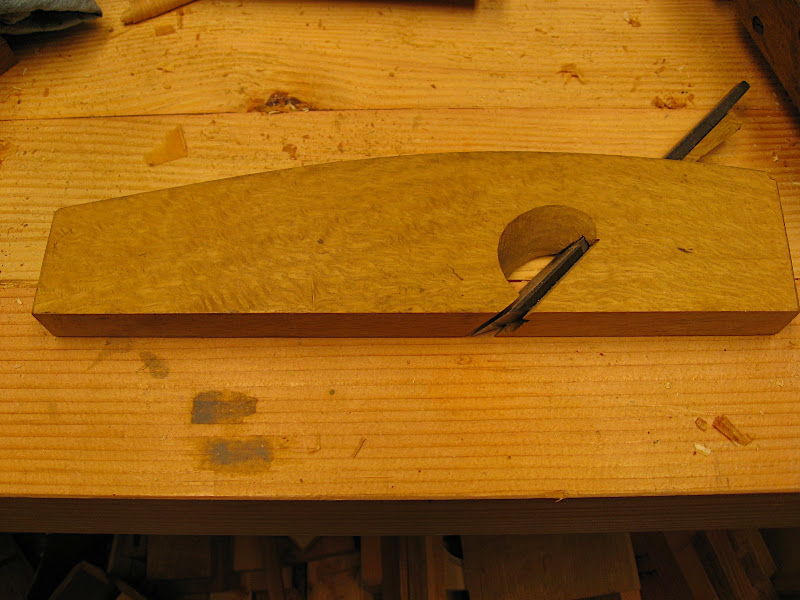
>Here's my Japanese dado plane. This will cut a groove/dado about 1/4" wide.
Overall views:
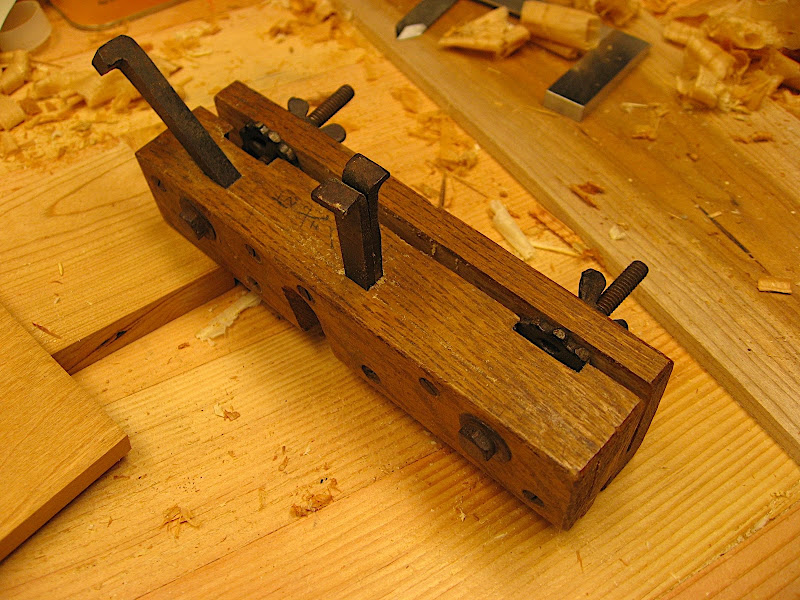
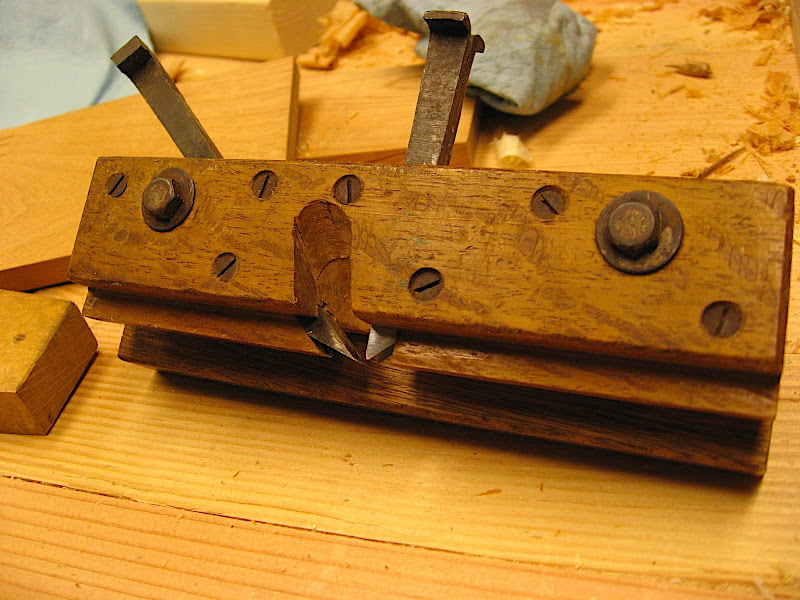
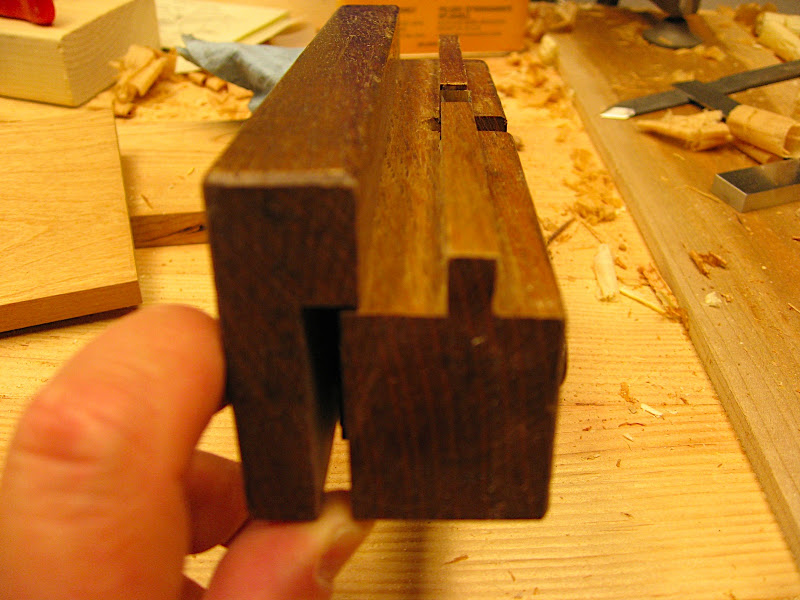
How the sole is configured. You can see how the sole is shaped so that the main part of the sole will bottom out on the board in which the dado is being made. This is pretty much a fixed depth stop. Also note that the fence can be adjusted, but at most a groove can be cut about 1" from the edge of the board. To use this for a dado in the middle of a panel, the fence would have to be removed and a batten would have to be used.
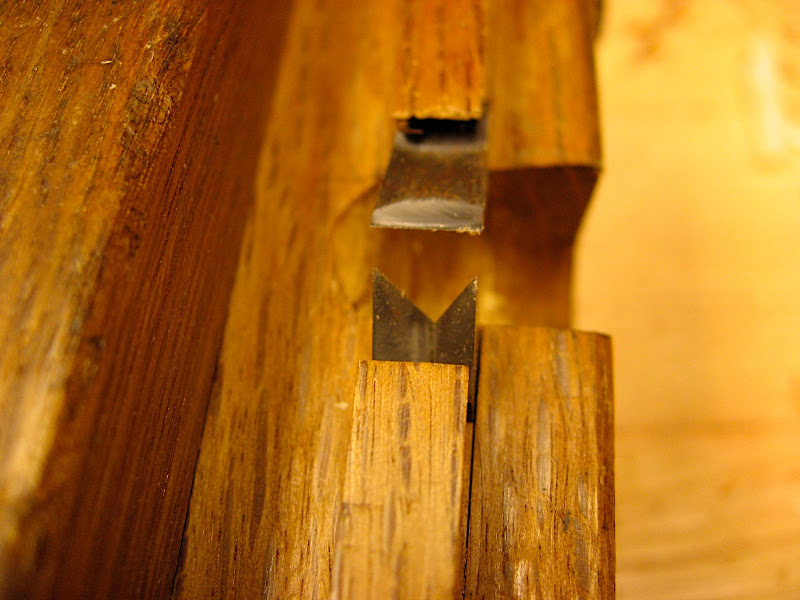
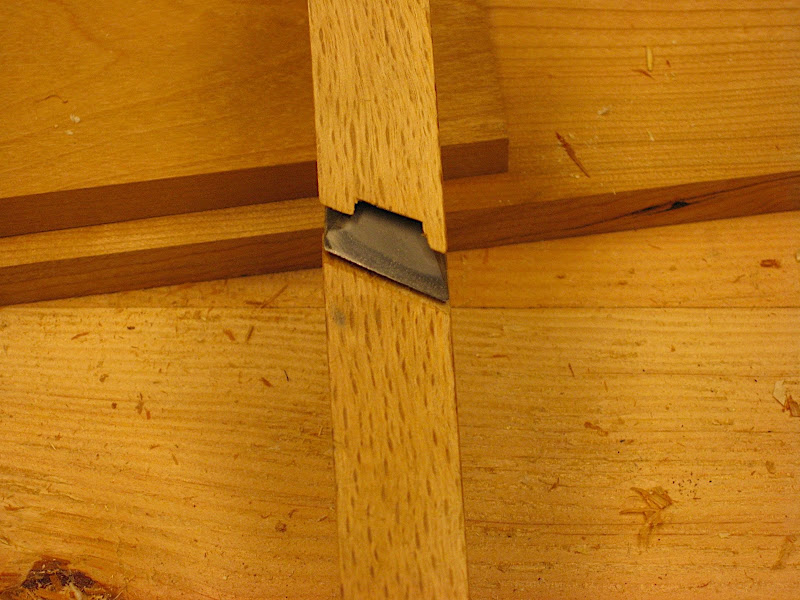
Closeup of the alignment of the nickers and the blade:
And some shots of the groove plane I had mentioned. This is about 3/4" wide, and you can see there are no nickers in it at all, which would make it less than ideal for crossgrain dados unless the sides were sawn/cut/knifed by an alternative method.
Interesting
Bill Houghton, Sebastopol, CA
>The straight/skew decision seems to be the opposite of Western practice - a Western dado plane is usually skewed, from the examples I've seen. I wonder if this is a product of differences in the wood being worked, or just an accident of historical tradition.
Re: Japanese dado and groove planes *PICS*
Pam Niedermayer, Austin, TX
>Thanks, Wilbur. I have several grooving planes; but have only seen the nickered planes on ebay. Maybe I'll try bidding again on one of them, if I can get over their appearance. :)
Pam


