Evenfall shooting board with Japanese planes
wilbur
>A while back I talked to Rob about his shooting board, and about how well they might work with Japanese planes. In many ways, a Japanese plane is ideal for endgrain shooting. It has a square body, a fairly low bed angle, there is virtually no chatter due to the way that the blade is bedded in a Japanese plane, the blade is really hefty, and can be sharpened very finely. About the only thing that I can think of to make a Japanese plane better for shooting is to add a skew to the blade. But this can also be accomplished by a ramped shooting board.
Rob was really willing to talk about and hash out what modifications might be needed to adapt his shooting board to be used with Japanese plane. Here's what we figured out:
1. The fence should be located towards the user, as the plane is being pulled.
2. The height of the top board needed to be increased. The corner of the blade on a Japanese plane is further away from the side of the plane than on your typical western Stanley-type plane, so if a Japanese plane was used on his regular shooting board, which has the runway 1/2" below the top surface, the corner of the blade would ride above the top surface. After measuring some of my Japanese planes, we decided that if the runway was 3/4" below the top board surface, that would be enough.
And that was really it. I also asked Rob to see if there was a way to combine this with his regular shooting board, as I also wanted something to use with western planes, just in case.
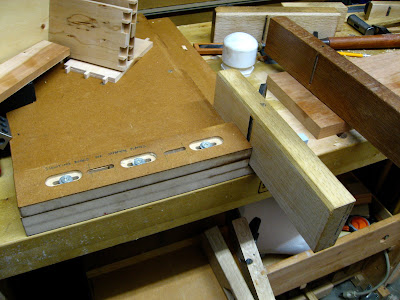
So this is what he sent me. For those of you who might not be familiar with Rob's shooting board, it's really well made, and comes with predrilled holes so that you can shoot at various angles.

You can see the two arcs of holes for the fence -- one for using a western plane, and the other for using a Japanese plane. The fence is set for a Japanese plane. The two arcs actually share a hole for 30�, which was really hard to drill accurately. Even though I know Rob took great care in lining everything up, the 30� hole is off a little for the fence in Japanese plane position. But that is really a very minor issue.
So how does it work? Let's start with a piece of freshly crosscut 5/8" cherry.
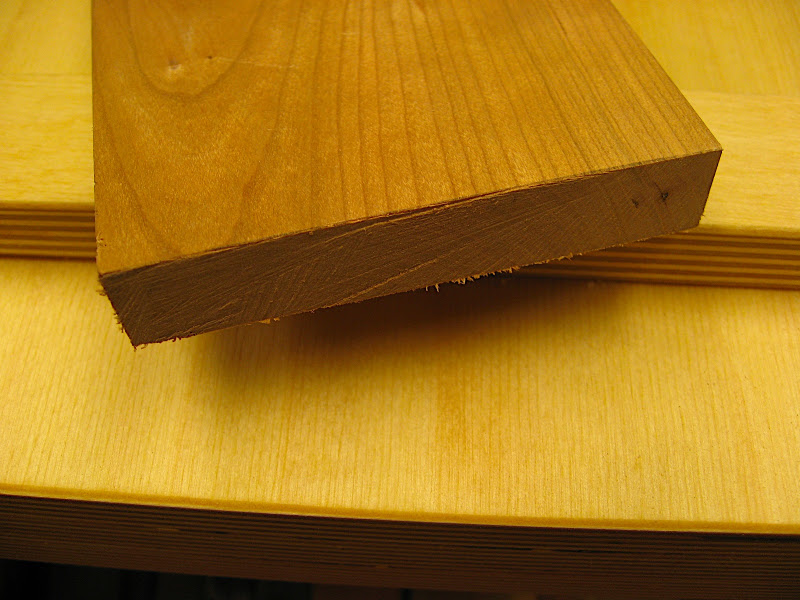
Not the greatest saw cut I've done, but it doesn't matter. I have a shooting board! Here it is in use with a Japanese plane.
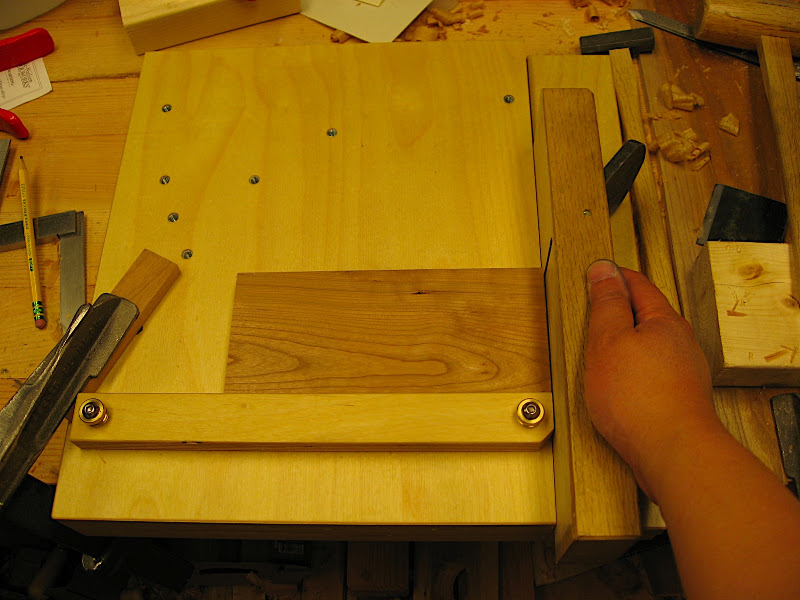
I'm using the Japanese plane one-handed to shoot the endgrain. Actually, I would also be holding the board with my left hand, but I needed it to hold my camera. ;)
I took about a dozen passes or so with my plane, and got this:
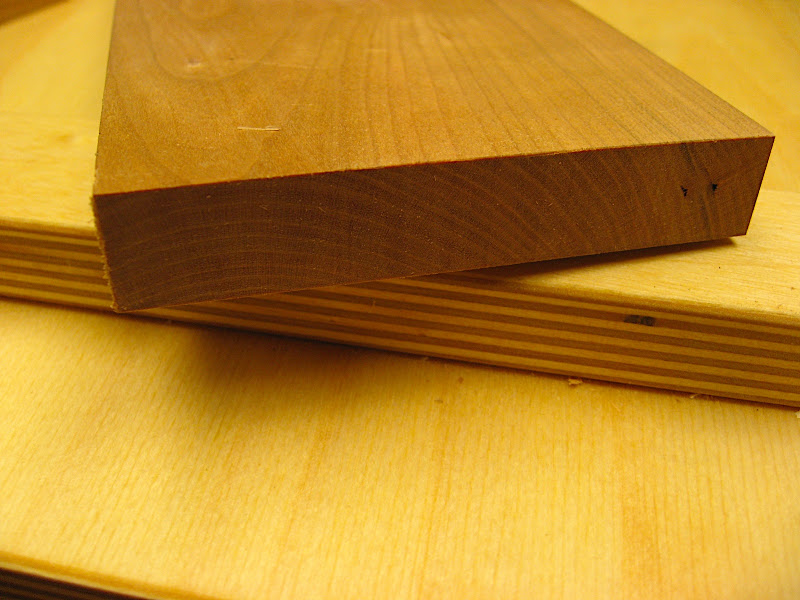
Not bad, if I do say so myself, and it was ridiculously easy.
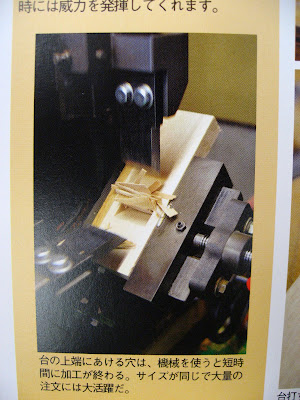
I've been trying to find any information on the use of shooting boards as they might have been used in Japanese or other Asian woodworking, but have come up with nothing. The traditional Japanese planing beam often had a 1x1 or 2x2 attached to the side of the beam so as to make it into a shooting board, but this was really used for edge jointing, and not shooting endgrain. The relatively narrow width of the planing beam (6" or so) wouldn't lend itself to shooting endgrain on boards much longer than a foot, since it would be too awkward to hold a long board across the 6" planing beam.
My guess is that endgrain shooting really wasn't an issue for Asian woodworkers. One of the design traditions in Japanese and other Asian woodworking designs was to try to bury endgrain as much as possible. A tabletop in an Asian piece of furniture would usually be more like a giant frame and panel construction, rather than a straight panel glue up. As such, the need to clean up the endgrain surface precisely wasn't really needed, as no one would ever see that surface, as it would have been covered by a frame member.
In any case, this modification of Rob's shooting board works great with Japanese planes. In speaking with him since, don't ask for a dual purpose shooting board like I have. It's too much trouble to make, due to the need to lay out two arcs for the different fence angles. I have to thank Rob for being silly enough to take on this type of modification. ;) Rob is offering a dedicated shooting board for Japanese planes on his website.
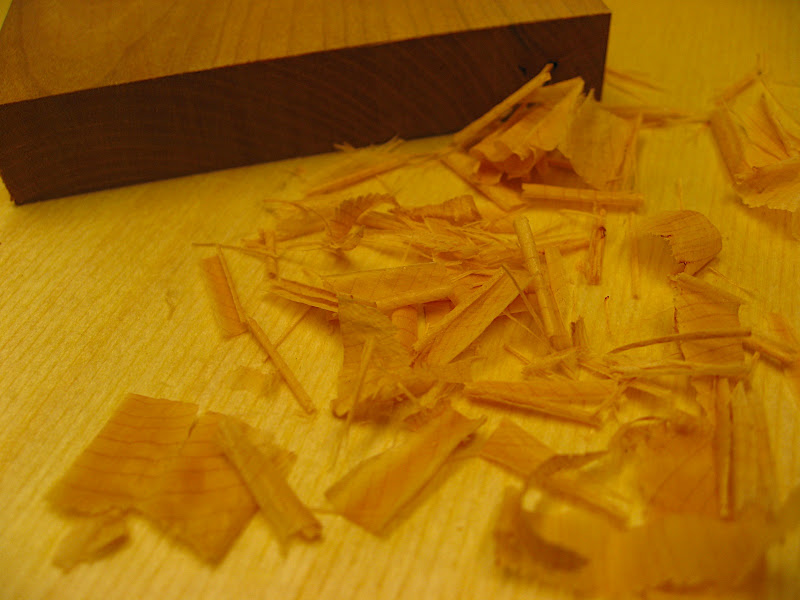
Finally, here's a gratuitous shaving shot, so you can see the super thin endgrain shavings I was able to get with this shooting board.