Home Articles Forums Gallery Marketplace Videos

WoodCentral Forums

Knowledge You Can Build On — Est. 1998

Super Resolution Thermal Imaging Camera

Japanese chisel bevel angle

Posts

Japanese chisel bevel angle

#1

Jack Guzman from Maine

Japanese chisel bevel angle

Jack Guzman from Maine

>I was rummaging through a junk box at a flea market and found a gem.Slightly flawed,but still a gem.This is a 30mm Japanese butt chisel.The ferrule that holds the handle tight to the tang was loose(easily fixed)and the edge was a mess.The previous owner had ground a bevel on the back.There is plenty of blade left to repair this screwup so I bought the chisel.$2.50 (mini gloat?)

Back in the shop I tightened the handle,cleaned the tool and started to fix the edge.I ground the edge back til I had a clean straight line on the back,then using a 400 grid diamond plate I flattened the back to get past the hollow.Now I'm ready for a new bevel.Here's where I need help.

According to Leonard Lee's book Japanese chisels should have a 35-45 degree bevel to prevent edge crumbling.Lie-nielsen's book says butt chisels are an exception.I have no experience with Japanese chisels.I'll be using this chisel for hinge mortises and general fine tuning in hardwoods when building clock cases.

How should I shape this edge?---Jack

Re: Japanese chisel bevel angle

#2

Re: Japanese chisel bevel angle

Derek Cohen (in Perth, Australia)

>Hi Jack

Japanese bench chisels are hooped as they are designed to be struck with a genno. The bevels on mine are ground and honed at 30 degrees. This has always worked well for me in hardwood.

My Japanese paring chisels have long un-hooped handles for pushing. They are ground and honed at 25 degrees.

Regards from Perth

Derek

Re: Japanese chisel bevel angle

#3

Re: Japanese chisel bevel angle

wilbur

>Leonard Lee's book is great, but his recommendation of a 35-45� bevel angle for Japanese chises is one point that I think he is way off on.

Like Derek, my Japanese bench chisels are at about 30�, my paring chisels are at about 25�, and to add another data point, my Japanese mortise chisels are at about 35�. Remarkably, this is pretty close to the bevel angles recommended for western chisels.

Re: Japanese chisel bevel angle

#4

Jack Guzman from Maine

hooped

Jack Guzman from Maine

>Derek,this chisel is hooped.I'm not sure how others are made but this one also has a square tang with a steel ferrule that is tapered like the socket on a socket style chisel.When the whole mess is pushed together the ferrule tightens the handle to the tang.Is this typical?thanks---Jack

Re: Japanese chisel bevel angle

#5

Re: hooped

Derek Cohen (in Perth, Australia)

>this one also has a square tang with a steel ferrule that is tapered like the socket on a socket style chisel

Hi Jack

That is typical of Japanese chisels - externally they look like socket chisels, but internally they also have a tang.


Regards from Perth

Derek

Re: Japanese chisel bevel angle

#6

No Secondary Bevel

Hank Knight

>Generally, Japanese chisels are sharpened with a single bevel, no secondary or "micro" bevel.

Re: Japanese chisel bevel angle

#7

Re: Japanese chisel bevel angle

Wiley Horne--So. Calif.

>Hi Jack,

Congratulations! You've gotten good advice already, so i won't repeat. For hinge mortising and fitting, as you've described, I would suggest starting under 30 degrees. This is pretty light duty. About halfway between Derek and Wilbur's hooped chisel and paring chisel recommendations--maybe 27 degrees. It might work well at 25 degrees, given the applications you describe.

Is there still a hollow on the back, or has that been sharpened away?

WIley

Re: Japanese chisel bevel angle

#8

Re: Japanese chisel bevel angle *LINK*

Pam Niedermayer, Austin, TX

>For some visuals, check out the forum below, particularly the sticky thread "How to set up a brand new chisel" by Soatoz.

Pam


Japanese Hand Tool Forum

Re: Japanese chisel bevel angle

#9

Jack Guzman from Maine

hollow

Jack Guzman from Maine

>Yes,there is still a hollow.The bevel that was ground into the back had just barely cut into it.I didn't have to do too much flattening to get a flat surface at the top.Funny thing though.This chisel isn't bevel edged.The bevel side is concave but the edges are square like a firmer chisel.---Jack

Re: Japanese chisel bevel angle

#10

Re: hollow

Wiley Horne--So. Calif.

>jack,

Glad to hear the hollow is in good shape. Those square sides are a good sign IMO. I was mentioning here recently that a very favorite chisel of mine is an old 36mm paring chisel with square sides. By an old Tokyo smith.

36mm is such a great width. You've made a very good find, I think.

Can you make out whether the cutting steel wraps up around the sides? Sometimes it takes a natural stone to bring that out.

Wiley

Re: Japanese chisel bevel angle

#11

Jack Guzman from Maine

Re: hollow

Jack Guzman from Maine

>If you mean the separation between the softer iron and the steel ,it doesn't wrap.You can plainly see the line along the sides.---jack

Re: Japanese chisel bevel angle

#12

Re: 35-45

ThomD

>I wonder if that was wishful thinking. I once saw a Japanese tools return box at the west toronto store, and it was full of chisels that were snaped off and otherwise mangled.

Re: Japanese chisel bevel angle

#13

Re: hollow

amelon

>Jack,

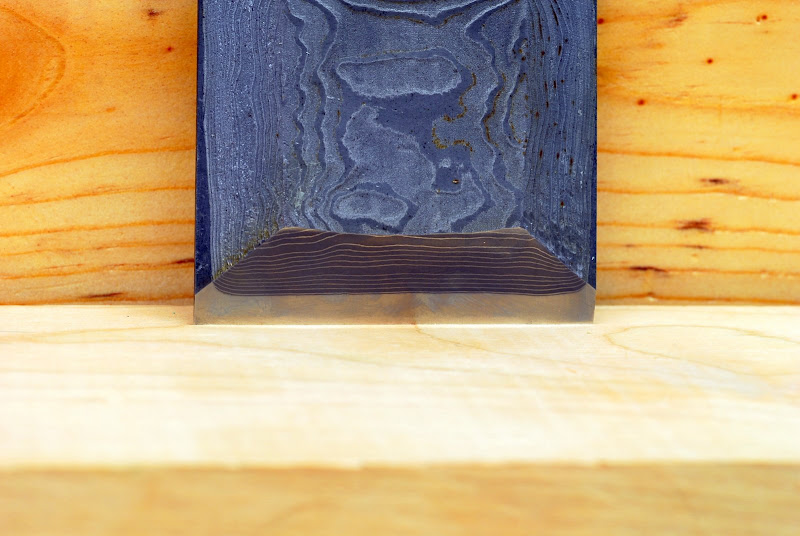
Below is probably what Wiley meant by "the cutting steel wraps up around the sides" - the hard steel has a U-shape pattern that "wraps" around the soft steel.

- Bob


img

Re: Japanese chisel bevel angle

#14

Exactly!

Wiley Horne--So. Calif.

>Thanks Bob! Looks very like Imai-san's work.

Jack, can you see the profile on the bevel? If not, a natural stone may bring it out, even an oil stone.

Wiley

Re: Japanese chisel bevel angle

#15

Re: Exactly!

amelon

>Wiley,

Yes, that is a sword steel timber framing chisel by Chutaro Imai. Rest of the photos are at http://daikudojo.org/Archive/gallery_nomi/20070204_imai_sword_steel_atsu_nomi/ . It's both a beauty and a beast (i.e., real hard worker).

The handle is a type of rosewood. I don't like it much (too jarring when struck with a hammer). I probably will make a replacement out of Japanese white oak.

- Bob

Re: Japanese chisel bevel angle

#16

Jack Guzman from Maine

Re: Exactly!

Jack Guzman from Maine

>That I'll have to look at more closely. All I have are king stones ,up to 4000 grit max.It's possible,because the line is pretty high up on the sides.I thought it was just a thick piece of hard steel.

I ground the bevel at 30 deg.on my slow grinder with a blue stone, carefully,never even got warm.Then I just spent about ten minutes on the 800 king and a quick polish with the 4000.This things gonna need new tools or more time. It's sharp enough for use but could be better.Because of the shape,shortness,none of my guides will hold it,so it's gonna be all freehand.---Jack

Re: Japanese chisel bevel angle

#17

Jack Guzman from Maine

yes,it wraps

Jack Guzman from Maine

>

Re: Japanese chisel bevel angle

#18

Re: yes,it wraps

Wiley Horne--So. Calif.

>Good, you want to see that. So Yamashita (www.japan-tool.com) says that the 'box' style was prevalent before 1950.

I think you'll find that the width of bevel will make it easy to feel when you have good contact for sharpening. Some people, James Krenov for example, hollow ground his Japanese chisels. The main concern there is keeping the grinding cool so as not to draw or lower the temper. If you have any trouble getting the bevel flat, and don't want to hollow grind, you can simulate hollow grinding by hand--just take the chisel to an edge of your coarsest stone, and hand grind a low place in the middle of the bevel. Not hard to do, because you're mainly grinding on iron or mild steel. That will knock down the middle and give you positive registration.

Wiley

Re: Japanese chisel bevel angle

#19

Jack Guzman from Maine

Re: yes,it wraps

Jack Guzman from Maine

>I hollow ground it.I got one of those blue cool cutting stones from Norton.Thanks for all your help.This is only my second Japanese chisel.The other is a 1/16" mortiser.It doesn't get alot of use but it's real handy for small box locks.I love the delicate feel of these things.---Jack

Re: Japanese chisel bevel angle

#20

Those blue Norton 3X wheels are great!!

Wiley Horne--So. Calif.

>

Re: Japanese chisel bevel angle

#21

Hollow grinding?

Derek Cohen (in Perth, Australia)

>I wonder how many here hollow grind their Japanese blades?

For many years I considered this to be sacreligious. Then I read about David Charlesworth doing it, and it gave me pause to think.

I assume that the arguments against hollow grinding are three fold: firstly, it is not traditional (or is it?); secondly, the heat from a power grinder may upset the temper of the thin tool steel layer. A third reason may be that the hollow will remove needed support for the bevel.

With regard speed/effort for honing, it should not be necessary to hollow grind as the soft steel layer wears quickly. The advantage of hollow grinding is the same as for Western chisels - creating a small secondary bevel or microbevel requires less work, and balancing the bevel on a hollow is easier and more reliable than balancing on a flat surface (maintaining the flat is more difficult).

I have been hollow grinding many (not all) of my Iyoroi bench and paring chisels for about 18 months using a Tormek. The 10" wheel creates a shallow hollow and the wet grinder keeps the steel cool (the 46 grit Norton 3X blue wheel on my half-speed 8" grinder is the other option).

So far I do not see any problems with either edge holding or chipping apparent. Chopping into hardwood is not different than with a solid bevel.

Comments and opinions?

Regards from Perth

Derek

Re: Japanese chisel bevel angle

#22

I hollow grind

Steve Elliott

>I've been hollow grinding Japanese chisels on a Tormek for about five years and it has greatly increased the amount I use the chisels. When sharpening isn't laborious I'm not as concerned about nicking the edge or even dropping the chisel on the concrete floor of the shop where I work. I'm moderately careful with my tools, but they're working tools and I'm always under the gun to work faster.

With careful grinding I can go right to the edge, then freehand on a 15,000X stone for about 30 seconds and end up with a killer sharp edge.

The grinding step has taken some practice to learn and I've made some simple fixtures to adapt the geometry of the chisels to the Tormek. It's not traditional but I'm after a great edge in minimum time and it fits my style.

Re: Japanese chisel bevel angle

#23

Re: Hollow grinding?

amelon

>Hi Derek,

I don't hollow grind. I've been told that the main reason is losing the support for the brittle, hard steel edge. From my experience, it makes a lot of sense. I don't have dedicated mortise chisels so the bench chisels I use have to work pretty hard. I've seen how fast the Japanese carpenters can chop through mortises and I can only imagine how stressful life is for their chisels. So not leaving anything to chances, I preserve my primary bevel.

I also don't use a secondary bevel. I find that if I keep my primary bevel absolutely flat, then it takes me almost no time (1-2 minutes max) to maintain a sharp edge.

Lastly is aesthetic. The bevels on Japanese chisels are beautiful when they're sharpened well (and I would also add "using natural waterstones"). See the example below. That is lost with the hollow grind.

- Bob


img

Re: Japanese chisel bevel angle

#24

Re: Hollow grinding

Pam Niedermayer, Austin, TX

>I'm with you, Bob: no hollow grinding, no secondary or tertiary bevels, and natural water stones (this is still new for me); however, I do have several mortise chisels.

Pam