Home Articles Forums Gallery Marketplace Videos

WoodCentral Forums

Knowledge You Can Build On — Est. 1998

Premium Live Edge Slabs, Hand-Selected in the Berkshires. Shop Unique Hardwood Pieces.

Summer workshop at the College of the Redwoods *LINK*

Posts

Summer workshop at the College of the Redwoods *LINK*

#1

Summer workshop at the College of the Redwoods *LINK*

amelon

>A month back, I attended a 4-week Projects workshop at the College of the Redwoods, Fine Woodworking Program (CRFW) in Fort Bragg, CA. Below is a link to the photos from the workshop. For the project, I chose to build a mini tansu (Japanese cabinet). I hope to find time to write more about the CRFW experience in the coming weeks. Here's a link to the first entry on my blog:

Back to School � College of the Redwoods, Summer 2009

- Bob


img

Selected Photos from the Summer Projects Workshop

Re: Summer workshop at the College of the Redwoods *LINK*

#2

Re: Summer workshop at the College of the Redwoods

Alan DuBoff

>Wow, what a great opportunity!

Impressive work.

Re: Summer workshop at the College of the Redwoods *LINK*

#3

Re: Summer workshop at the College of the Redwoods

wilbur

>HI Bob,

That's a really nice project, and it looked like the workshop was a lot of fun!

To go off on a tangent, I had a good time looking at the rest of your blog. In your entry on your toolboxes, you mentioned that you came up with a list of most essential tools. Would you care to tell us what you think is essential?

Re: Summer workshop at the College of the Redwoods *LINK*

#4

Re: Summer workshop at the College of the Redwoods

Dick Coers

>Beautiful work Bob, and thanks for bringing back some great memories for me. I dug out the photos I keep at my desk from a trip I took there is 1997, I think that was the year. I must have driven through that same redwood area coming up from San Francisco. I was there for a visit from Woodworker's Journal where I was working at the time. I sat in a weekend seminar with James, then took a LONG drive down the coast to the AWFS in Anaheim. I was shown around the school by David, then had two days with James. It was a weekend to remember. Did you stop at the Highlight Gallery in Mendocino? When I went there, it was like seeing all the woodworking magazine projects in the flesh. Countless pieces that I had seen in Fine Woodworking, Woodwork, etc..... Oh man, I think I have a tear forming in the corner of my eye.

Re: Summer workshop at the College of the Redwoods *LINK*

#5

Re: Summer workshop at the College of the Redwoods *LINK*

Wiley Horne--So. Calif.

>Hello Bob,

Thanks for posting this great photo sequence.

Looking at the photos, it looks like the tansu only appears simple. Can you help me with a question about the 3-way joint at each corner. Looking at your layout, there were some dovetails drawn, yet the case itself appears from external appearance to be all M&T.

However, when I looked at the parts photo (see link), it appears that the corner joint is M&T in the horizontal plane, but that the vertical member dovetails into the joint, with a shoulder to completely conceal it. Is that right? And if so, how then is the joint put together? It looks like you would assemble the top and the bottom frame, and then slide the four corner verticals into place--but that would take approximately 4 hands.

Anyway, it's a great piece, and I'm still trying to figure out the assembly of the corner joint.

Wiley


Bob Le's Tansu: parts ready to be joined

Re: Summer workshop at the College of the Redwoods *LINK*

#6

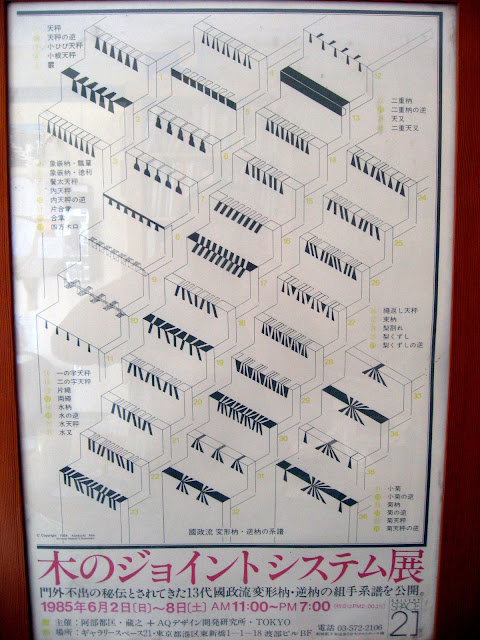
I love this dovetail variation chart!

Alan DuBoff

>Bob,

This dovetail variation chart is excellent!


Re: Summer workshop at the College of the Redwoods *LINK*

#7

Me, too.

Pam Niedermayer, Austin, TX

>Any chance, Bob, that you can email me a full resolution version? For personal use only.

Pam

Re: Summer workshop at the College of the Redwoods *LINK*

#8

Large pic of dovetail variations chart *LINK*

amelon

>Pam/all,

Here's the original. Enjoy!

- Bob


Dovetail variations chart

Re: Summer workshop at the College of the Redwoods *LINK*

#9

Re: Summer workshop at the College of the Redwoods *LINK*

amelon

>Thanks, Alan. And you can check out what the 9-month students have accomplished. See link below.

- Bob


CRFW student gallery

Re: Summer workshop at the College of the Redwoods *LINK*

#10

Re: Summer workshop at the College of the Redwoods

amelon

>Hi Dick,

The four weeks went by pretty quick and I think I put in 10-12 hour days. I didn't get a chance to visit the Highlight Gallery. I hear there's a big show starting the first Friday of every February. I might drop in for that. The staff is very friendly and helpful. It was a great experience.

- Bob

Re: Summer workshop at the College of the Redwoods *LINK*

#11

Many thanks.

Pam Niedermayer, Austin, TX

>

Re: Summer workshop at the College of the Redwoods *LINK*

#12

Re: Summer workshop at the College of the Redwoods *LINK*

amelon

>Hi Wiley,

I'm still trying to piece all the photos and notes from the trip together and to organize them better. I worked on two variations of the tansu joinery (below link). The first is a half-lap-with-through-tenon joint that Jay van Arsdale helped me with (the design part). The second is a hidden-dovetail-with-through-tenon which I found in a Japanese temple joinery book. I imagine traditional tansu joinery might be entirely different. One of these days I would like to buy a traditional tansu just to take it apart to find out...

It funny because I made friend with a Japanese woodworker and I showed him the tansu joinery. He told me, "Bobbie, this looks like temple joinery, not tansu!" Anyway, this thing is not coming apart!

- Bob


img

Tansu Joinery

Re: Summer workshop at the College of the Redwoods *LINK*

#13

How is this done?

Pam Niedermayer, Austin, TX

>Have any idea what the internals on the sample below are done?

Pam


img

Re: Summer workshop at the College of the Redwoods *LINK*

#14

Re: Summer workshop at the College of the Redwoods

amelon

>Thanks, Wilbur. I recall a WoodNet post by Joe Moskowitz about developing skills/learning (can't seem to locate the post anymore). "To be a good woodworker I think you need to develop the following skills for 95% of the work:

- Accurate Layout

- Sharpening

- Sawing accurately

- Chiseling accurately

- Milling lumber to finished dimensions"

I agree with the assessment and would only add that sharpening is, to me, the most important/foundational skill and I would also include planing skill to the list. Anyway, the reason I mention it is because I build my essential tools list base on this. With that, here's my list which allows me to do 95% of the work. It is heavily weighted toward Eastern tools, though not entirely. Big caveat: This is just my list (i.e., it probably won't work for others).

  • Layout

    • Technical (drafting) pen. I like the 0.25mm nib (referred to as 3x0). You get such a fine line and repeatable performance with these pens.

    • 0.5mm mechanical pencil.

    • Kegaki gauge. You can see it in this photo. LV sells a similar tool called the stop rule. I prefer the Japanese version because the layout face is wider and it's in vernier, so there's more precision. I rely on this gauge quite a bit for layout works.

    • Marking gauge. I like the Tite-Mark gauge but sometimes bounce back and forth between Tite-Mark and the Japanese mortise gauge (Kinshiro).

    • Square. I prefer the flexible Japanese square (sashigane).

    • 4" Double square

    • 6" Engineering square

    • Sliding bevel

    • Veritas bevel setter (along with the sliding bevel make up my dovetail kit)

    • Straightedge (for checking straightness as well as for plane sole conditioning)

  • Saws

    • Gyokucho 240mm ryoba (durable, general purpose saw)

    • Mitsukawa 180mm ryoba (fine joinery saw - I've been using this one exclusively for dovetail works)

    • Hishiki 4-3/4" dovetail dozuki (I got this one at at JWW recently and I like it a lot. Even finer than the Mitsukawa yet it cuts rather aggressively as well. Also reasonably priced at ~$29.)

    • Japanese 90mm panel saw (azebiki)

    • Zona saw

    • Keyhole saw

    • Fret saw

  • Chisels

    • 9mm, 15mm, 24mm Japanese bench chisels. This is the minimal list recommended by Jay van Arsdale for new students.

      • I would add the whole range of sizes if possible.

      • I like using paring chisels but they're optional - most things can be done with bench chisels.


    • Sokosarae chisels (for chip extraction)

    • 6mm, 9mm special dovetail chisels

  • Planes

    • 60-65mm smoothing plane

    • 42-48mm Scraper plane for plane sole conditioning

    • 36-48mm block plane

  • Miscellaneous

    • Chisel hammer - 1-1.5 lbs (375g or 460g head)

    • Boat building hammer (funate) - 9-12oz, for tapping plane/chisel blades (ura dashi)

    • Camelia oil + applicator

    • Single-edge knives (left- and right-hand version)

    • Small carving knife (I like the Hock knife)

    • Painters tape

    • Tweezer

    • Planemakers float (I use the small cheek, push version)

    • Small triangular file

  • Sharpening stones (if I need to bring them along)

    • 1000, 2000, 4000-grit stones (I have Norton, Bester, Norton respectively)

    • Natural finishing stone

    • Diamond plate (for flattening fine stones)

    • Ohmura 180-grit coarse stone (for flattening coarse stones)


  • Re: Summer workshop at the College of the Redwoods *LINK*

    #15

    Re: How is this done?

    Wiley Horne--So. Calif.

    >Looks like the joint would have to be mitered, but that doesn't explain how you'd get it to go together.

    Wiley

    Re: Summer workshop at the College of the Redwoods *LINK*

    #16

    Re: How is this done? *LINK*

    amelon

    >Pam - I assume you mean the one at the bottom? Nakashima's book has a sketch of the disassembled joint. I made 2 boxes with this joint last year. Mine didn't come out that tight because the wood moved a bit, or perhaps my saw line moved a bit... Next time I'll let the wood sit for a few days before doing final dimensioning.

    - Bob


    img

    Boxes with double end grain joints

    Re: Summer workshop at the College of the Redwoods *LINK*

    #17

    Why do you need both 6 & 9 mm dovetail chisels?

    Pam Niedermayer, Austin, TX

    >

    Re: Summer workshop at the College of the Redwoods *LINK*

    #18

    Re: How is this done?

    Pam Niedermayer, Austin, TX

    >Thanks, will have to try this. But I also intended to ask about the one on top. My assumption is there's some sort of half lap involved, but I recognize that I can be really wrong.

    Pam

    Re: Summer workshop at the College of the Redwoods *LINK*

    #19

    Re: How is this done?

    amelon

    >The trick is to treat it like a mitered half lap, and leave plenty on the waste side so the end grains don't break off. Then cut off the waste and plane it flushed. This joint is actually easier done on the tablesaw with a little bit of handtooling afterward.

    - Bob

    Re: Summer workshop at the College of the Redwoods *LINK*

    #20

    Correction - 4.5mm and 6mm

    amelon

    >Sorry, I meant 4.5mm and 6mm dovetail chisels. I find that the smallest gap between my tails is about 4.5mm and I can chop out the waste in one shot. For larger gaps, I can use a regular bench chisel to chop most of the wastes out, then sneak up with the 6mm.

    Re: Summer workshop at the College of the Redwoods *LINK*

    #21

    Re: How is this done?

    amelon

    >It looks like how you would cut regular tails and pins except with miter, but the miter is discontinuous so it will just take a lot more work. Since there are tails on both sides, the pieces have to come together at 45-degree.

    - Bob

    Re: Summer workshop at the College of the Redwoods *LINK*

    #22

    Re: Correction - 4.5mm and 6mm

    Pam Niedermayer, Austin, TX

    >Ah, that makes a lot more sense (not that 6 & 9 would be nonsensical, but would be in a portable kit). But where did you get 4.5 & 6? All the makers say the female necks are too narrow to support such a small size.

    Pam

    Re: Summer workshop at the College of the Redwoods *LINK*

    #23

    Re: Correction - 4.5mm and 6mm

    amelon

    >Pam,

    I got them from our favorite J-tool pusher. To be more specific, mine are the Tasai Type-2 in 4.5mm and 6mm. 3mm is also possible although I didn't order it.

    - Bob

    Re: Summer workshop at the College of the Redwoods *LINK*

    #24

    Re: Correction - 4.5mm and 6mm

    Pam Niedermayer, Austin, TX

    >That's good to know, Bob. I'm going to get one of these things one of these days (currently use a 9 mm Tasai bachi nomi).

    Pam

    Re: Summer workshop at the College of the Redwoods *LINK*

    #25

    Re: Correction - 4.5mm and 6mm

    Pam Niedermayer, Austin, TX

    >Oh, yeah, and if I get really ambitious and try to make a smaller dovetail, usually have to resort to some tiny, tiny Dastra carving chisels.

    Pam