Home Articles Forums Gallery Marketplace Videos

WoodCentral Forums

Knowledge You Can Build On — Est. 1998

This is the most versatile work station you will ever use

WWKD

Posts

Re: WWKD

#26

Re: clarification of question

Wiley Horne--So. Calif.

>Bill,

You're right, I didn't understand the situation. Not listening well enough. Thanks for drawing the picture. Also, I'm hoping others will jump in this thread--I'm becoming acutely aware of talking too much in one thread......

Anyway.....A short try plane, 17" length, will joint a 3 foot board just fine. In fact, I used to have a 16" or 17" favorite plane (1-3/4" blade) for just this purpose, gifted it to a friend, and now have a 20" for the same job. Also 1-3/4" blade. If it were me doing it, I would do it just as previously described. Work from the inside out, and right at the end make a last stopped cut 1/2" inside each end to prevent there being any snipe at the board ends.

It's surprising (to me, at least) how many 1-1/2 to 2-foot sticks there are in a chest of drawers. Like even in your tall Chester Co. one, I'd love to know the number of shorter sticks and boards which were required to be straight. It would be a whole bunch--drawer divider runners and assemblies, drawer parts, vertical dividers, and so forth. That's why a 17" or so short try plane is a valuable player, though unsung. Reminds me of the heyday of the Boston Celtics, when John Havlicek was their sixth man, never started, came in off the bench, but was in the running for MVP every year.

Some great edge jointing practice, and fun too, is making drawer bottoms from odd pieces in the shorts pile.

Wiley...hoping for some help on this thread

Wiley
Re: WWKD

#27

Re: clarification of question

Warren in Lancaster, PA

>Any length plane can be used to make a joint. The technique is to plane the high spots and then take a full length shaving to finish off. It is helpful to have a straight edge as long as the joint. Such straight edges can be made and maintained by the craftsman. The value of a longer plane is that it enables one to get close to straight with less testing and it limits the trouble one can get into. Really just a labor saver. The two boards should be tested with each other as a final step. My feeling, Bill, is that if you have a consistent problem you want to correct, correcting with a handplane would become pretty routine with experience. You have to get a feel for how much planing is necessary. Might seem frustrating at first.

Tests have shown a hand planed joint to be marginally stronger than that from a machine, especially with the yellow glue. But with any jointing, hand or machine, the worker's skill and experience are large factors. In our area serious commercial shops hardly use a jointer any more; the straight line ripsaw is much safer and reliable.

I have not seen references to "sprung joints" in historic (pre 1840) texts.

Re: WWKD

#28

Re: Jointer

David Brown

>Thanks for the pictures, Derek. Did you make that beautiful jointer with the ebonized handle? If so, how did you fashion the lever cap? It's a beautiful plane. Do you find you prefer the tote style to the whatever-you-call-those sticks-sticking-out of the HNT Gordon ones?

I hope things are well down south.

--Dave

Re: WWKD

#29

Re: Jointer  *LINK*

Derek Cohen (in Perth, Australia)

>Thanks Dave. Yes, the jointer is one of mine.

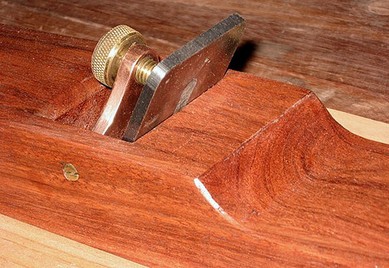
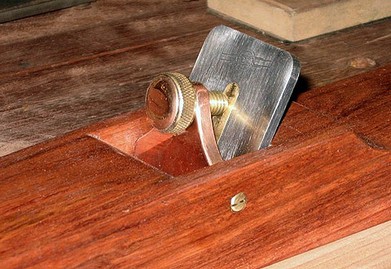
This is a close up of the lever cap ..


The blade is "infilled", that is, I inserted a brass section into the slot.

I have an article on building lever caps and lever cap screws without metalwork tools. The link is below. I hope this helps.


Making Lever Caps and Lever Cap Screws in the Back

Re: WWKD

#30

Re: Jointer

David Brown

>Thanks for the link Derek. Wonderfully interesting. You have a wealth of information on your site and when I have time, I'll spend some time reviewing your excellent articles.

Just out of curiosity why did you build your plane with a screw cap instead of a wedge?

Thanks for sharing.

--Dave

Re: WWKD

#31

WWKD ?

Scott Burr in Ben Lomond, CA

>Who the f*&k cares, make a plane fit to the job at hand.

Then move on...

You can't go wrong wit a nice Hock blade.

Re: WWKD

#32

Re: Jointer

Derek Cohen (in Perth, Australia)

>Why the screw cap?

Dave, a wedge works perfectly well, but a screw cap has more reliable and consistent pressure. It is easier to dial in tension - such as when setting the blade with tension reduced just enough to permit the blade to slide on the bed. Plus you do not need to reset a screw cap as you would a wedge each time you change the depth of cut. On my Spier infill I can create very fine changes in the depth of cut by adding more or less pressure via the cap screw.

As I said, one is not necessary, but I find it adds a little to performance.

Regards from Perth

Derek

Re: WWKD

#33

Re: Thomas...Wiley.....more questions

James Watriss

>I don't think it's all so difficult to see the need. I don't know how modern factories do it. Nor do I know how well their joints hold up over time. It's been a while, though, since I've seen good factory furniture. I'd ask Thos Moser how they do theirs.

On a related note, one of my shop-mates is in the re-assembly stages of restoring an old 16" American (before they became Yates-American) jointer, that has a lever on the outfeed side. He came to find out that it was the cabinetmaker's model, that the lever is there to tip the outfeed ever so slightly, for making spring joints. So, maybe factories now have found a way around it, but clearly it was still done in factories in the old days.