Wanna see a nice backsaw? *LINK*
Marv....... Northern California Lake Co.
>
~Not just another backsaw~
Knowledge You Can Build On — Est. 1998
Wanna see a nice backsaw? *LINK*
Marv....... Northern California Lake Co.
>
~Not just another backsaw~
I think Pop WW should start doing centerfolds
Bill Houghton, sun/cold in Sebastopol, CA
>that saw qualifies as tool porn for sure.
Congratulations to Andrew Lunn
Wiley Horne--So. Calif.
>for earning such a high recommendation from Chris. I'd like to hear from Andrew, if he doesn't mind talking about it, as to what drew him specifically to saws.
I can't help but notice how the current backsaw trend is tending toward thin plates, high tooth count, diminishing set, canted blade, and aggressive rake. Reminds me of Japanese saws.
Wiley
Oh my...
Scott Burr in Ben Lomond, CA
>Andrew, now you've done it. Guess we should start calling you the Larry Flint of the saw world. Wait, the Hugh Hefner would be better here. More beauty than flat out porn.
Re: Oh my...
Tony Zaffuto
>That saw is drop dead gorgeous! Like a Gramercy, but with a fatter handle. May have to wrap my Gramercy with duct tape to see how that makes it feel. If anyone has both, might be nice to see an overlay of one on the other.
T.Z.
Re: Congratulations to Andrew Lunn
ThomD
>Makes sense, doesn't it, considering the quality of Japanese saws, and their distribution these days. On the other hand, when I got my independence saw, it pretty much horned it's way into my use because it lacked some of these Japanese features. While I always thought the picture in Tage Frid's book of the destroyed "weak" J. saw was ridiculous, there is something to the idea that as long as a saw makes a quality easy cut, there really aren't any more points for it being super thin or extra easy. In some regards a wide kerf is more useful if it didn't cost anything to make. Still no need to choose with all this selection of fine tools.
Re: Congratulations to Andrew Lunn
Wiley Horne--So. Calif.
>Hi Thom,
You make good points. Here's a thought though, in regard to the thin kerf. It is frequently said, 'so what if it's a thin kerf, you're sawing in the waste, so what does it matter?' I think the way it matters is this--a backsaw with thin blade body, light set, and high tooth count can take a more aggressive rake than a saw with heavier body, heavier set, and lower tooth count. The reason is that the finer saw is ploughing up less wood, and therefore doing less work per inch of saw travel, and less work per cutting tooth per inch of saw travel, than the coarser saw. The user can feel this. Put the same aggressive rake on the coarser saw, and people will complain it's hard to start and a rough runner.
So the finer saw is as an easier starter and an easier runner, but in addition the aggressive rake will make it drop through the wood quickly.
I think these premium saw makers are tending in this direction, just looking at the tendency toward thinner plates, higher teeth counts, and more aggressive rake.
Here's a mystery to me, that I think may involve the canted blade. Does the canted blade, regardless of eastern saw or western saw, feed the teeth into the work more effectively? The fast answer might be, 'no, it doesn't matter because what matters is the angle at which the user presents the saw to the work'. But. Does the canted blade tend to drive the user toward a more effective blade feed? Note that all unbacked saws have canted blades, so why shouldn't backsaws do likewise, and again, we're beginning to see this in the modern premium saws.
Wiley
Wiley
Re: Congratulations to Andrew Lunn
Joel
>"Here's a mystery to me, that I think may involve the canted blade. Does the canted blade, regardless of eastern saw or western saw, feed the teeth into the work more effectively?"
absolutely yes.
with a parallel blade the saw as it cuts has to move down in the cut to continue cutting. you need a heavier back to keep it engaged in the wood.
with a canted blade each secceeding tooth is a little lower than the tooth before it and the saw itself doesn't need to drop down to stay engaged. So less downward pressure is needed to saw and the forward stroke is more effective.
Re: Congratulations to Andrew Lunn
Derek Cohen (in Perth, Australia)
>Hi Wiley
While I accept the reasoning behind a thin blade, the thin kerf that is produced in a dovetail saw is going to alter the dovetail-making methods of many. Specifically, you will struggle to use a fretsaw since the blade will be too wide to slide down the kerf (as it can do with a .20 wide blade). It's not a deal-breaker, however, since you can still saw out the waste with two extra cuts from the centre of the waste to the corners.
Of course none of this effects those that prefer to chop out waste.
And finally, transfering the markings of pointy, skinny dovetails is going to be fun! Looks like a new line in marking knives will be in order! :)
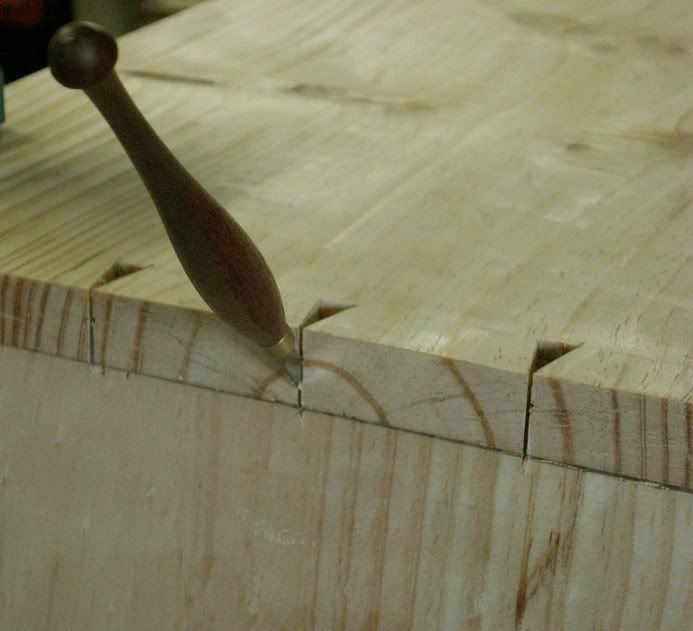

Looks like there will be those switching to tails-first sawing :)
Andrew, none of the above must be construed as a criticism of your beautiful and well-conceived saw. It is stunning work, and I would be extremely proud to own one.
My best wishes to all for Christmas, Channukah, and a safe New Year.
Regards from Perth
Derek
Re: Oh my...
Derek Cohen (in Perth, Australia)
>Hi Tony
Andrew's thicker tote sounds good to me.
I have the LN "Independence" dovetail saw as well as the original Independence Tools dovetail saw from which the LN sprang.The latter was sharpened for me by Mike Wenzloff for Aussie hardwoods.
Physically, the saws are differentiated by the thickness of the tote. The IT saw cuts more sweetly than the LN (which still cuts beautifully - just that Mike did a fabulous job on the IT), but I often prefer using the LN because of its thicker tote. It is much more comfortable and secure in my hand than the IT (which has a skinny tote by comparison).
Regards from Perth
Derek
Re: Congratulations to Andrew Lunn
Wiley Horne--So. Calif.
>Derek,
Nice work! In regard to sawing the waste, I use Japanese saws with an 0.012" thick plate. I saw the waste with an Olson No. 2 fret saw blade, 20 tpi, whose kerf is also rated 0.012". The little bit of set on the dozuki is sufficient to get the Olson blade down the kerf. Here are specs on the Olson line of fret saw blades:
OLSON� Regular Skip Tooth Scroll Saw Blades
The regular skip tooth blades are for cutting wood, plastic and fibrous materials. Skip tooth blades cut fast, provide good chip removal, and a smooth finish. They are 5" long and have plain ends.
Stock # Width Thickness TPI
3/0-ST .022 .008 33
2/0-ST .022 .010 28
0-ST .024 .011 25
2-ST .029 .012 20
4-ST .035 .015 15
5-ST .038 .016 12.5
7-ST .045 .017 11.5
9-ST .053 .018 11.5
11-ST .059 .019 9.5
As you can see from the thickness spec, a saw with an 18 thou plate could use up to a No. 7 or No. 9 blade, which are 11-1/2 tpi. The 15-thou plate of Andrew's (allowing for a little tiny bit of set) would accommodate up to a No. 4 blade, with 15 tpi.
Hope things are going well in Perth and elsewhere in Oz!
Wiley
Re: Congratulations to Andrew Lunn
john jesseph
>Not to be argumentative, but that doesn't make any physical sense.
OTOH, cant does change the hang, and maybe make the blade stiffer at the toe than it otherwise would be...
Re: Congratulations to Andrew Lunn
Joel
>I am sorry if my explanation is bad but just test it out. 2 saws identical except for the cant. You can of course just tip a saw up, but it just doesn't seem as effective as a cant.
Re: Oh my...
Andrew Lunn
>Hey guys, thank you all very much! Your kind words do the heart good, that's for sure. Thanks. I'll see if I can reply here to your questions and thoughts.
Wiley, as to how I got interested specifically in saws, I started out thinking I wanted to make myself a kit of tools and would start by making the saws. So I started researching it and thinking about it and knew almost right away that I was hooked. For whatever reason saws have proven to be one of those uncanny affinities for me that each of us has.
As for Japanese saws, to tell you the truth I've never used one. I have nothing against them but just haven't gotten into them. I have read about them and researched how they're made, but I didn't have them in mind when developing my saw. My goal was simply to make as refined a dovetail saw as I possibly could.
I like the very thin blade because it removes less wood and therefore requires less force to use than a thicker blade. I find the real benefit of this is that it in turn enhances how refined and precise the saw feels in use. After all, no dovetail saw requires all that much force to use, so it's not really the savings in force itself that is so terrific--it's the enhanced sense of control and precision that comes with it. It just feels very surgical.
Canted blades seem to me to enhance cutting action in backsaws rather like breasting does in long saws. It brings the blade in at an advantageous angle to the wood, creating more of a shearing cut than a blunt cut. I also think it creates a subtle plunging effect as you push the saw forward--the blade is deepening in the wood as you push it forward.
Tony, as to the thicker tote, they are a tad thicker, but I'm talking a tad. Most totes I believe are 7/8" thick, and mine are probably somewhere between 1/32" and 1/16 thicker than that. It probably varies a bit from handle to handle. I shape each one entirely by hand until it feels good. I find the slightly thicker tote fills my hand better than thinner ones.
Have a great evening everyone. Thanks again for your interest.
Andrew
Re: Congratulations to Andrew Lunn
Chris Friesen
>I think what Derek is talking about is that with a regular saw you can put the fret saw blade crosswise in the kerf of the dovetail saw and just saw across the gauge line.
With the extra-thin kerf you have to steer the fret saw around the corner.
Re: Congratulations to Andrew Lunn
Wiley Horne--So. Calif.
>Hi Chris,
Could be. However, one pull and you're around the corner. It's not a deterrent. IMO.
Wiley
Re: Congratulations to Andrew Lunn
David Cockey
>I agree, what's happening in the cut between the teeth and wood has no idea what the angle of the back is
Re: Congratulations to Andrew Lunn
ThomD
>Good points W. and all. I feel the same as Derek about how it impacts the joint making. I do fret saw DTs, or show how to to beginers, though in most applications I think it is an unecesarry step, however, I feel with the chisel a fatter kerf speeds things up also. Exactly how one goes about all this is a personal preference thing. I have a feeling that the same folks who have the tight saws, are also obssessing about angles on their DT chisels, make your bed and lie in it.
Overall, in the real world I think tougher blades easier to file, would be an advantage in the supply chain. Anyone who does this work on a regular basis couldn't care less about the effort required to pump the blade, the results are what mater, and I think the open kerf wins. But we don't live in the real world, and modern tools are a little like buying chocolate: whatever tastes better to the idividual user. Of course we live in the real world also, but here the premium is on distinctive tools of quality regardless the practicalities. This is totally fine, think of a fine double shotgun, nothing to do with really feeding a family.
Where a saw like this would be great, would be with really fine drawers, once the sides start to run in the 3/16-1/4 range, the smaller teeth come into their own.
On the specific question of tooth hook angle, there is a disadvatage to too much feed, or hook, or maybe there is. We have a lot of history, both Japanese and Western, of having square angles for hardwoods. Sure one can make the hook angle higher, and make the teeth so small they don't feel overloaded. This leads to the need for extra deep and harder to file teeth like the Japanese ones, to deal with the sawdust. Though even they use the square hook angles. etc... Is a saw that is more complex, harder to sharpen, no appreciable improvement in result a better design? In this market place, at times, yes.
Anyway, the saw that imspired this thread is a very cool saw that I would like to have for fine work.
Of course...
Dan Donaldson
>If you do pins first, you do not have the marking problem. ;-)
(ducking and running) ;-)
Sure, but...
Alan DuBoff
>Have you tried doing pins first on half blind dovetails? :-/
;-)
Dan Donaldson
>No, not too practical, but I was working on some "interesting" replies. ;-) (not that anyone is opinionated on this subject ;-))
Re: Congratulations to Andrew Lunn
Andrew Lunn
>Hi Derek, thanks for the kind words. No problem with respect to your thoughts. I guess I just don't think it's a big deal, though. Like Wiley said, you can still use a fret saw, and I think the best way to mark out super thin pins anyway is just to use the saw blade itself.
Take it easy,
Andrew
Re: Congratulations to Andrew Lunn
Andrew Lunn
>Hi Thom,
While I note your cocern about the thin kerf, I think it's pretty much a non issue. You can still use a fret saw.
With respect to your remarks about practicality and the insinuation that modern tools (presumably including my saw) cater to impractical desires like chocolates, that's just nonsense. Really thin saw plates in western dovetail saws aren't something new. You can find them on very old saws, like the Kenyon saw that recently surfaced at WWIA, for instance. Or you can go to Williamsburg and watch the guys in the cabinetshop use one in their efforts to reproduce period methods. It's hardly something I dreamed up to cater to people who just play around with their saws.
With respect to your comments about no one who really cuts dovetails caring about how much energy it takes to push the saw, I described in an earlier post how it's not really the savings in energy itself that makes the thinner plate nice--it's the enhanced sense of precision that comes with it.
A lot of thought and care went into the development of this saw.
Regards,
Andrew
Re: CONGRATULATIONS to Andrew Lunn
Marv....... Northern California Lake Co.
>Hello Andrew,
.015....020, who cares. Your saw is a work of art. I love old tools. I marvel over how much time and effort went into the embellishments that we see with some of those old treasures. Perhaps after enough time has past, someone will think of your saw in that same way.
Your saw isn't just a piece of sheetmetal with a tote at one end. It is symbolic of what was/is in your heart and soul. The object didn't exist in it's present form just a short time ago. Now it does. Your thoughts coupled with your desire to create something different from the norm is what brought it into being.
What is more simple than making a dovetail saw cut? That is all the saw is meant to do. For the most part, it saws end grain and produces shallow cuts. Any thin piece of sheetmetal can be made to do that.
I hope we can get away from critiquing only what the saw does, rather focus on what it really is and what it took to create it. Lets focus on the symbolism of the creation. Thats the only way a tool of this kind can be fully appreciated.
Some people are skilled at working with wood, using tools made by others. Some are skilled at working with metal. Your skills produce the tools that others use.
You did good, Andrew! I'm looking forward to seeing more of your future creations.
Marv
Re: Congratulations to Andrew Lunn
MikeW
>Perhaps it is because of being stuck at home for the second day that I am feeling a bit testy. And without access to my web site and email, sorry. The forums are my stomping ground for another day...
"Here's a mystery to me, that I think may involve the canted blade. Does the canted blade, regardless of eastern saw or western saw, feed the teeth into the work more effectively? The fast answer might be, 'no, it doesn't matter because what matters is the angle at which the user presents the saw to the work'."
Absolutely NOT. Neither the Japanese nor western saws have altered sawing dynamics due to the top edge of the blade shape. What matters is the tooth shape.
As goes "feeding" the teeth, only the Japanese or a western saw that is filed where the tip is forward for the tooth's face will "feed" itself into the wood. On a Japanese saw, it is what controls the rate of sawing (in conjunction with the ppi and or rate of progressive toothing).
On a western saw that is filed with a forward facing rake, it is only effective on soft woods, and in particular soft woods that are still a bit damp (think pond dry construction lumber). The drier the wood, the more trouble this tooth shape causes.
"But. Does the canted blade tend to drive the user toward a more effective blade feed? Note that all unbacked saws have canted blades, so why shouldn't backsaws do likewise, and again, we're beginning to see this in the modern premium saws."
If anything, a canted blade on a western backed saw can aid in not over cutting the back line on joinery. But neither the tooth geometry nor the cutting dynamic is altered.
To say otherwise is the creation of a myth, an aura of mystery, or simply disinformation.
Take care, Mike


