Home Articles Forums Gallery Marketplace Videos

WoodCentral Forums

Knowledge You Can Build On — Est. 1998

THE WOODRAT IS BACK!

Overdue Review...

Posts

Overdue Review...

#1

Overdue Review...

Rob Lee

>At the end of August, a mysterious parcel turned up in my office. As you can tell from the A4 in the background�. They�re HUGE!

R1

Ok � maybe that�s the wrong background� here they are again� actually a very reasonable size.

R2

A close-up of the spearpoint knife:

R3

And the awl:

R4

Physical Description

Both handles were beautifully turned from what turns out be, after extensive analysis, wood. ( Specifically, Allocasuarina fraseriana.)

Each has what appears to be a hand-rubbed satin finish, and the handles are smooth without being slippery. Major handle diameters are .652� (1.66cm), and handles have an overall length of 5.285� (13.42cm). Each is capped with a .312� (.79cm) ferrule. We were unable to determine whether blue brass, or white brass was used.

The knife blade measures 1.375� (3.49cm) long, is .225� wide (.57cm) and is .038� (.20cm) thick. Using an optical comparator, it was found to have an included angle of 60 degrees (optional angles were not supplied).

The awl tip is 1.221� (3.1cm) long, with a root diameter of .152� (.38cm). The tip tapers to a point over half of the length of the blade.

When examined under a microscope � both were just as sharp and pointy up close, as far away.

In Use

Both precision instruments were tested in the highest quality hard and softwood samples we could get our hand on� Pinus strobus, and Acer E Guitarensis. (commonly known as Eastern White Pine, and �Rock� maple�.)

Softwood results for both knife and awl are shown below. Lines were carefully scribed at 15 degree increments to a given axis, to test cut ability across and along the grain. While both did an excellent job marking in softwood, fiber tearing is visible in the lines left by the awl.

SWK

SWA

Hardwood results were much closer � as can be seen in the test pieces below. Both left clean marks, though again, the awl did have a slight tendency to follow the grain in some instances.

HWK

HWA

One can only conclude from these tests that the marking knife is the best choice for use as a marking knife� unless of course, you don�t have one � in which case you�re clearly faced with a choice of awl or none.

For dovetail work, the knife proved to be an excellent companion to the revolutionary Veritas dovetail saw prototype during testing, the results of which can almost be seen below�

Dove

Other comments

When left on the bench � both exhibited a tendency to roll in a clock-wise direction (contrary to the counter-clockwise stated in the instructions???). The small knob on the end of the handle made them comfortable to hold in your mouth, while fiddling about aligning pin board to tail board. The differing finish on the ferrules (one brass, one nickel plate) made it a snap to tell which was which, just by looking at them�. Something we wish more manufacturers would do.

Pair

So there you have it � my first official review, in what I am sure will be a very short career as a reviewer�.

Cheers �

Rob

PS � Ok � what I really meant to write is that these are beautifully made, and very useful tools. The handles in particular are superb � my hand grips the thinnest part of the handle at the web between my thumb and forefinger, while the balance of the handle mimics the natural curve of my fingers when relaxed. These are well thought out tools, and it�s a privilege to have them. Many thanks to Derek!

Re: Overdue Review...

#2

Re: Overdue Review...

Wiley Horne-- So. Calif.

>Great review, Rob!

I had the great good fortune to receive a similar marking knife, and agree that the feel in the hand is just right. I suspect the explanation for the CW vs. CCW roll direction is the difference in Coriolis force moment between the hemispheres--as I mull it over, am quite sure this is the reason. Plus the early wood/late wood pattern is reversed down under compared to our 'more normal' clime--which might add to the odd rolling direction.

The knife and awl seem to be enjoying themselves hanging out in a really swank tool neighborhood. Semi-seriously, we should do a thread sometimes on ornament in tools.

Thanks for showing,

Wiley.....wondering about the incidence of left-handed people in Oz (<:).

Re: Overdue Review...

#3

So is "curly" maple Acer Nyuknyucknofolium?

Don in Northern Arizona

>

Re: Overdue Review...

#4

ROTFLMAO!!

Wiley Horne-- So. Calif.

>

Re: Overdue Review...

#5

Overdue Response ...  *LINK*

Derek Cohen (in Perth, Australia)

>Hi Rob

My first reaction when I received your email this morning alerting me to your review was �Oh my Gawd!�. As I was to discover, my fears were completed well founded.

All I can say is thank goodness for the distraction of the new range of Veritas tools. The new H.O.L.T.E.Y. block plane makes a splendid backdrop, and the new J.M. plough highlights the tones of the She-oak.

I did omit to mention in the 22-page manual that the marking knife was designed for bevel up use and best held at 77�. The scratch awl is more forgiving � may be used either BU or BD, and is actually the left-handed version.

Since completion of this pre-production model, I have not only added another 13 pages of notes, but also accessories for the knife and awl combination.

The first accessory is a fence for the marking knife. This is to aid those who find it difficult to mark a straight line, or who have sniffed a little too much buffing oil the night before.


The second accessory is a guide for the scratch awl. This one is to assist the compulsives amongst us resist their insistence on marking straight lines.


And here is the full set on offer ..


For those reading this review of the review, and are inspired to send me money for a set, please be aware that they are only intended to be released in the Spring of never. I make them mainly as gifts and occasionally have some over. Alternately, I can send you a kit comprised a block of wood and an unground HSS jigsaw blade. A lathe is optional but recommended. Instructions are below.

Thanks Rob for making my day!

Regards from Perth

Derek


A Knife for Marking Dovetails

Re: Overdue Review...

#6

Rob and Derek, I find you both quite annoying

Todd O. Cronkhite Maine Native, Presently Away

>Rob, there was absolutely no need for you to use those center wheels planes as background the way you did. All you've done by doing this create for me a strong desire to own such a beauty, which I cannot afford and don't have the talent to replicate. You just flat out done me wrong.

Derek, all you accomplished by showing off what incredible things you can create with just a few bits and pieces of odds and ends is create a strong feeling of complete incompetence in me.

Rob, where Derek went wrong is he failed to reverse the rotation of his lathe when during these handles to offset the opposite rotational effect between the Southern Hemisphere, and the Northern. As simple oversight on his part, but still one that I would of thought he'd of caught.

Very nicely done Derek on not only the knife and awl, but the other tools as well.

T.O.

Re: Overdue Review...

#7

Re: Rob and Derek, I find you both quite annoying

Pam Niedermayer, Austin, TX

>Well, perhaps it will bring some solace to know that neither of them probably uses the marking knife properly. :)

Pam

Re: Overdue Review...

#8

Hah ! Good one Pam :-)

Joe Rogers, Northern Virginia

>

Re: Overdue Review...

#9

Re: Overdue Response ...

Alan Schwabacher

>What an impractical approach. If I'm too cheap to cut up a perfectly good jigsaw blade, and too committed to handtools to dull one, this means I need to befriend someone who uses a jigsaw!

Re: Overdue Review...

#10

I'll bite

Tom Sontag - St. Louis

>That probably means I am using mine wrong too since I am not consistently pleased with my results.

I have a double bevel knife similar to the one reviewed. I just put the flat against my straighedge and drag the point.

So, what is the proper way to use it?

Re: Overdue Review...

#11

Re: I'll bite

Pam Niedermayer, Austin, TX

>Contrary to what Dunbar says in PopWW, you place the bevel against the straight edge, not the flat. This provides a cut a bit closer to the straight edge, but mainly tracks the edge better. According to Jeff Gorman.

Pam

Re: Overdue Review...

#12

Re: I'll bite

Alan DuBoff

>Pam,

How would Dunbar or Gordon know what type of knife I'm using or even the wood I'm using it on? I don't know if I use my marking knife right, but mine seems to mark lines for me when I need it to...for that matter, I have used a good 'ol #2 pencil with great success, didn't have to flat the point at all...:-)

How do you use your marking knife? You do use it yourself, right?

Re: Overdue Review...

#13

Re: Overdue Review...

Dave Anderson NH

>You mean to tell me that a marking knife is used for marking? All these years I've been under the impression that what I've been making and selling were for use with a dart board. What people thought was a finial on the handle was just a way to fletch the shaft in wood since feathers are too hard to turn on the lathe.

Re: Overdue Review...

#14

Maybe not ...

Derek Cohen (in Perth, Australia)

>you place the bevel against the straight edge, not the flat.

Hi Pam

Jeff has said as much to me. But I disagree. Perhaps his knife blades are short and the back of the blade does not reach the full length of the "fence" (in this case, when transfering the tail to the pin). I make the blades on my marking knives 1" long.

A while back I posted this picture, more to show off the slimness of the blade. They are essentially the width of a dovetail saw kerf. But the blade is long enough and slim enough to slide along the inside of the tail.

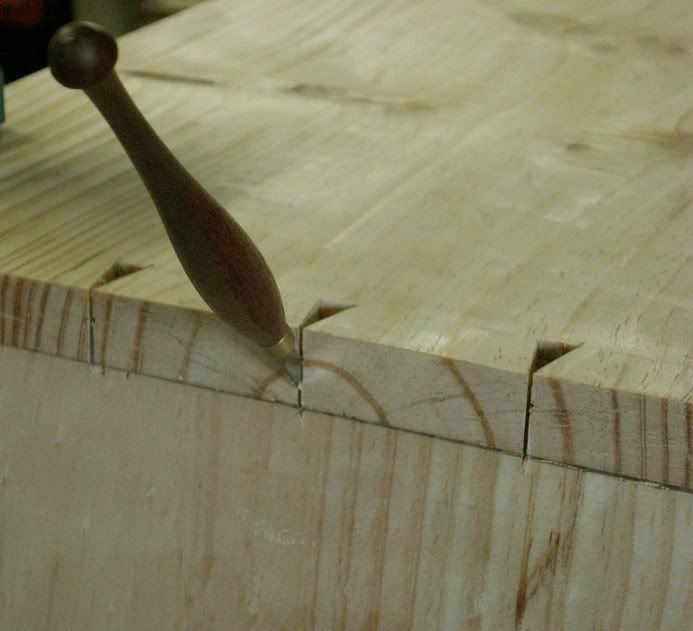
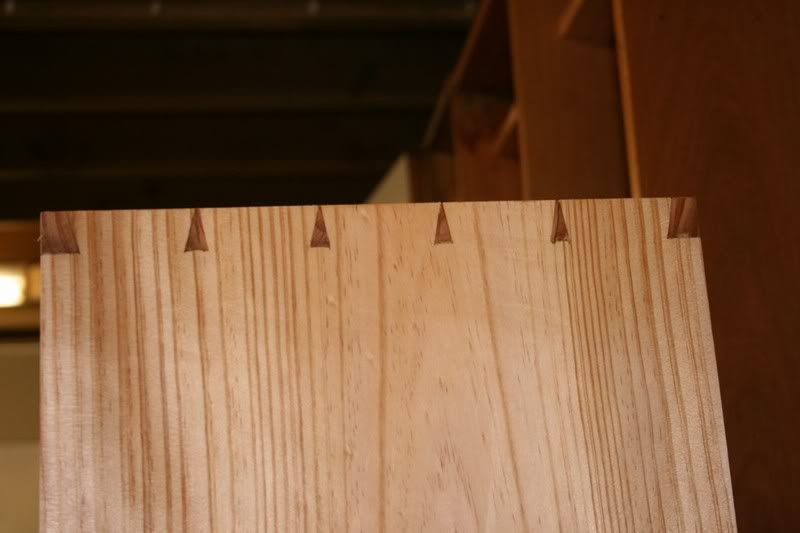
If you look carefully in the following image, you can see the knife marks at the lower edge of the sides of the tail.


Here you can see the tails being pared. The skinny ends are there for inspection.


The proof of the pudding is in the eating. Here is the result of when the two boards came together ..


I'd say that the knife did just fine using it the "wrong way around". :)

Regards from Perth

Derek

Re: Overdue Review...

#15

Re: Maybe not ...

Pam Niedermayer, Austin, TX

>Derek, sure, you can do good work even with the knife turned the wrong way around; but it's a little easier, straighter, and tracks a little better using Jeff's approach.

Alan, I don't read your messages, say what you will, I assume it tries to be insulting, assuming I could possibly be insulted by you.

Pam

Re: Overdue Review...

#16

Re: I'll bite

MikeW

>Due respect to Jeff G, I think he is "wrong." Not that there really is a wrong here when something as mundane as which side of a marking knife goes against a straightedge and works for them.

While I have done the bevel side of a marking knife against the straightedge before, I find it harder to control. For myself that is. In Derek's instance of marking-knife wide tails, using the bevel against the straightedge wouldn't even work as the knife would be canted to one side.

Perhaps I'll have to play with my marking knives next time I use them and give actual thought to how it works.

And for a little gratiuitous marking knife picture...


The Japanese knife at the top is one of those available from Woodcraft. The others are handmade. These have low enough angles to try it Jeff G's way, but I am pretty certain the bevel angles on my couple spearpoint type are too obligue and would cant the knife over too far for the size of DTs I do--which are not as skinny as Derek's.

Strightedge work, though, might work OK. I'll give it a renewed try.

Take care, Mike

Re: Overdue Review...

#17

Re: Maybe not ...

Alan DuBoff

>You don't have to read any of my messages, that's the beauty of the inet. I often can't help but read your messages on this fora, you respond to most every post, many time NM.

Re: Overdue Review...

#18

Don't quite understand

Bill Houghton, Sebastopol, CA

>Pam, if I understand your suggestion correctly, you place the marking knife against the straight edge - say, a metal rule - so that the bevel is facing the straight edge. You commented, "This provides a cut a bit closer to the straight edge..."

Wouldn't it be FARTHER from the straight edge, by the thickness of the marking knife blade?

Re: Overdue Review...

#19

Re: Don't quite understand

Derek Cohen (in Perth, Australia)

>(Pam) commented, "This provides a cut a bit closer to the straight edge..."

Wouldn't it be FARTHER from the straight edge, by the thickness of the marking knife blade?

Hi Bill

I think that Pam meant that the knifed line would end up closer to the straight edge if used the way Jeff recommends.

My thought is that it makes no difference whether you use the knife bevel up or bevel down. The side against the straight edge automatically becomes the cutting edge. Only the shaft angle alters. Using a marking knife is not the same as using a marking gauge where the cutting angle alters.

Regards from Perth

Derek

Re: Overdue Review...

#20

And...

Scott Burr in Ben Lomond, CA

>B.S. marking knifes work great for "darting" all the critters that come up to steal my cats food.

Re: Overdue Review...

#21

Gorman's site *LINK*

Pam Niedermayer, Austin, TX

>Jeff explores things markin, including info knife bevels, here. It's well worth a full read/study.

Pam


Jeff Gorman's Marking Time

Re: Overdue Review...

#22

Re: Don't quite understand

Alan DuBoff

>Derek,

I guess I truly don't understand why it even matters what way one puts the bevel, I use a Stanley utility knife most times which has a bevel on both sides, it is a knife after all. It seems to work fine for what I do. This is akin to me like cutting tails or pins first, when doing hand cut dovetails. While I prefer to cut tails first, I can see value in one point that Tage Frid pointed out in an old video of his, that marking the tails from the pins seats the marking knife in the grain to hold a clean line, and that is true. So that is certainly a valid point in doing pins first. It comes in handy in knowing how to do both. I think the way one uses their marking knife is a personal decision, and something each of us need to feel comfortable with.

We should all use what works for each of us, not just use something that someone suggests, but try it and see if it fits our style, then decide.

More so, I wanted to point out something, that being that your tools and work are always a joy to look at. These marking tools are no different, and I especially like the accessories you created for them, very resourceful. I get more pleasure in seeing something which was crafted by a non-professional that might not be perfect, rather than a professional. I always expect a professional toolmaker to produce professional quality tools, for instance, but knowing that your not a toolmaker and seeing tools like these is a great pleasure. They appear to be very useful and well made, up to professional standards.

In reading Rob's review, which I felt was fair, there was one comment he made that I agree with. That being that they look as if they would have a tendency to roll off a bench. Round vs. flat is something I struggle with in my own tools, and have more often ended up rounding the edges. But that is a minor point, also one that is a personal choice, and which I feel could be fixed easily by planing a flat on the sides of the body...none the less, great execution, great looking tools. I was going to thank you for sharing, but that thanks should go to Rob since he was the one who shared. Great job on your part though! :-)

Re: Overdue Review...

#23

cutting action

paul womack

>Here's a closeup diagram of the cutting action (grey straight edge, blue knife, brown wood)

Photobucket

I don't see how the cut would "know" wether the knife-face against the rule is the back or the bevel.

Further, in Derek's case, angling the knife in the DT space is simply not possible.

BugBear

Re: Overdue Review...

#24

cutting action

paul womack

> I use a Stanley utility knife most times which has a bevel on both sides, it is a knife after all. It seems to work fine for what I do.

A Stanley knife will make a line half the blade thickness from the straight edge. This can be allowed for by placing the knife in the correct location, and then sliding the square (or straight edge) up to the knife. This is (in any case) Ian excellent way to place the reference edge.

However, the Stanley Knife also makes a 'V' line as opposed to a non-symmetric line with a straight wall. This is less than ideal if one is marking (and partially cutting) shoulders. The deeper the cut, the more the 'V' becomes undesirable.

BugBear

Re: Overdue Review...

#25

What I understand ...

Derek Cohen (in Perth, Australia)

>Hi Alan

Thanks for the kind words.

Rob's review was a lot of fun, and my reply to him was intended to be fun as well. Somehow the thread has become a little more serious and intellectual.

Anyway, I do not believe that there is such a thing as the the right side of a marking knife - in the same way that I believe that there are two sides of a chisel to use, and that both are approapriate.

To clarify: Jeff's point is that a knife turned and cutting on the bevel side will pull the work to the fence. I am saying that this is only valid if the blade is held in the vertical, as one does when using a cutting gauge. Otherwise a marking knife is cutting exactly the same way regardless of the face of the blade - whether the bevel is held against the fence, the back of the blade is. The wood sees the same "shape".

Rob's identification of the knives rolling is a valid criticism. It is just one of those design priorities that one has to decide on - does one go for ergonomics (comfort in use) or practicality (placement on the bench)? I chose the former, and to make up for this, I make sure that I have somewhere to place them when they are not used ...


(Shopmade birdscage and scratch awls, knives, burnisher, and plane setting hammer. Sliding bevel by Chris Vesper. Watch out for his work - just stunning!).

Regards from Perth

Derek