Chisel questions
Bill Tindall, E.TN
>First bear with some background. I feel I may need to convince some that I do listen to advise, eventually.
Some time ago, smitten by the success of the short dovetail chisels I made, I asked on this forum why long chisels were made. Time has passed and I am using chisels more now and I am seeing the benefit of a long chisel for paring. I am left with needing/wanting a set of paring chisels (or at least chisels with long blades, what ever they may be called).
The only set of chisels that has come up on Ebay has been a set for $400. I have no interest in spending the time to accumulate a set one at a time and I have ground the pits out of the back of the last chisel I ever intend to. New chisels are $30-75 depending on size and manufacturer. That's a pile of money for a set of chisels.
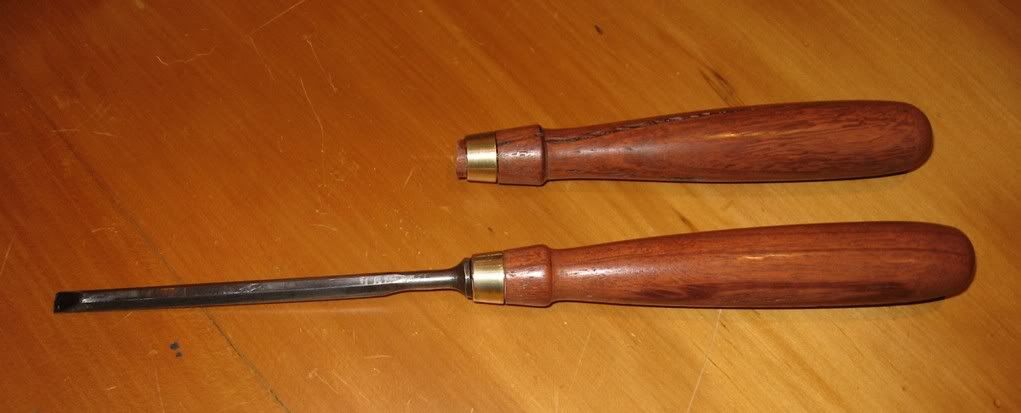
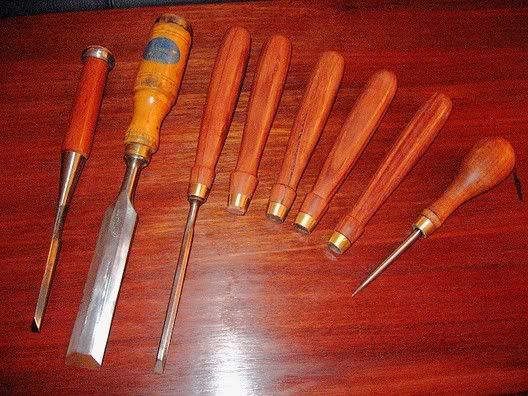
I said some time ago that I was done fabricating metal, but the situation compels me to make a set of paring chisels. The dovetail chisels cost only a few bucks each and not much work. I have to make them out of some kind of metal so why not 3V? It remains the best metal for the task so long as one can use diamond sharpening techniques. They will be tanged chisels because that is the only kind I can make.
1. Will someone send me, or post, a picture of a tanged (as opposed to socket) paring chisel? I am particularly interested in how the tanged versions are handled.
2. Given that I have a set of bevel edged dovetail chisels is there any reason to bevel the edges of paring chisels? I currently have one Swan paring chisel with square sides and one with beveled sides. For what I have used them for I see no difference. But then there is more wisdom here than my limited experience. Both kinds seem to be made. Where is one better than the other? It is easy for me to bevel the chisels I make, if for some reason I should.
Thanks in advance for some thoughtful responses.