Home Articles Forums Gallery Marketplace Videos

WoodCentral Forums

Knowledge You Can Build On — Est. 1998

Want Better Milling & Firewood Knowledge?

Jointer/Planer

Posts

Jointer/Planer

#1

Jointer/Planer

Frank

>Howdy Guys

It is coming up the Fall woodworking shows and I have been looking at those jointer/planer 10" or the 12" tool. Because I am lacking in room like a lot of us, I think I could just work in the 10" jointer/planers. My 6" jointer makes me do a lot of glue up and plus most of my wood is 8" to 16" wide. It looks like the bed is a lot shorter then a reg. 10" jointer but that is why it is good for me because of lack of room. Is there someone out there that could tell me some of the pit falls going this way and maybe has one of these machines???

Frank

Re: Jointer/Planer

#2

Re: Jointer/Planer

Bill Houghton, Sebastopol, CA

>Maybe better posted on the general board. Here, of course, a jointer/planer is a really long plane, like 24 - 36".

Re: Jointer/Planer

#3

Re: Jointer/Planer

ThomD

>I have tried quite a few different combinations and there really isn't any satisfactory replacement for a really big space with some really big machines in it, which I have never had. Currently I have an 8" jointer and a 16" planer. I also have an Inca 10.625 over under. Everything you can get will have some limits to it, and they fall into format issues and individual machine characteristics.

For instance the idea of a smaller jointer and a larger planer, comes from a culture that assembles smaller boards into larger pieces, may not believe in actually planing flat those boards before or after assemly. The word "Jointer" vs. the UK version "Planer", shows the edge jointing orientation of the machines. The guards are normally only safe for edge jointing. Etc... Over under planers are better for solid wood use, but the examples in shops do not have sufficient capacity. There are 24" version of these, and the fact some upper end dealers sold 10 inche ones may falsely suggest these machines are large enough for everyday use. They were large enough for Krenov, because he was willing to work small. Those machines like the inca came into showrooms at Lee Valley, and Garrett Wade, in the wake of Krenov's books. I remember looking at those books and doing the calculations. In the late 70s we didn't even have the Ryobi, so these were the low cost option, but they didn't really cut it unless you were willing to work to the scale.

Ultimately this is all part of the larger struggle of whether one does woodwork for a hobbie or for production. If people come up to you and ask why you can't make a new door, then you need some production tooling. But if you just do it for fun you can get by with all sorts of smaller gear. A lot of standard household stuff is in 16", 24", and 32" widths.

By the way, there is a way of using the smaller american machines to joint wide boards. You set the machine to rebate one edge of the boards, and just hog away a relief. With that material missing, you joint one face from the other side. Then you run the board through your planer using the narrowed, jointed, face as the index. Then you flip it and plane the other face flush removing the rebate. Can work quite well.

Re: Jointer/Planer

#4

Re: Jointer/Planer

ThomD

>The thing about that is what a guy who is really hand tool oriented will want is different from the all power tool guy. I always have had power tools around, for the grunt work, I have some ridiculous number of stationary tools like 25+ in my current workshop, though a third of those are metal tools. But I consider myself to be mostly a hand tool guy. I have the bench and my tool racks at the center of the shop. And ever since I had to give my trimaran storage in the same shop, I pretty much can't get to the power tools. For me the two most important big tools are the bandsaw and the planer.

Re: Jointer/Planer

#5

Re: Jointer/Planer

Dick Coers

>I bought a Minimax CU300 combination machine years ago. It has the jointer/planer on the side of the table saw. I love the machine, but hardly ever use the thickness planer. I already had a big thickness planer, but wanted the wide jointer, shaper, sliding table tablesaw, etc.....What is most annoying about the combination planer jointer machines is the dust hood. The thickness planer table must be dropped something like 4 inches to get the dust collector flipped over to use the jointer. This will take LOTS of revolutions (something like 40 or 60 revolutions) of the crank to get the table down. It will make you want to think about a feed motor on the table adjustment. Also the planer bed is closer to the floor than on a standard thickness planer. You'll have to bend over more to use it. I really enjoy my machine. Having that much machine capacity in my small basement shop is a joy.

Re: Jointer/Planer

#6

Re: Jointer/Planer

wilbur

>I have a 10" jointer/planer that Rikon had for a little while, but no longer carries. It's probably a rebadged version of the 10" planer/thicknesser that everyone and his brother sells in the U.K. and E.U. I think it's a great machine. I really like the ability to face joint 10" for only $600. The "short" bed is not really an issue, as jointer bed length is overemphasized, I think. Converting from jointer to planer mode doesn't take that much time. It's inconvenient only when I forget to joint a piece before switching to planing mode and I don't want to lose the thickness setting that the planer is set at, but [1] this forces me to be more organized in milling my workpieces, which is better overall, and [B] I can fix this with hand tools anyway.

Re: Jointer/Planer

#7

Re: Jointer/Planer

ThomD

>I think the dust arrangement on my INCA is also poor. Back then machines didn't come with collector shoots, and it can be a hassle retrofitting them.

One way to get a power feed is with a drill driver. Replace the screw bolt with one that has a good hex drive, and then use your driver. Unfortunately it might take some doing to get it to work in both directions. This gets done on mills, and they have left and right drive handles. Maybe locktite would work. Or possibly a fixture for the drill driver like one of those tenon cutters could be adapted to turn the handle. Just a bolt in a disc of wood that would capture the handle.

Re: Jointer/Planer

#8

Re: Jointer/Planer

Paul M.

>I find that hand jointing is much preferable to using a power tool. For edge jointing, my trusty #7 can square up any board that isn't too waney, and my bandsaw can hog away whatever larger material I need to remove to get to where the #7 can square this up quickly.

For face jointing, again hand tools are preferable. I've found that I can flatten a face with much less waste doing this by hand than I can by running a board repeatedly over a jointer. It may take a bit more time, but wood ain't free! Careful stock selection will minimize the amount of face jointing required and that's time I would rather spend up front rather than later on trying to salvage a bad choice in wood by doing lots of face jointing.

My 12" planer is indeed useful. I've hand thicknessed many boards, but it's grunt work that doesn't really involve much skill. I'll let the machine do most of that work for me.

I used to desire a combo jointer/planer, but after discovering that a power jointer is really not necessary I've been happy with just the planer.

Re: Jointer/Planer

#9

Jointer/Planer ... or 14" jack?

Derek Cohen (in Perth, Australia)

>Gee .. I thought this was the handtools forum?! :)

I must admit to buying my first jointer (as it is termed here in Oz), an 8" Carba-tec/Delta. This will partner a 12 1/2" Delta thicknesser that I bought about 12 months ago and have used less than a handful of times. Reason? Masses of salvage timber to convert to furniture grade boards for a forthcoming wall unit at home.

Generally it just seems so much easier to use a jack plane and a jointer plane.

A week or so ago I had this pine roof truss to four square in preparation for a lathe stand. It is about 5' long x 10" wide and 3 or 4" thick.


A #51/2 with a moderatly cambered blade was all that was used.


Smoothed with a woodie (Mugingfang)


What does one do when an 8" jointer is not wide enough?

Regards from Perth

Derek

Re: Jointer/Planer

#10

Re: Jointer/Planer ... or 14" jack?

ThomD

>"What does one do when an 8" jointer is not wide enough?"

That isn't the big problem, the big problem is if the piece gets too heavy. I did mention above how you can get a few more inches of width.

Re: Jointer/Planer

#11

Re: Jointer/Planer ... or 14" jack?

Derek Cohen (in Perth, Australia)

>Hi Thom

Yes .. I meant to write "too wide and too heavy". It was easy to take a handplane to that beam. I just cannot imagine (too little experience here) in taking the beam to a plane.

Regards from Perth

Derek (owner of a new 8" aircraft carrier)

Re: Jointer/Planer

#12

width

paul womack

>My #8 handles up to 24" wide quite handily.

If you're pushed for space (in all seriousness) don't forget that handtool woodwork requires a pretty massive bench.

BugBear

Re: Jointer/Planer

#13

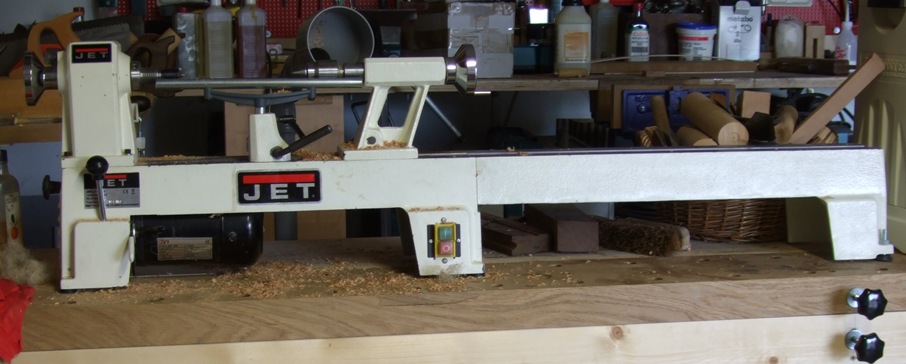
Hey, that's my Jet lathe...

Parisian, VL

>only your's appears to have a longer bed :>)

Nice work with the stand. I can only imagine trying to wrestle that beam through a jointer or planer (oh my aching back!).

Victor - In Hot and Humid Houston

Re: Jointer/Planer

#14

You talk about your drive bys...

Patrick Gibbons, Katy, TX

>Really nice work on the lathe stand. I was thinking about doing the same thing.

Re: Jointer/Planer

#15

Don't wanna hear you sighing and so...

Marc in Luxembourg

>Hey Victor,

I do not know what they told you, when you bought your lathe...

but hey, they come all this length! :-D


img