Re: Looking for some advice *LINK*
Dave Mount, NE Minnesota
>Morning Skip--
I don't have all the answers, that's for sure, but I can give you the perspective I've developed from the things I've done and mistakes I've made. I think a lot of one's opinions about these matters arise from the path one takes as well as some personal convictions that vary from person to person. As you know, using hollow ground edges at all has generated a lot of intense debate here over the years.
Before I get into my own experience, I'll mention Joel's article on grinder sharpening in the last FWW. Even if you don't follow his exact path, I thought there was a lot of good stuff to think about in that article.
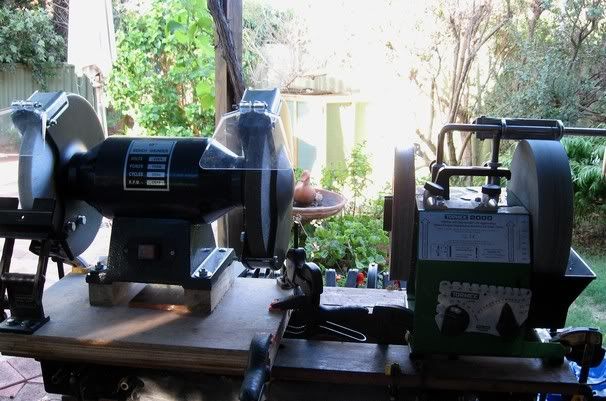
My "grinder path" started with a Tormek I received from the widow of a woodworker friend. I'm not sure I would have jumped to such an expensive approach otherwise, but it was a generous and appreciated gift in return for some other things I did for her. Point is that I backed into a dry grinder after I already had a wet grinder. At that time, I thought of a dry grinder as a shaping tool for rough steel, not really as a sharpening tool. I bought an 8" 3450 rpm grinder on the "more power more better" illusion, then equipped it with a 1" Norton white wheel, again with a "wider is better" mentality.
As time went on, I started using the dry grinder as a more refined sharpening tool. One good thing I did was to buy a Veritas grinder rest set up. If the grinder you buy doesn't have a pretty good tool rest as stock equipment (and most don't), I'd strongly suggest getting a good aftermarket rest. I like the Veritas a lot, but I don't have any experience with any other, so that's doesn't necessarily mean it's the best one to get. My memory is that Joel's article kind of downplays the significance of the tool rest, but I'm not sure I agree, at least for the period where you're learning to work with a dry grinder. I've had mine for a while and I still like it a lot. I think it's like learning to work with planes; if you have the chance to use one that's well tuned, it enables you to get more out of a poorer plane than you could if you just started with a poorly tuned plane and tried to improve it. I've also seen pictures of shop-built auxiliary tables people have built for their grinders and those seem like they would work well.
You're already thinking variable speed, so you're already heading off one problem I have, and that's the high speed of a 3450 rpm motor spinning an 8" wheel. It's easier to burn edges with it. However, there are other disadvantages to an 8" wheel -- they are more expensive and tend toward wider sizes. While I thought this was a good thing when I started, now I don't think it is. Most of the grinding I end up doing is at a narrow point on both the wheel and the workpiece. I don't really grind across a whole 1" width. You end up grinding straight not by registering the workpiece to the flat face of the wheel, but by orienting the workpiece to the overall plane of the wheel and then moving the piece across. Working this way, you get a straight edge even from a rounded wheel face. Working with a narrower, rounded face you also reduce the chances of grinding where you don't mean to by slightly cocking the workpiece and having it start cutting somewhere else on the edge. With a wide wheel, I think you end up cutting away most of that extra abrasive with your wheel dresser, not removing metal from your workpiece.
Another thing to think about is the size of the concavity you create with your grind. Since you're going this route, I'm assuming you're already past all the arguments about less supported edges. That being the case, the larger the concavity, the more honings you get before you have to re-establish the concavity. That comes with a smaller wheel. I did some calculations and, if I did them correctly, a 1/8" thick blade ground at 30 degrees on a 6" wheel has a concavity 0.0026" deep, while ground on an 8" wheel it is 0.0020" deep. While neither one is very much, there's more room for honing before your hollow is gone if you use a smaller wheel. The difference is much more on a thicker workpiece; for a 1/4" thick iron, the concavities are 0.0104" and 0.0078" for 6" and 8" wheels, respectively. As long as you don't feel the concavity compromises the strength of your edge (and I don't, I'm just acknowledging that others disagree), you get more honings from a smaller wheel.
I have a white Norton wheel, and it definitely runs cooler and cuts better than the stock grey wheels that come on most grinders. However, I've been reading a lot about the purple Norton 3X wheels and the talk is sufficiently positive that I intend to try one in the near future. What I haven't yet decided is whether to get a new 6" grinder before I do that. I put a link to one source for Norton 3X wheels below (no affiliation other than customer).
So, my advice, for what it's worth, is to get a 6" grinder and equip it with at least one Norton 3X wheel. If you want to spring for the money, get a slow speed or variable speed version, though I'm not sure I think that's necessary if you get a 6" -- this was the recommendation in Joel's article as well. Also, buy a good quality tool rest such as the Veritas (again, there may be others to suggest here, my experience is limited to one rest). This setup is not where I am, but it's where I wish I was. The 6" model is cheaper for the grinder, cheaper for the wheels, has lower surface speed, you can get narrower wheels and I think you end up using more abrasive on your tools and less wasted dressing the wheel.
Best,
Dave
Norton 3X wheels from TFWW