Home Articles Forums Gallery Marketplace Videos

WoodCentral Forums

Knowledge You Can Build On — Est. 1998

Have a question? Ask Woody!

A2 vs High Carbon Plane Blades

Posts

Re: A2 vs High Carbon Plane Blades

#26

Re: A2 vs High Carbon Plane Blades *LINK*

rarebear

>I dont think there is many here that have as much experience working 0-1, A-2 and D-2.. I have 35+ years milling, drilling, heat treating and grinding.. I do only have about 5 years honing plan irons I will add..

0-1 and A-2 are prett close to the same steel yeah they have different elements but thats mostly because one hardens with air and one with oil.. Also A-2 is a little better with coarser grain, that makes it harder to sharpen that 0-1

D-2 is a whole different animal when trying to mill or grind it, if you had two blade to grind and did not know which was which you could eaisly figuer out which was D-2 by trying to sharpen it..

Its a real bear to sharpen compaired to the other, like taking apples and oranges..

IMHO any after market blade is a improvment, make some wood chips and dont get carried away with whats the lastest and greatest new stel on the market...

I had asked Crucible what best for wood and they said CMP-10V I think it was so if you want the best get some of that... Link Below :)


CRUCIBLE CPM� 10V� (AISI A11)
Re: A2 vs High Carbon Plane Blades

#27

Which stones?

Warren in Lancaster, PA

>I am wondering what sharpening system this steel was designed around. Arkansas stones? Japanese water stones? Or are we supposed to invent a new sharpening regimen and purchase new materials just to accommodate one more unfriendly steel.

Re: A2 vs High Carbon Plane Blades

#28

Re: Which stones?

Derek Cohen (in Perth, Australia)

> Or are we supposed to invent a new sharpening regimen and purchase new materials just to accommodate one more unfriendly steel.

Hi Warren

That's the question I raised earlier.

In my limited experience with D2 and HSS, these respond best to diamond (stones and paste). Even A2, of which I am more familiar, do better on a waterstones such as Shapton rather than King.

Is there a general move away from O1 as manufacturers seek increased durability? If so, I suspect the days of using Arkansas are numbered (on modern blades, that is).

Regards from Perth

Derek

Re: A2 vs High Carbon Plane Blades

#29

Elaboration on Crucible Steel recommendation

Bill Tindall, E.TN

>The Crucible 10v has proven to be a good steel for lathe tools where wear resistance is the steel's most important factor to consider. However, for a chisel, toughness is most important. For this application Crucible recommended to us to use 3V and we have been very satisfied with the performance. For a plane iron we have found that a balance of toughness and wear resistance is important. I don't think it is settled which steel is best for a plane iron. I might have said M2 or 3V but now we have someone experimenting with D2 and ever M4. The issue will not ever be settled because the variability of heat treating will confound the performance and no one will do the number of experiments necessary to eliminate this variable in making comparisons.

Re: A2 vs High Carbon Plane Blades

#30

Re: Which stones?

Warren in Lancaster, PA

>I suspect that the great interest in using steels that were not designed for hand tools is among amateurs who think it would be helpful not to sharpen so often. Ironically many of these same people have had such limited practice already that they find it necessary to use electric grinders and honing jigs. It is like the guy who uses four different power saws, but must practice sawing for dovetailing because his hand sawing skills are lacking.

I think there will always be a market for steels that were designed to sharpen quickly and easily and produce a superior edge. Steels actually designed for woodworking hand tools.

Re: A2 vs High Carbon Plane Blades

#31

Re: Which stones?

Joel

>Things go in Fads.

As people have made sharpening more complicated a longer lasting iron makes some sense.

THe longer lasting iron is harder to sharpen so people go back to carbon steel.

The major problems with exotic alloys aside from the sharpening is that typically they cannot be sharpened at the low angles top performing chisel geometry requires and because of their toughness forging traditional tools is basically impossible and just grinding to a shape is a costly adventure. Therefore for most users traditional alloys have a place, and for most manufacturers, especially with rising steel prices, you want to have options for customers because otherwise you start alienating one segment or another of your customer base.

Re: A2 vs High Carbon Plane Blades

#32

Hi Joel

Derek Cohen (in Perth, Australia)

>Joel

Speaking of sharpening, I watched your sharping DVD a few days ago. Thanks for the prompt delivery (I ordered a couple of Jim KIngshott DVDs and could not resist getting yours at the same time).

I was nice seeing you there on the screen, finally to put a face to the written words. And to see your shop (store .... your "store" is our "shop", while your "shop" is our "workshop"!!!).

The DVD was interesting, in part because I am reassured that I hold and move a blade across the stone with the same technique you demonstrate. Or at least try to do so. What I found interesting here is that you do not go front-and-back, but move the blade diagnonally, even side-to-side. I wrote about this a little while back.

The one area I disagree with you is the addition of a microbevel to a chisel. Now I know that you are adding a true microbevel - it is .. err .. micro (not a secondary bevel), and it is probably to strengthen the edge (you do not actually say so) - however the reason I avoid doing this is that I am concerned that I would lose registration when I use a chisel bevel down. I wanted to run this past you as the DVD was playing ... :)

Regards from Perth

Derek

Re: A2 vs High Carbon Plane Blades

#33

Re: Hi Joel

Joel

>I suppose in theory that you could lose registration but I have certainly never noticed it. I also never consciously ride the bevel either. I pay attention when I use a chisel to where the tool is actually cutting so if I need to cut at the very bottom of a joint I would subconsciously raise the chisel to the edge bites at the very bottom. Sort of like driving a car I guess - you look in the distance not at the hood of the car when you drive.

Also unless you really have a perfectly flat bevel on the chisel chances are it might have some sort of belly or secondary bevel anyway so I wouldn't normally even think of getting used to riding the bevel - I would guess it's a guide that I don't need so I don't really know much about it.

Also even if you do ride the bevel on occasion I would think most of the time the trade-off in strength and performance is worth it.

I am very pleased that my DVD has made it down under and I am glad that you seem to think it's decent.

thanks,

joel

Re: A2 vs High Carbon Plane Blades

#34

Re: Hi Joel

Joel

>one more comment:

I was trained by Maurice to use a micro-bevel. Then for about 10-15 years I stopped using one and then about 10 years ago I started to use one again. I think it's worth the extra effort.

Re: A2 vs High Carbon Plane Blades

#35

Re: Where does Cast Steel or

ThomD

>"I suspected the cast steel was harder (from hardening) than blades made of solid steel, since they would be brittle."

I understand that cast steel isn't cast in the sense that it is steel poured into a chisel shaped mold, it is just the name given tool steel of the day. This probably has something to do with why it is so similar to O1, since O1 is a simple carbon steel with some alloys for stability. I forget where the "cast" part comes from, maybe the method of steel making of the day (at some point it all gets poured from something into something).

Re: A2 vs High Carbon Plane Blades

#36

Re: Pardon my skepticism...

ThomD

>"But somehow I'm still confused as to the laminated Japanese steel.

I've experienced that in Japanese chisels the quality stuff takes a very keen edge and keeps it for a very long time. AFAIK anyone outside Japan can access the same kind of steel the Japanese do"

Right you can buy the Hitachi steel online from Dick's last time I looked. So presumably any manufacturer could open an account with hitachi.

" I don't know if it's a question of cost, but the results are there. Quality Japanese chisels are harder yet don't chip, I can see that the steel has something to do with it, but I can't accept that the steel alone is the reason."

The edges can chip either as a result of what happened during making and the outermost parts being a little over-cooked, or through abuse. Like when some guy used a 300 dollar chisel to hack out my parent's oil tank. Thanks. But it sure is the best stuff available.

"Also, with a 1/8" thick hard steel piece forge-welded to a soft steel blank, I can't believe that the soft part can support a thin wedge 1/8" away. There has to be something more in play here..."

You are right, it doesn't whether there would be ay advantage (certainly not at the edge) to the fact the whole thing is stiff and therefor not pre-loaded much, I don't know. The toughness thing is just that if you took 1/4" worth of tool steel hardened it to above file hard then dropped it on a cement floor it could and probably would shatter into pieces. But run the forge welded material through the same process and it doesn't. It is thicker, but in agregate tougher. The edge would still chip. So the advantage is just that you can get a very hard edge and good tool toughness in use, but you stil have to be reasonable about the end, you can snap it off with prying etc...

"but I can't accept that the steel alone is the reason."

And further evidence is that many Japanese makers are using the Hitachi steel and yet the tools by different makers are pretty diverse.

Re: A2 vs High Carbon Plane Blades

#37

This entire thread has convinced me...

Stephen Shepherd in the State of Deseret

>laminated blades are the way to go. You can use much harder steel that is 'hardened' even more with quenching and protected by the softer substrate.

Makes perfect sense, no wonder that is how they use to do it. The argument was that steel was more expensive than wrought iron and that is true but it is not prohibitive.

They used laid steel on wrought iron because it was a better way of making blades. I have a very thin plow iron that was bent at some point and the steel on the back cracked across the blade. Had this been made of solid steel it would have broken off, instead I straightened the blade, sharpened it and it still has a long life ahead of it.

Stephen

Re: A2 vs High Carbon Plane Blades

#38

Re: Hi Joel - mea culpa

Joel

>Derek,

rereading my response I think I might has implied that I don't think one should ride a bevel. I didn't mean that.

I never do it. If I need to get that close I will go bevel up. If there have been occasions to ride the bevel I haven't noticed them but I can't think of any. Therefore YMMV for the work you are doing. It's possible I don't do it because my chisels won't work well in that application or I don't have that application. I don't know.

I think if one does ride a bevel a secondary bevel of any kind is not useful and it's a reason to maintain a single bevel just like they do in Japan (where they have been sharpening things for many a millennia).

Re: A2 vs High Carbon Plane Blades

#39

steels and chisel angles, properties discussion

Bill Tindall, E.TN

>"The major problems with exotic alloys aside from the sharpening is that typically they cannot be sharpened at the low angles top performing chisel geometry requires"........

I suspect this statement was directed toward LN's poor choice of A2 for their chisels. This choice was a puzzle to me too. What ever might be "typical" about tool and die steels is irrelevant if even one of these products delivers superior performance. Lets us set aside the pejorative labeling of anything other than carbon steels as "exotic alloys". I think in the trade this labeling would apply to jet turbine blades but not common tool and die steels sold in ton quantities at prices not far above carbon tool steels.

The main edge failure modes in chisels are chipping and bending, not wear as in a plane iron. To that end, the most important metal properties are toughness to resist chipping and hardness to prevent bending(crumbling). Such attributes are tabulated for common tool and die steels and the information is readily available from the steel manufacturers. Hence, for chisels it would be a simple matter to determine if there are common alloys that should be better than carbon steel for chisels sharpened at acute angles and pounded upon with mallets, pried and/or pushed.

For anyone not wedded to the details of how the metal is fastened to the wood it is a simple matter to fabricate chisels from any steel, with a handle that won't fall off when the humidity falls.

The bottom line is that carbon tool steel is an excellent chisel metal. There are other steels that practical chisels could be made from that might perform better.

Conservative woodworkers will have no interest in researching this possibility. Their choice should not discourage others from investigating possibilities that have a good chance of finding superior steel for woodworking tools.

Re: A2 vs High Carbon Plane Blades

#40

Re: Hi Joel - mea culpa

Derek Cohen (in Perth, Australia)

>Hi Joel

I was wondering about that. I use both sides of a chisel quite frequently. Mostly, of course, it is bevel up. However, when one needs to work in confined spaces, then it is handy to turn the chisel around.

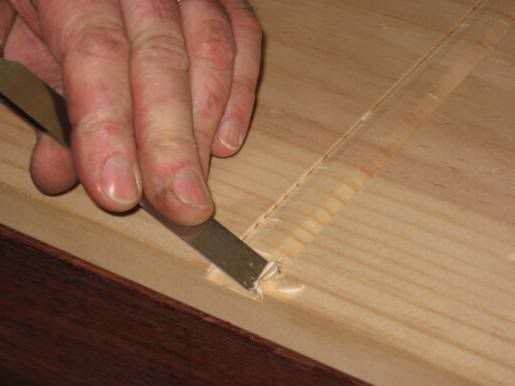
Here is an example I had on file - cutting the end of a dado prior to planing.


Having microbevel, as small as that may be, is no different from a micro backbevel.

Regards from Perth

Derek

Re: A2 vs High Carbon Plane Blades

#41

Re: Hi Joel - mea culpa

Joel

>Dang I never even thought of the sawn then chopped dado - which is how I do it. I use a wide chisel, microbevel and all and never noticed an issue. I waste away the material - much like your picture and then come in with a router plane to get consistent depth across all the dados in the project.

Re: A2 vs High Carbon Plane Blades

#42

Chris Scholz

Mostly a matter of skills

Chris Scholz

>...producing high-quality laminated steel in quantities is not quite as trivial as it might appear at first glance.