The Ruler Trick and stropping
Derek Cohen (in Perth, Australia)
>In the earlier thread on honing guides I stated that I did not like using the Ruler Trick as part of the honing process for "good" plane blades (i.e. those with flat backs) because I like to maintain the blade by freehand stropping in between formal honing. I stated that I found it difficult to freehand the black of the blade if it has a micro backbevel for fear of rounding the edge.
It occurred to me that stropping the back of the blade had its own dangers, and that a microbackbevel might just provide a controlled rounding.
Today I thought I would try something that I had not attempted before (insert sound here of hard smacking forehead).
I used one of my strops with green rouge (the strop is hard horse butt leather glued to hardwood) on my workbench, and used the Ruler Trick while stropping the back of the blade. That is, I laid down a thin steel 6" ruler as if I were doing this on a waterstone.
Here is the blade I was using. It is a Mathieson ex-woodie iron that I hollow ground at 25 degrees (done on a Tormek). You can just make out the microbevel on the front ...
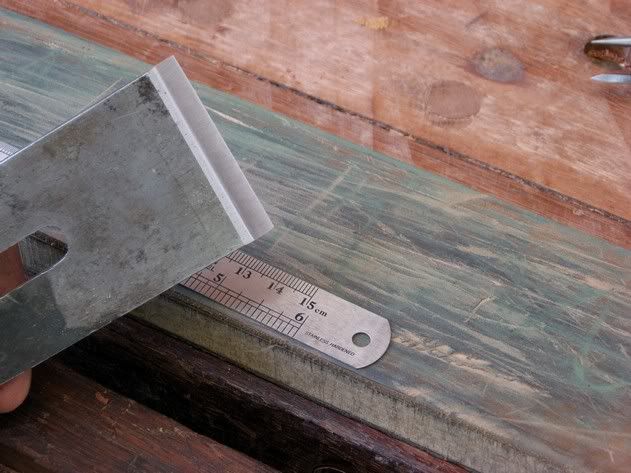
It comes from this chamfer plane I made. This uses the blade in BU configuration.
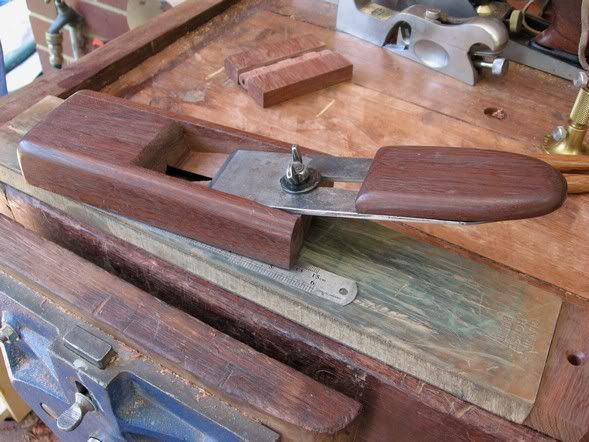
.. and here is the process (my finger is just for decoration) ...
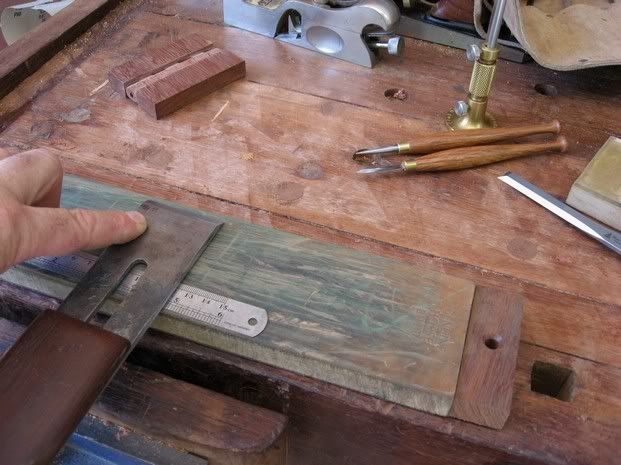
I stropped both the front and the back. The result was excellent. A rejuvinated edge that popped hair and was sharp enough to chamfer end grain cleanly. How much of this is due to the input of the RT is not currently possible to say.
I will do a few more and report back after some time.
Regards from Perth
Derek
Re: The Ruler Trick and stropping
#2Re: The Ruler Trick and stropping
Charles
>Oy vey.
Re: The Ruler Trick and stropping
#3Nice drive by Derek, beep, beep
Patrick Gibbons, Houston, TX
>
Re: The Ruler Trick and stropping
#4Re: The Ruler Trick and stropping
Charles
>Derek, why are you still using those hard wax-laden crayons that were meant to be softened when touched to a wheel?
Get some stropping paste first. Throw the ruler away next.
Re: The Ruler Trick and stropping
#5Re: Also of concern...
Marv
>is the distance from the cutting edge to where the ruler is placed. The angle should be minimal, perhaps using something thinner than a rule so the iron is barely tipped upward ever so slightly.
Marv
Re: The Ruler Trick and stropping
#6Re: The Ruler Trick and stropping
wilbur
>Hi Derek,
I thought that the reason stropping on a piece of leather could lead to rounding over more so than a waterstone was because it was harder to maintain a consistent angle on leather than a waterstone, possibly due to the relative softness of the leather, or due to the relative uneveness of the surface of the leather compared to a waterstone.
Also, my understanding of the ruler trick is that the reason that it works is that it allows you to get a very flat, albeit thin area right at the cutting edge with little effort. So it may not matter what sharpening surface you use to do the ruler trick: waterstone, leather strop, diamond stone, oil stone, sandpaper, they all will allow you to hone that microbevel.
Re: The Ruler Trick and stropping
#7Charles and Marv ...
Derek Cohen (in Perth, Australia)
>Hi Charles
Long time ... yeah, I know how you feel about the crayon. But I use it sparingly, and it is not creating an "unflat" surface. I do want to experiment with other forms, though, and will let you know how these compare.
Hi Marv
The pictures were not intended to demonstrate technique. I understand what you mean - trying to lower the bevel angle - but even at this distance it is very low. Perhaps 1 degree rather than .75 degrees. More importantly the angle is kept constant.
Incidentally, with technique in mind, I work the blade sideways, not in a front-and-back manner (ala Side Sharpening). I suppose that this ends up creating the same bevel angle as a wider waterstone.
Regards from Perth
Derek
Re: The Ruler Trick and stropping
#8Re: The Ruler Trick and stropping
Denis Ch�nard, Orl�ans, Ont.
>The way I do the ruler trick is back and forth, not side to side, so in theory that microbevel is somewhat rounded (although I use very short strokes, like 1/4").
Haven't tried it myself, but it is said that the green rouge works very well on a piece of hard maple. No flex or flatness issue to deal with in that case, compared to leather.
DC
Re: The Ruler Trick and stropping
#9Re: The Ruler Trick and stropping
Derek Cohen (in Perth, Australia)
>Hi Denis
Stropping on a hard horse butt leather, especially one glued to flat hardwood, must be experienced. It has very, very little "give".
Working a blade side-to-side is also likely to minimise rounding over. The fore-and-aft motion is sawing the edge back and forth and this is more likely to create a micro round shape.
I have used hardwood and MDF with green rouge. I prefer the feel of MDF.
Regards from Perth
Derek
Re: The Ruler Trick and stropping
#10Re: The Ruler Trick and stropping
Denis Ch�nard, Orl�ans, Ont.
>According to my father, who had to deal with these animals, horse hooves are much harder than their butts, and have basically no give, especially with shoes :-D
Sorry, couldn't resist...
DC
Re: The Ruler Trick and stropping
#11Another thing my father likes to say...
Denis Ch�nard, Orl�ans, Ont.
>"Horses are animals that are uncomfortable in the middle, and dangerous at both ends" :-)
DC
Re: The Ruler Trick and stropping
#12Patrick, what drive by ? I am dying to know!
Derek Cohen (in Perth, Australia)
>
Re: The Ruler Trick and stropping
#13Re: Another thing my father likes to say...
David Charlesworth
>Derek,
The short stroke across the stone or strop (1/4" or so) does create a miniscule curve, but this is entirely negligible as the shape is exactly repeated each time. I experience no problem with this technique whatsoever.
A half mm ruler on the edge of an 8,000grit waterstone creates a nominal angle of 2/3rds of one degree.
A clever mathematician could calculate the change of angle over the 1/4" stroke, but it is very very small and above all else totally repeatable.
A To & Fro stroke is good for maintaining flatness across blade width. Lengthways strokes in my experience can often lead to rounding in the direction of the stroke.
Now that I come to think of it, the ruler trick is a form of controlled stropping on a stone surface rather than on leather.
Dressed maple sound a good alternative to me, and years ago someone used to polish blades with metal polish on glass, if I remember correctly.
Now those nice cast iron lapping surfaces with 1/2 micron diamond paste would do a fantastic job. I regret not applying for some of those cast iron laps discussed some time ago......
best wishes,
David
Re: The Ruler Trick and stropping
#14"...it comes from this chamfer plane I made
Patrick Gibbons, Houston, TX
>
Re: The Ruler Trick and stropping
#15Re: Another thing my father likes to say...
Derek Cohen (in Perth, Australia)
>Hi David
You wrote ...
A clever mathematician could calculate the change of angle over the 1/4" stroke, but it is very very small and above all else totally repeatable.
I agree - the amount of angle here is so small as to be insignificant, and in this regard it plays no part in changing cutting angles.
A To & Fro stroke is good for maintaining flatness across blade width. Lengthways strokes in my experience can often lead to rounding in the direction of the stroke.
Front-and-back verses side-to-side is an interesting comparison of blade wear. F&B will round the edge front, and S-S will round the ends. If one is careless of course. Personally I would rather have the latter as this will fractionally hone a camber. Have you any experience of cambers? :)
Dressed maple sound a good alternative to me, and years ago someone used to polish blades with metal polish on glass, if I remember correctly.
I frequently use diamond paste on dressed Jarrah offcuts. 40/10/1/0.5 microns. It is fantastic. BUT do not try to use a honing guide on oil-based diamong paste this way ... the wheel of the guide will not turn on the slick surface and it will hone a flat. DAMHIK! So I only freehand on diamond paste. I would like to try some .25 diamond paste on a leather strop.
Regards from Perth
Derek
Re: The Ruler Trick and stropping
#16Thanks, but ...
Derek Cohen (in Perth, Australia)
>... that is Old Hat. I made it about 5 years ago. :) It is familiar to most here. You are not paying attention!
Kind regards
Derek
Re: The Ruler Trick and stropping
#17Re: Another thing my father likes to say...
Denis Ch�nard, Orl�ans, Ont.
>I would like to try some .25 diamond paste on a leather strop
Doubt it will work. According to Bill Tindall, the particles embed themselves in the substrate and don't do their work. Cast iron is the material of choice here, hard enough that the diamond particles don't "sink in" the substrate, yet soft enough that it holds the diamond in place.
That's my recollection of the principle.
DC-C
Re: The Ruler Trick and stropping
#18Re: Another thing my father likes to say...
David Charlesworth
>Derek,
Thank you. Not sure I have ever heard of this new fangled camber thingy........;-)#
Seem to remember that Hampton did not like it.......
I tend to sharpen with pull strokes so not clear if there is a debris issue?
Will be most interested to hear what you make of Sharp-Skate.
best wishes,
David
Re: The Ruler Trick and stropping
#19AARGH no edit function
David Charlesworth
>Sorry, don't know where that debris stuff came from...
please ignore.
David
Re: The Ruler Trick and stropping
#20Get some stropping paste first?
Scott Burr in Ben Lomond CA
>Hi Charles, Care to elaborate? Perhaps a source?
Re: The Ruler Trick and stropping
#21Re: Get some stropping paste first?
Charles
>Get a high quality barber strop and charge it with Dovo strop paste. A search will reveal several sources.
You can lay a big barber strop right on your bench and hang it when not in use. You don't need to glue it down to a piece of wood.
The compound sticks most people use are made for charging a buffing wheel. They have a high proprotion of wax which softens when applied to the running wheel. Used on a plain strop, it leaves ridges and a terribly waxy residue that totally obscures the leather, ruining the leather's efficacy. I never fail to get a chuckle when fine quality leathers are advertised for use as a strop and then somebody proceeds to completely coat it with waxy compound meant for power buffing.
DO NOT USE STROPPING COMPOUNDS FORMULATED FOR POWER BUFFING EQUIPMENT.
STROPPING PASTES ARE INTENDED FOR HAND-POWERED STROPPING!
Stropping is a partnership between the leather and the compound. A paste works into the leather instead of sitting atop it like the waxy, block/stick compounds do.
Trust me.
Re: The Ruler Trick and stropping
#22Thanks for the excellant explanation.
VLParisian
>
Re: The Ruler Trick and stropping
#23Thanks! Food for thought.
Scott Burr in Ben Lomond CA
>I've always used a hair dryer to melt the green stuff on leather or masonite. Makes for a nice smooth surface.
Re: The Ruler Trick and stropping
#24What about dubbing?
Derek Cohen (in Perth, Australia)
>Hi Charles
Thanks for the info on the stroping paste. I will search it out in Perth and give it a go.
I wonder if any here have experimented with polishes for stropping, such as Autosol. I have used it on powered cloth wheels, but not on leather or wood. David Charlesworth appears to like it.
Charles, the one concern I have is that you do not ensure a flat strop (by gluing it to a flat surface, as I do). When I have tried this - with any/every strop I have ever used, including the stiff and hard horse butt strop from Joel - the leather curls. I believe that the danger of dubbing an edge is magnified several fold.
I use two strops - Joel's horse butt with green rouge (used lightly), and a longer, equally hard barber's strop I got off eBay. The latter is used plain. When not in use they hang alongside my bench.

Regards from Perth
Derek
Re: The Ruler Trick and stropping
#25Re: What about dubbing?
paul womack
>I wonder if any here have experimented with polishes for stropping, such as Autosol. I have used it on powered cloth wheels, but not on leather or wood. David Charlesworth appears to like it.
The reason (us brits) use Solvol Autosol is that it's pretty fierce, as polishes go.
That's because it's chrome polish; since chrome is so damn hard, the polishes for it can be aggresive (and thus effective on the crud you're trying to remove) without damaging the chrome.
Such a polish would quickly cause damage if used on softer metals e.g. brass. One may note that a hardware store has separate polishes for chrome, brass, silver.
BugBear


