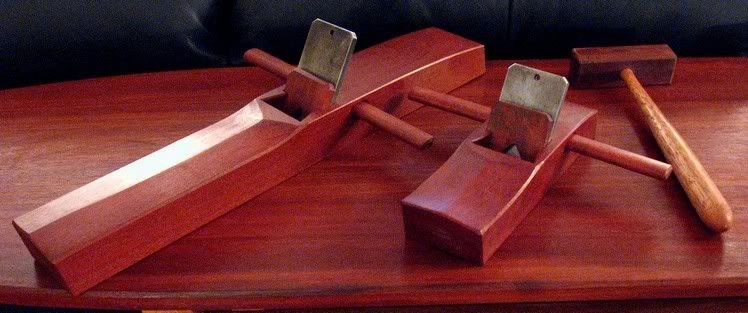
I am about to embark on building a couple of my own hand planes. A lot of my existing planes have nice thick irons with no chip breakers, while plenty of them, mostly older ones, have chip breakers/cap irons (whatever they're properly called).
When deciding how to build these planes, as well as what irons to purchase, I'm trying to decide which type to use, and really don't have a preference, other than to think simple is better. Both types seem to perform equally well as far as I can tell.
I will be building a jack and a coffin smoother to begin with.
Any input and advice on the type of iron will be greatly appreciated, as well as some potential sources (other than robbing my existing planes). Thanks!
There seems to be in theory a rationale for using a chipbreaker (read that somewhere), but it has to be precisely made and adjusted to have an effect. In practice I believe that CBs were commonly used to stiffen thin blades more than anything else.
If that's worth anything to you, Karl Holtey doesn't believe in them. And as you've seen from your experience, one is hard-pressed to see a difference.
If your iron is thick enough and well bedded, I don't think you need to bother with a CB.
>Karl Holtey, Konrad Sauer, and I all have bevel-down high-angle smoothers with no chipbreaker. We all use thick irons. I do feel that no chipbreaker is required when using a thick iron. None were ever used in miter planes, or in plow planes, or moulding planes, etc..... -wayne
Ps...I also think adjusters are extremely overrated, and are unnecessary as well. But that's another topic....
Clark & Williams are of the opinion, especially with respect to smooth planes, that the combination of single, thick blade + tight mouth + 55 degree bedding angle + SHARP is the best approach to avoiding tearout and getting a nice surface in our typical furniture-making woods. I can testify that their system works, and works well. As a footnote, in using both 50 degree and 55 degree smooth planes from C&W, there is a perceptible difference favoring the 55 degree, in the more challenging boards.
Another up and coming maker of wooden planes, Phil Edwards of the UK, is also using the single blade/high angle/tight mouth approach successfully.
There has been some testing performed in regard to the effectiveness of cap irons in breaking the chip. Steve Elliott is of the opinion-- and he quotes testing by a Japanese professor as well as his own results--that the cap iron can be effective in breaking the chip, but only if it is located very close to the cutting edge, like 4 to 8 thousandths of an inch. Here is a link to Steve's thoughts:
Perhaps Steve will come by and discuss this further and bring us up to date on his work. His published thinking is that the chipbreaker, even when set very close, would be more useful in planing soft woods rather than hardwoods, and in planes bedded at lower angles.
The idea that the cap iron must be set within a few thousandths of the edge to be effective also jibes with the opinion of the Japanese plane gurus, one of whom has stated that "...the subblade has to be set so close that if it were any closer, it would be doing the cutting..."
So there is a body of opinion that (a) a cap iron is not needed to prevent tearout when taking thin shavings through a tight mouth, using a high angle plane; (b) a cap iron may break the shaving, provided it is set within a few thousandths of an inch from the cutting edge.
Note that there is a bit of a conflict in having both a tight mouth (say, 3-4 thousandths) and a cap iron located within a few thousandths of the edge. Everything would have to be perfect for the shaving not to clog the mouth. Plus, the closeness of the cap iron in this situation complicates putting any camber on the blade.
Now the foregoing discussion relates mostly to taking thin shavings. It has also been argued that the cap iron, in a bevel down plane, stabilizes the edge against deflection when taking a thicker shaving. Jack planes and fore planes come to mind. My experience using C&W jack and fore planes, bedded at 50 degrees with single blades and plenty of mouth clearance, is that you still do not get noticeable tearout. I would speculate that the reason for this is that the camber on the thick-shaving planes is also effective against tearout by making more of a shearing-type cut than a straight-bladed plane.
Conclusion: You'd be in very good company if you made your coffin smoother at a higher angle, with a tight mouth, and with a single blade. Also if you used a single blade on the jack plane, 50-degree bedding, and with camber of, say 6" to 8" radius.
>The double iron is a sophisticated 18th century device. Unless you find it helpful, I would go with the simpler single iron design and concentrate on the other aspects like fitting the iron to the bed, fitting the wedge, making the mouth , etc.
>Mike ... having built many, many (100 +) wooden planes and have come to the following conclusion(s):
When I first started building these planes, and didn't know of a source for custom made irons, I used irons from old Stanley bench planes. These irons are pretty thin and seemed to benefit from the addition of the cap iron (set pretty close to the aris). I think the cap iron added stiffness and, of lower importance, helped break the chip in softer material. The downside(s) being the need to precisely fit the cap to the cutting iron to avoid having the shaving jam between the two; and, the Stanley type breaker has a tendency to jam the throat of the plane. When I started making my own caps out of .250 steel the throat jamming problem pretty much when away.
With a bedding angle of 45 degrees or less (bevel down) the cap seems to be of some (slight) help in breaking the chip in softer material. I happen to like a bedding angle of 47-48 degrees for the material I use most often (cherry) and I have found no objective advantage in using a cap iron in this configuration.
Good luck with your planes. I think you'll find, as most plane building junkies have, that it's fun to experiment with different configurations. I know, from personal experience, that trying different set-ups has helped me understand the dynamics of how a plane works.
>Thanks tons for the great info and guidance everyone. One more thing please, no one pointed me to any sources for irons. Is it a closely held secret or something? Thanks in advance.
>Hock makes a variety... everything from their krenov irons (which come with a cap iron, if you choose to go that route) to big beefy parallel irons that are made for infill planes, and I've only seen them at thebestthings.com
I have a soft spot for the low-angle irons from L-N, because they're good steel, and not too expensive. The irons for the low-angle jointer are 1/4" thick and not too long.
I haven't tried one of the galoot irons yet, but I'm going to pretty soon, I think. :)
But, at the end of the day, you can use pretty much anything. Jim Krenov used thin irons from block planes, with great success. Keep things sharp, well bedded, and properly wedged, and you can get away with almost anything. With that in mind, the old sweetheart irons from Stanley were actually made of laminated steel, so they're worth looking for, and they're not too hard to find.
>The actual mechanics of shaving formation with different blade/chipbreaker/mouth configurations is what interests me most right now regarding planes. Unfortunately my new job is taking all my attention so I don't have any recent test results, just plans.
My belief is that chipbreakers are of use mostly when planing softwoods using a blade bedded at about 45 degrees or less. Japanese planes are bedded at these lower angles and are used mostly for softwoods.
The recommendation Wiley made of a blade bedded at 50 degrees or more used in conjunction with a tight mouth is excellent for almost all domestic and exotic hardwoods and many softwoods. Some softwood species, though, take on a cloudy appearance when planed with a high-angle blade. This happens when the force of the blade deforms the wood below the cut line, spoiling the "deep" look of the surface. I've seen this mostly in Douglas fir, which looked very cloudy when planed with a sharp blade that produced an excellent surface in Port Orford cedar.
Now back to chipbreakers and why they may sometimes be helpful. Using a blade bedded at a lower angle can result in tearout, and a chipbreaker set VERY close to the edge can help eliminate the tearout. I haven't had a chance to test different combinations of chipbreaker setting, bed angle and mouth size, but I have been able to plane without clogging using a chipbreaker set at .005" with a mouth of .008".
If I were making my first plane I'd skip the chipbreaker and use a thick blade bedded between 50 and 55 degrees, depending on the sort of wood I planned to be planing.
Also, I'd like to second Wayne's opinion that adjusters are overrated. I wonder if Stanley would have used a chipbreaker at all if the adjuster didn't need it to link to.
>I didn't mean to suggest that Japanese planes aren't used on hardwoods, but most of the work I've seen in the Japanese tradition has been in softwoods. I own a Japanese plane bedded at 47 degrees and am sure that in capable hands it would do excellent work on hardwoods.
One of the things I like about traditional Japanese woodworking is the elegance and sophistication of work done in softwoods.
>I also have to chime in on the japanese plane thing because the one I learned to use is of the "ichi-mai" variety... no chip breaker. So even among japanese planes, the chip breaker isn't always used.
Incidentally, I've taken very fine shavings off of both hard and softwood, including some very curly maple, without using a chip breaker.
>The reason for the cap iron/chip breaker probably isn't to strengthen the blades, old laminated blades are very thick. It may reduce chatter, but on wooden planes it had a purpose.
As long as the mouth opening is tight a chip breaker is not required, however when the sole wears and the mouth gets wider the chip breaker becomes more useful.
I am not sure about the hardwood v softwood reason for the cap iron. I work mainly in softwoods but on occassion use hardwoods and do not notice the difference between cap verses no cap. The blades need to be sharper for softwoods, else the grain crimbles under a dull tool.
I have one bench plane a small coffin smoother that is a single iron all the others are doubles. I sharpen them both make sure the cap is real close to the end of the blade. Why do I use cap irons, because all of my old planes have them, it is simple as that.
>A double iron is not necessary if all you are doing is taking fine shavings. But if you are surfacing a panel by hand you don't want to spend all day taking very thin shavings. Try taking a shaving of .005 or more. If your mouth opening is only .005 you are in for some trouble (talk about jam ups). It is the versatility available with a double iron plane that caused craftsmaen to switch to double irons in the 18th century.
>Just as modern woodworkers turned to the used tool market when Stanley gutted and cheapened its offerings about 1960, I believe the 18th and early 19th Century woodworkers turned to and used up the supply of earlier single iron bench planes. Why do you suppose so few early bench planes survive when thousands of molding planes of the same era survived? Ever wonder why of the two smooth planes in the Seaton chest the supposedly cheap and inferior single plane is the one missing?
Look at Steve's information on the actual performance of cap irons. How practical is it to critically maintain and adjust two pieces of steel when only one is necessary? At best a cap iron on a 45� for 47 1/2� can only marginally emulate the performance of a single iron plane bedded appropriately for the wood being used. What did woodworkers get in this change? More work, more difficulty, more effort but no real benefit. When double iron planes came in traditional choices in pitches went out.
Look at what plane makers and hardware dealers got. They no longer had to make, ship and stock bench planes in a variety of pitches. This is a significant advantage to the makers and dealers.
I think the idea that double irons are an improvement may well be the most successful marketing fabrication and gimmick of all time. That nonsense still shows up in almost every woodworking book published today.
Some around here may find the following post on a forum for plane makers interesting:
>Larry, I think you have to tread carefully when criticizing 18th century craftsmen, both makers and users. I don't think you are being careful. There is evidence that cabinetmakers made double iron planes for their own use. Were they trying to make an inferior tool? Were they looking for "more work, more difficulty more effort but no real benefit"? The fact that one did not need planes in a "variety of pitches" benefitted the craftsman, not the planemaker.
I doubt that an elderly gentleman from Scotland remembers anything at all from 18th century America.
>"...Look at what plane makers and hardware dealers got. They no longer had to make, ship and stock bench planes in a variety of pitches. This is a significant advantage to the makers and dealers..."
Uhmm now where is the advantage again to the old plane makers to make less plane models to sell then there is to make more different models to sell, eh?
...Seems that if you made more different types of planes [think Stanley] that people could buy for different jobs or woods you would do better then if you just made one type that did it all and that the consumer would not have to buy others after getting it....That is if the market wanted these different types.
...Well if you think it was easier and cheaper for plane makers to make these double irons I sugest you forge a blade out, cut the slot into it for the cap iron, forge the cap iron out , make the cap screw, thread it and cut the threads in the cap iron and report back to us as how much easier this all is then to make just a single iron.
...Cap iron blades were made and sold because tradtionaly wood workers thought they were better and wanted them....and were willing to pay more for them.
Woodworkers had the choice of single iron planes long after double irons became available and judging by the large number I don't see not to many wood workers wanted them even though again they were a good bit cheaper.......Todd
> I wonder if Stanley would have used a chipbreaker at all if the adjuster didn't need it to link to.
In the Bailey design the chip-breaker also transfers downwards pressure from the lever cap so that the iron is forced down onto the bedding very close to the cutting edge. In truth, if an iron is beeded well near edge, the rest of the bedding doesn't matter (*)
This may well be important with the thin blade used in a Bailey.
So I suspect the Bailey design is rather well integrated.