>Has anyone used Shapton's new GlassStone sharpening system? If so, your thoughts on them vs. the Shapton professional stones and other water stones. Thanks, Mike
>Last week Harrelson Stanley was at our local Woodcraft and I got to use the Shapton glass stones and the diamond-on-glass flattening plate. They worked very well and I was able to take a Hock high carbon blade from almost new condition to very sharp during the class, including flattening the blade back.
I've used Shapton professional stones for a number of years and like some of them very well, others not so well. For some reason the light green (2000 grit?) stone cuts way better than any of the others. I don't like the 8000x but do like the 15,000.
The glass stones seemed more uniform in how they performed, and all cut well. The final edge was excellent.
When I replace my light green stone I'll buy another one from the professional series rather than the new glass stone. I like having two sides to the stone that I can use so that when I'm almost done with that grit I can turn the stone over and use a freshly flattened surface. Even though Shapton says not to use the side with labeling on it, that side works just like the other one.
The diamond-on-glass flattening plate is VERY flat and one of the most important parts of the glass stone system is keeping each of the stones equally flat. After the coarsest stone very little work needs to be done on the finer stones. The flattening plate is so expensive I can't even consider getting one.
Overall, the only real difference for me between the professional and glass stones is the ability to use both surfaces on the professionals.
Thanks for the great info. Is there any other practical way to flatten the glass stones other than with Shapton�s flattening plate? I have a large diamond stone. Would that work or is it not flat enough?
Some people report blades �sticking� while using the professional stones. Have you experienced this with either type of stones?
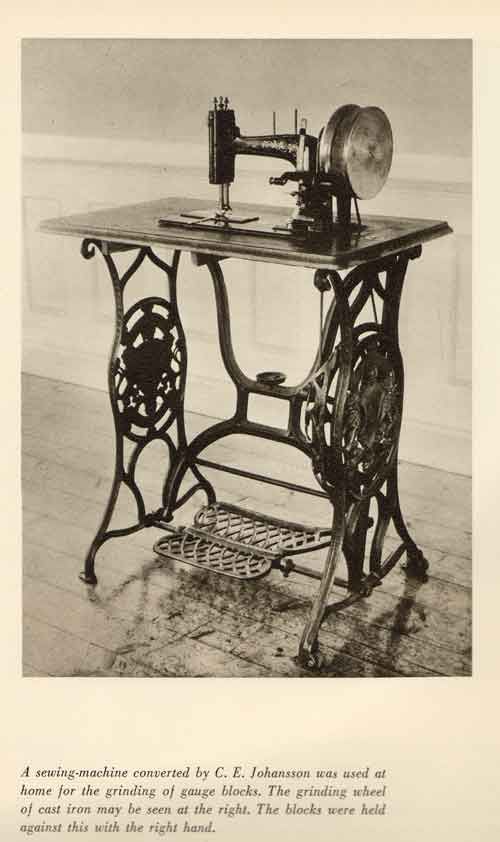
>If there were a patron saint of flattening hardened steel in the home shop, he would be CE Johannson...machinists will know him as the man behind "Jo Blocks". I find it reassuring that he was able to do this long before the current fashions in abrasion.
Here's a photo of his first lapping machine and a link to a few more photos and talk about him and flatness.
>I think the Shapton Glass Stones are a way for them to offer a less expensive product. It appears that they have about half the sharpening grit of their professional stones. Since they are harder in the finer grits (1000 and up), I don't think they will wear out so quickly. I have three professional series stones: a 320, an 1000, and an 8000. The 1000 is a wonderful stone, it cuts quickly. The 320 is worthless to me, it is too soft and is dished almost instantly upon use. The 8000 is ok but my King S-3 (6000?) works just as well. $289 is ludicrous in my opinion for something to flatten your stones. Do you really need something of "optical flatness" to maintain your stones? I have a coarse DMT diamond stone that I paid $25 that works great on the Shaptons.
One more thought. If the glass on the sharpening stones is tempered, the stone may survive a fall to a concrete floor better than a professional stone. I dropped my 8000 and it cracked in half! Luckily, polyurethane glue made it as good as new.
>Using diamond stones to flatten other stones is an obvious trick. I've been trying it for over 25 years. Always seems to result in the destruction of the diamond stone, though I know some people here say they haven't had that experience. If the tempered glass was strong enough to resist erosion from the particles used to cut the steel in the glass stones, that would be a worthwhile thing.
>I have been using my DMT diamond stone for close to three years on my Shapton's and haven't noticed any degradation. I only use it for my stones. I use plenty of water to flush the swarf. In my experience what hurts diamond stones is using them on steel. They seem to cut very fast at first and it is tempting to use them for flattening backs but they go down hill quickly.
>Interesting. I suppose it depends whether the DMTs are surviving simply because of light use or type of use. It does say something about DMTs if you are correct that they go downhill quickly when used on steel!
There are these products out there that look and sound good, and have regularly let me down, and because they are always being lauded or claim improvements I go back to the well and buy a new example, only to be burned yet again. It's hard to take that over and over, but then maybe they are better...
>I've been flattening all my waterstones using W/D sandpaper on an inexpensive granite plate for about 5 years and it works fine. With good technique I can keep both stones and blades way flatter than they really need to be.
One advantage of the Shapton flattening plate is that the stone can be left in place and the flattening plate used for a few strokes when needed. It's both quicker that way and makes less of a mess. I haven't tried using diamond stones mostly because I haven't been satisfied with their flatness in the first place.
I've had problems with "stiction" on the Shaptons as well as other brands of fine stones. The Shapton 8000x was the worst one, and I finally scraped some grooves in the surface. That helped some, but I've stopped using that stone. The honing technique Harrelson taught avoids stiction problems because you're just flattening a small part of the back, about 1/2" along the edge. When I got up to the 30,000 grit stone I had some trouble keeping the bevel moving smoothly. It's not a stone I'd buy anyway, considering the price. For me 15,000 is already overkill.
My observation is the same as Paul's--my fixed diamond stones lost cutting strength against steel pretty quickly. Mine are Norton monocrystalline. They ultimately got bald. This leads me to think that the problem may be that--in my hands at least--the steel was ploughing the diamond right out of the matrix (as opposed to friability of the diamond). Someone with a lighter touch or who used a cutting oil might not have the same problem. There has been a happy ending, though, which is that the bald Nortons (which still had their flatness spec) turned out to be excellent substrates for diamond paste. Don't throw out your played-out diamond stones.
I was interested to note that even modern engineers are repeating the notion of atomic level forces to explain "wringing"
I have a Lindsay reprint (reference tomorrow) where a pre 1900 (IIRC) experiment is reported.
When the blocks are sufficiently (and rather carefully) cleaned, the wringing effect disappears.
Subsequent work proved that "wringing" is due to capilliary attraction of minute amounts of liquid (e.g. skin oil, water). Because the blocks are so very flat, a tiny amount of liquid spreads to completely fill the (small...) gap, in a very thin layer, which results in the great force that is so notable.
They even measured the force for different liquids.
>"Are diamonds friable at all? What can break down a diamond?"
A diamond, though very hard, can be fractured if hit at the right angle. Given the number of angles of impact a diamond in a sharpening stone must encounter, this probably happens to some degree, although certainly not as much as in a regular waterstone.
Remember the car commercial from the 70's where they put a jeweler who cut a diamond in the back of a Mercury Grand Marquis? He did it with a chisel.
Even better was the Saturday Night Live parody of that commercial where a rabbi did a circumcision in the back of a "Royal Deluxe II".
>Sure, I know that diamonds can be broken/cut with mechanical shock, but that's hardly what I'd call friable for sharpening purposes. It's interesting, I didn't even think of this aspect of diamonds until Wiley mentioned it. Then a whole lot of diamond sharpening behavior clicked into place.
>To Shapton's credit, stiction doesn't really occur with Japanese blades due to the hollows; but on western blades, it doesn't take much at all to grind to an absolute halt. In that case, the only thing that seems to work is putting grooves in the stones.
Diamond friability is one of those things where I tend to believe the last convincing person I heard talk about it. What I understand is that monocrystalline will not break down, while polycrystalline will tend to fracture--that is the word from the monocrystalline folks, so maybe a pinch of salt would be good.
I managed to get one or two of my Norton monocrystalline stones plainly bald, and intuitively attribute that to my ploughing out the diamonds with very hard steel.
>I'm here only to share my experience with "diamond" stones (DMT). What was left of their original sharpening capacity after very limited use in ordinary shop-related sharpening tasks, was nullified by using them to flatten Norton waterstones. That was an expensive lesson in consumerism...I believed what I was told by people who have something to sell to me. Other than a few diamond slips that I use for small jobs, I have bought my last diamond stones. I find it curious that so many respected sources recommend using diamond stones for flattening. Norton water stones flattened with SC paper on granite works as advertised.
>I think a lot of people, with good intention, don't always speak from personal experience, and there is a tendency to provide advice on very limited experience. So whenever someone recommends a technique, especially if they stand to profit from convincing me, I try to remember to ask them whether they've actually done it. Personally, I only speak from experience. No experience, I close my mouth or pass on something someone told me with the explicit caveat that I haven't done it.
>My experience with diamonds involved using them for sawing and machining a very high silica contant sandstone. The diamonds are of course harder and cut readily. However the trick was to find the exact hardness for the matrix material that held the diamonds. It has to wear away to expose more diamond as the diamonds are worn. If it wears too fast diamonds go down the drain with the swarf, too slow and the motors start to load up because there is reduced cutting action. It seems that the matrix that was ideal for steel would NOT be the same as the matrix for a very abrasive stone like a sharpening stone.
The matrices for the stone we were cutting were custom formulated for our application.
>Phillip, I suspect that you are correct about the matrix in which these small diamond crystals are implanted. In the case of DMT I believe that they state that the matrix is nickel. A water stone presumabley would trump nickel in an abrasive encounter. The diamonds from my stones, as you say, are probably now residing elsewhere.
>I wore out(pulled the diamond from)more than one of the more expensive brands of coarse diamond stone while flattening backs and gave up on them.
I then went back to using diamond for flattening my waterstones and oilstones and what I found was for flattening waterstones the drywall screen on granite offcut is all I need.
For oilstone flattening the cheap(less than $25)coarse diamond stones from the borg work just as well and last as long as the high dollar items.
My finishing grade waterstones are staying flat now that I`m using diamond paste on cast iron for final hone.Maybe my son will be able to find a use for them.
Mainely,Bob
PS-The oilstones are for sharpening and touchups in the field.Besides,I`m still a fool for a stone priced at a dollar or less.
>I looked at a worn stone under a microscope and the diamonds were there, they just didn't stick up as far. I would presume that if the diamond stone was grinding away at something that would also grind away the metal the diamond is embedded in then it might last longer. I have considered dipping my diamond stone in nitric acid from time to time to eat away the metal binder, but haven't tried it. Instead I just added some diamond powder as Wiley described.