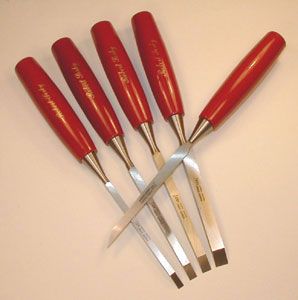
Wood Chisel Survey for Beginners
Bob Smalser, Seabeck, WA
> Okay, here I go yet again -- but I just have to ask: Butt chisel vs. bevel edge chisel -- how are they defined and what's the difference? Mortise chisel vs. sash (?) chisel -- again, how are they defined and what's the difference?
That�s OK�some of it still confuses me these days as there is some overlap between types. This is just my take on it as terminology by trade, country and era varies a bit:
Bevel edge doesn't mean much per se, as even some firmer and framing chisels have them....it merely allows getting into a tighter corner. Neither does socket or tang handles, although the larger chisels are generally socket chisels, as are many high-grade chisels, as sockets are considered a better design as handles are easier to replace, but cost significantly more to manufacture. To call a chisel a �socket� chisel with no other descriptor is a common mistake today, often by people who should know better.

Butt Chisel: Any short chisel, usually with bevel edge and design suitable for paring and striking with 30-degree bevels. A finish carpenter or shipwright�s pocket chisel easy to store with a major role in hanging doors and all around trimming. Usually tang handles.

Bench Chisel: Longer chisel for workbench use. Paring and light chopping, usually with 30-degree bevels and beveled edges.
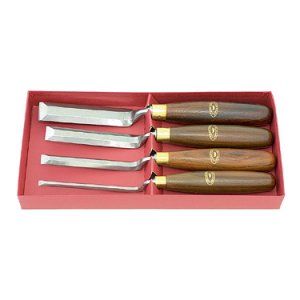

Paring Chisel: Long, thinner chisels not designed for any striking, only paring with 20-25 degree bevels. Some have "cranked" handles for clearance and were primarily used by pattern makers making negative patterns in soft pine. Others are skew cut to reach into corners, and a �dovetail� chisel is diamond-shaped to clean female sliding dovetail sockets. Usually with tang handles.

Firmer Chisel: Usually the same length as bench chisels but of thicker, heavier steel, usually straight sided. For paring and striking with 30-degree bevels. Usually with socket handles.

Framing Chisel: Larger, longer chisels usually an inch or larger wide. Some were designed for paring with beveled edges and 20-25 degree bevels and some for striking with square edges and 30-degree bevels. Usually with hooped, socket handles.
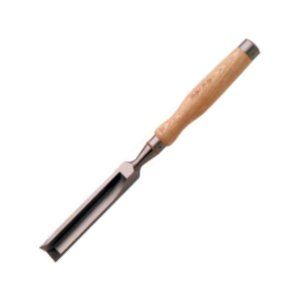
Corner Chisel: A framer forged into a 90-degree angle to clean out corners. Generally 30-degree bevels. Usually with hooped, socket handles.

English �Pigsticker� Mortice Chisel: Ward and other makers. A short, stubby, fit-in-the-tool-chest, tang-handled mortise chisel with unhooped handle designed for striking. All mortise chisels are generally straight sided�some have some taper for ease in popping out chips. All with 35-40 degree bevels.
Continued�