WoodCentral Forums

Est. 1998 — 27 years of woodworking knowledge

Shoulder plane technique.

Posts

Shoulder plane technique.

#1

Shoulder plane technique.

Tony Sade (Charleston, WV)

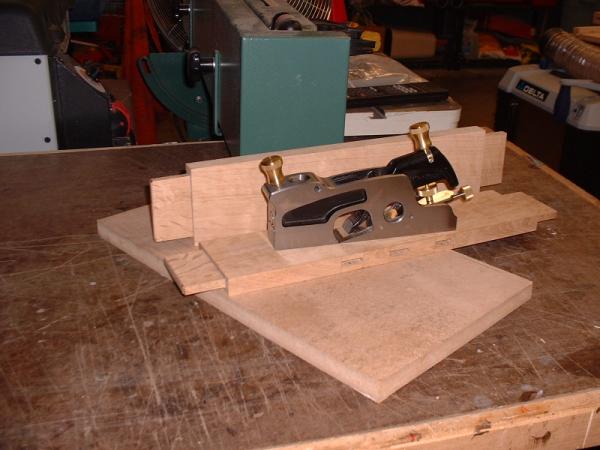
>I was trimming some tenons with a new shoulder plane tonight and was wondering if there was a tutorial somewhere on the proper use of this plane. I made a small bench hook which made fitting the cheeks pretty easy, but I found using it on the shoulders a bit difficult. The plane is large, and coming straight down on the shoulder (perpendicular to the ground), with little bearing surface didn't work all that well, and created some tearout, although I was able to fit the tenons pretty well. (The tearout is a factor because a these are through tenons.) Any suggestions? I must say I wonder how I ever trimmed tenons to fit without this tool. Thanks, Tony

Re: Shoulder plane technique.

#2

What works for me

Wiley Horne--Glendora CA

>Tony,

What I do for the shoulders is to hold the work in an end vise (twin-screw in my case), so that the tenon is projecting from the bench front at right angles, and horizontal to the ground. So then you're planing horizontal, with the side of the plane registering on the tenon cheek. You can get two hands on the plane, and it's easy to check square quickly.

Spelching is an issue--meaning splitting a chip off the end of the shoulder as the plane exits the cut. Some folks avoid this by clamping some support on either side of the shoulder. I find it simpler to always plane in from the sides, and do not plane straight across and off into midair.

Depending on your bench setup, you might need to adapt this, but the key thing is to plane horizontal, with the plane on its side, letting the tenon support the side of the plane.

Wiley

Re: Shoulder plane technique.

#3

What I do

jim_reed@marietta

>I rough out my tenons with a RAS. It cuts such a nice shoulder I never have to plane the end grain. As for the rest, I raise two bench dogs about 1/8" and pinch from the two underside shoulders. Holds the board like a rock and makes planing the tenons a snap. I use a #93. What plane are you using?

Re: Shoulder plane technique.

#4

Re: Shoulder plane technique.

George D. Huron

>For trimming mortise cheeks I find the best tool to be a router plane. I remove most of the waste with a backsaw or chisel. Then, hold one handle down so that the base of the plane is held flat against the board and swing the other handle in an arc so that the cutter takes very thin shavings starting at the end of the tenon and moving toward the shoulder. Come in from both sides of the cheek to prevent blowing out the far end of the cheek.

Then use a shoulder plane to reference the now parallel tenon cheek and trim the shoulder to your knifed shoulder line. Concentrate on making the shoulder a concave cut versus a convex cut that will ruin the fit. With the plane set very fine, you will not be able to achieve very much concavity. Start the cut from about 1/8 inch from then end of the shoulder and end it about 1/8 inch from the other end. You should be able to split you knife line easily.

Re: Shoulder plane technique.

#5

Cheeks fine, Shoulders difficult.

Don Thompson - Cutler Ridge, Florida

>"I found using it on the shoulders a bit difficult. The plane is large, and coming straight down on the shoulder (perpendicular to the ground), with little bearing surface didn't work all that well, and created some tearout..."

If the tenons are big enough, can you flip the board to horizontal on your bench, and rest the plane on the tenon? What size are the tenons, and what plane are you using?

Re: Shoulder plane technique.

#6

Re: Shoulder plane technique. *LINK*

George D. Huron

>I clamp the board in my front vise on its side and lay the shoulder plane on its side against the cheek to plane the shoulders.


http://www.springharvestfww.com

Re: Shoulder plane technique.

#7

Clarification. . .

Tony Sade (Charleston, WV)

>Sorry it took so long to get back to respond to all the suggestions and curiosity about which plane I was using. Too many leaves to rake--it's the only time of year I don't like trees.

I realize now that I mislabeled the area I had problems with. It wasn't the shoulder, but the edge of the tenon-the part that's 90 degrees to the wider cheek. (In at least one of my ww books, that area is also referred to as a cheek, but I won't call it that.) At 3/8 in. wide, it's just too insubstantial to get a nice even peeling cut with the plane, so I wound up just laying the stock flat on my bench hook and planing straight down, trying to keep the tool 90 degrees to the stock.

I was using my new LV large shoulder plane, which, as I said in my initial post, was a dream to use, on the cheeks at least. (Yeah-I sprung for the brass knobs.) All my "shoulders" were cut fine-nice and straight, so I didn't have to do any work on them, just had to make the tenons fit the mortise. I deliberately left the tenons a little fat so I would have an opportunity to play with my new tool-next time I think I'll try to get a little closer, leaving a little to clean up to justify the purchase of this very nice plane. (Keep in mind that I have no frame of reference, not heretofore being much of a hand tool guy, but the LV sure feels and works great.)

I guess part of my problem is I don't have a much of a bench or vise-just a MDF/masonite setup with a cheapie Lowe's vise in a not-very-accessible location. Guess I'll have to work on that. Thanks for all the responses. Tony

img

Re: Shoulder plane technique.

#8

Re: Clarification. . .

Wiley Horne--Glendora CA

>Hi Tony,

I started the same way you're describing, which is to saw the tenons fat and then pare or plane. Somebody gave me some good advice about that: don't do it. Go for the money cut right off the saw. The worst thing that can happen is that you overcut a little, and then have to glue a shim piece back on. This is not a big deal, and you'll find it won't happen often. Take the risk; you'll be surprised how fast you get good at it.

Now on the little end pieces, if you need to take a sliver off, use a chisel. In my opinion, and others will disagree, a big chisel is also the best thing if you want to take some material off the tenon cheeks. The shoulder plane does a really neat job of it, and I appreciate you're justifying this jewel you just bought! But it's way faster with the chisel, and you can justify a 1-1/2" - 2" chisel if you take my advice. Pare across grain with the chisel.

Nice shoulder plane! That big shoulder plane is also great for cleaning up raised panels.

Wiley

Re: Shoulder plane technique.

#9

Good bench helps a lot

Bill Houghton, Sebastopol, CA

>The best time investment I ever made in the shop was improving my bench, particularly the end vise and bench dogs.

Re: Shoulder plane technique.

#10

You do not need a shoulder plane for that...

Don Thompson - Cutler Ridge, Florida

>, just use a low-angle block plane. That is pure, classic, end-grain shaving. I use a little Lie-Nielsen 102 (or is it 103?), which is small enough to comfortably guide with one hand.

I think that I would call that the "tenon end." Projecting tenon ends often are chamfered on all sides - that should help with the spelching.

Re: Shoulder plane technique.

#11

Not the end,

Tony Sade (Charleston, WV)

>Don. Guess I wasn't being clear, again. The ends, as you can see from the picture, are chamfered, which I did after trimming the tenon to fit. The part I'm talking about is the edge of the tenon-if the tenon has four faces-two cheeks and two edges, and one end. So I guess I'm not talking about end grain, but long grain and the need to cut across the grain on this very narrow piece. Now that I think about it, a chisel, as suggested by Wiley, might make the most sense. Thanks. Tony

BTW: What is "spelching"?

Re: Shoulder plane technique.

#12

Re: Not the end,

Don Thompson - Cutler Ridge, Florida

>Oh, OK. That has a name, but I can not remember what it is. I agree. Careful paring will do it.

Spelch is a woodworking term referring to the endgrain splinters that tear off at the end of a cut.

Re: Shoulder plane technique.

#13

FYI-Tutorial

Tony Sade (Charleston, WV)

>I found a video tutorial on Tauton's site here:

http://www.taunton.com/finewoodworking/pages/wvt085.asp

And an article on shoulder planes in FWW #171 at page 42.

Both useful (to me at least). Tony

👍 This page answered my questions

Your vote helps other woodworkers quickly find the answers and techniques that actually work in the shop.