WoodCentral Forums

Est. 1998 — 27 years of woodworking knowledge

Sweet Heart of a question

Posts

Sweet Heart of a question

#1

Sweet Heart of a question

Mike Rachocki

>What exactly is the difference between the Stanley "Sweet Heart & Non-Sweat Heart" items?

Whas it a specific era of their manufacturing? What whas it supposed to signify? Are they more sought after because of quality or rareity?

Thank you in advance for any information.

Reagrds,

Mike

Re: Sweet Heart of a question

#2

1921-1934 or 36

jim_reed@marietta

>SW was a short lived trademark which dates planes and irons in a narrow time span between the wars. Some say that this was a time of high quality.

Re: Sweet Heart of a question

#3

Re: Sweet Heart of a question

Neal (San Jose)

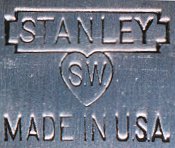
>Sweatheart refers to the trademark design adopted by Stanley in 1920. They added a small heart shaped device with the letters S.W. inside the heart to a rectangle with the corners cut off with Stanley inside the rectangle. This device lasted with a couple of minor modifications until 1933. The trademark after 1933 is basically the same one you see today. Some collectors, needing to limit the range of their collections specialize in collecting these tools. For a user, this is significant in that all meaningful improvements to the tools, especially planes, had happened by that time, and these tend to be good users. After that date, we see things like kidney shaped lever cap holes. Biggey Wow! The heart derives from a guy named Hart (spelling?) becoming president of Stanley, and S.W. is for Stanley Works.

Re: Sweet Heart of a question

#4

Re: Sweet Heart of a question

Jonathan Peck - N.Y.

>I don't think I ever get tired of answering this question. Welcome to the slippery slope. The sweatheart era is 1919/20 - 1932 (types 12-15) and the SW logo on plane irons was to commemorate the merger of Stanley Rule and Level Co. into Stanley Works. People like SW's because they're easy to spot without needing to memorize any dating flowchart statistics. It also signifies the high water mark of Stanley tools before they started to go downhill in quality. A SW plane would have all the latest desirable (to some) features like frog screwing, be of quality manufacture, and have a cutting iron prior to Stanley adding vanadium to their iron. The high front knob on SW planes is another indication of a post 1919 plane.

So do you wanna know why people like type 11's?

Re: Sweet Heart of a question

#5

Re: Sweet Heart of a question

Doug Reynolds in Seattle

>Yes, inquiring minds do want to know why Type 11s are preferred. Why is that?

Re: Sweet Heart of a question

#6

Yes !!, why are type 11's so sought after?

Doug Littlejohn

>I like them to, though I confess, I really don't know for sure what about them is so attractive.

Re: Sweet Heart of a question

#7

Re: Yes !!, why are type 11's so sought after?

Jonathan Peck - N.Y.

>Sorry...I don't know (just kidding). This is another easy one to spot without being an encyclopedia of type study factoids. It's a little more curvascious than an SW and is identifiable by it's low knob and three patent dates in front of the rear tote. It also has all the features that (some) may want in a plane including the frog adjustment screw. Some might say that this would signify the high water mark for Stanley metal bench planes, and I wouldn't dissagree with them.

Being a low knob freak myself, and not caring much about frog screwing, I am preferential to type 9's. Type 9's will have two patent dates in front of the rear tote

Re: Sweet Heart of a question

#8

It's because...

Scott Burr in Ben Lomond CA

>On type 11 planes the frog is the closest type to a bedrock type frog.


img

Re: Sweet Heart of a question

#9

Re: It's because...

Jonathan Peck - N.Y.

>Hi Scott,

I'm a little foggy on types earlier than type 9, but... I happened to pick up a type 4 jointer that is in good condition, but not good enough to be collectors meat..beep..beep. When I took it appart, I couldn't help but marvel at how huge the bearing surface was for the frog. From the hyperkiiten type study:

" The frog receiver is now a broad, rectangular area, with an arched rear (the portion nearest the tote). It is machined flat. "

and the Bailey type 4 predates the first Bedrock by 24 years. Not sure what any of this means, but another nice feature that appears with the type 9 (1902) is (also from hyperkitten)

" Frog receiver undergoes a major redesign. A smaller bearing surface is now cast into the bed, toward the tote. Two circular bosses, to receive the screws are located just ahead of this bearing surface, toward the mouth. A rib runs from the mouth to bearing surface, over which the frog rests. This is to align the frog laterally, to keep it square to the sides of the plane, and, thus, make the iron parallel to the mouth. The frog has a slot at its bottom (the portion nearest the mouth) to fit over the rib cast in the bed. "

This change is introduced four years after the introduction of the Bedrock line. I'm no expert, but I think the Bailey bed design was changed in 1902 to be less like the Bedrock design after the Bedrock line was introduced in 1898.

Regards

Jonathan
Re: Sweet Heart of a question

#10

Re: It's because...

Tom Price

>Don't understand this statement as the dual height frog was introduced with the Type 9 planes (no frog adjustment screw) and varied only in minor design changes thereafter. Bedrocks had a large frog receiver area at 12 degrees with the mating surface on the frog. No dual height there. Are you referring to the frog adjustment screw? That was introduced on the Type 10 planes.

I really like Type 11 planes because of the low knob myself.

- Tom

Re: Sweet Heart of a question

#11

OK.......

Todd Hughes

>There are 3 different sweet heart marks commonly referred to as X, Y, and AA from the letters given them in the John Walters stanley book. X is the most uncommon as it was only used for one year, 1920. It has a notched stanley logo with a heart half way into the bottom of it and under it says New Britain Conn. USA. The Y looks the same except it says only "Made in USA". It was used from 1921-22. The most common mark is the AA which says the same as the "Y" but the heart now is lower and top of the heart rests on the bottom of the notched Stanley logo.It was used from 1923-35. Is not unusual to find planes with overlaping parts.

The sweet heart mark honored William Hart who was chairman of the company and died in 1919 after serving Stanley for 65 years.

In my experance Sweet heart tools are not rare as they date from a time when Stanley was probably at the height of thier hand tool production.They might bring a very slight premium but not that much in my experance over other pre war tools. I don't think a sweet heart plane made in 1920 / 1935 is any better then non sweet heart one made in 1919 / 1936 .....Todd

👍 This page answered my questions

Your vote helps other woodworkers quickly find the answers and techniques that actually work in the shop.