WoodCentral Forums

Est. 1998 — 27 years of woodworking knowledge

James Cam Chisel

Posts

James Cam Chisel

#1

James Cam Chisel

Paul in NJ

>I found this large socket chisel at the flea market last week-end that piqued my interest. It looked to be old and more primitively made than the old factory made socket chisels I am used to seeing. The makers mark read "James Cam" which was one of the other reasons I purchased it. You see, a friend of mine mentioned he had just found one a few weeks ago. With a little research I found James Cam was a Sheffiel maker from 1781-1838. His company was bought by Marsh and Shepard who used his mark for time after that.

If anyone has more information on Cam I would appreciate hearing more. I understand he was a prolific maker but how common are his tools to find? What are the chances this is a 200 year old chisel?

Paul Dzioba


img

Re: James Cam Chisel

#2

Re: James Cam Chisel, PIc 2

Paul in NJ

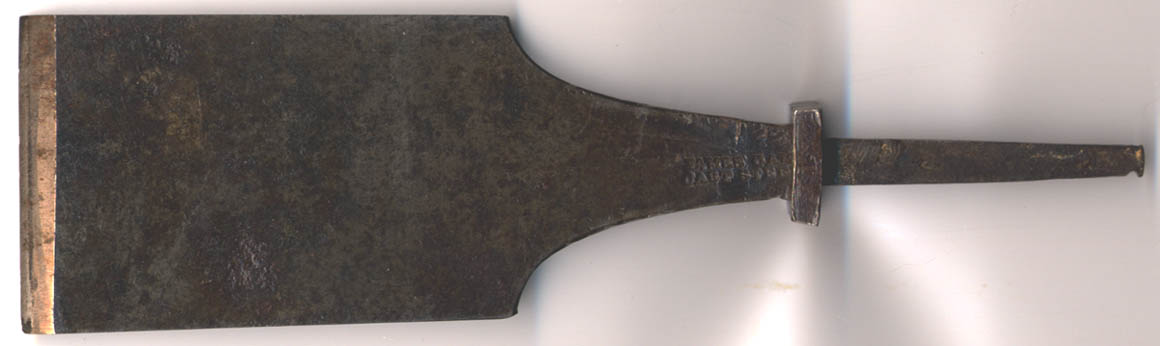
>You can see in the picture how the socket was formed. It looks like it was formed by hand but I may be wrong since the condition is rough and I don't have a lot of experience with hand made tools. There is still life in this survivor, about 2 inches of hard laminated steel.

Paul Dzioba


img

Re: James Cam Chisel

#3

Re: James Cam Chisel, Pic 3

Paul in NJ

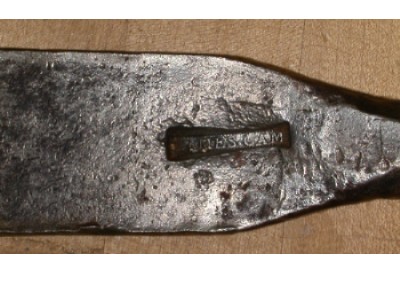
>Here is the makers mark, nice and clear. I won't be sorry if it turns out to be common or maybe only a hundred years old. I think it has a interesting story and it has provoked a few thoughts on where it might have been and what good deeds it has accomplished.

Paul Dzioba


img

Re: James Cam Chisel

#4

Re: James Cam Chisel, Pic 3

Todd Hughes

>James Cam tools are not very rare, even in the old tool hell I live in I come across them a good bit but like you said his name was used for a long time past when he died and I have to confess as to not being able to tell with certainly an original old stamp and a later one.Your stamp does look like an early stamp to me.I have never seen a socket chisel made this roughly from an established maker, esp. one of Cams caliper, remember his tools were so good they kept using his name after he died to sell stuff.Also early chisels are normamly not socketed but tanged.I might be wrong but what you chisel looks like to me is a tang chisel that because of damage was re worked by a blacksmith into a rough and ready socket chisel. Kind of neat no matter what.....Todd

Re: James Cam Chisel

#5

Thanks Todd

Paul in NJ

>I was hoping you would weigh in on this, I knew you would have good information. I think the chisel is way cool and it just might be the first tool I bought to collect! I still might put an edge on it and take it for a spin, we will see.

Paul Dzioba

Re: James Cam Chisel

#6

Re: James Cam Chisel, Pic 3

Bob Hackett

>I have a James Cam plane iron(single iron,no chip breaker)That has a maker`s mark that looks much like the one on your chisel.Under the James Cam stamp there are 2 more lines that say Warranteed and then cast.steel(the dot is centered between cast and steel).The 3 stampings have sawtooth edges all around much like you would see on old molding plane stamps.

The marks run rather deep and thier location can be felt on the back of the iron.I`m told this is an early iron(by a friend who knows these things).The plane body was shot and I bought it just for the early iron.

Good steel,I tried it in another wood body.It will make a great plane some time in the near future.If your chisel is anything like my iron it`ll be a pleasure to use.

Mainely,Bob

Re: James Cam Chisel

#7

Re: James Cam Chisel, Pic 3

Adam Cherubini, NJ

>Todd,

How could a smith have forge welded that socket on without disturbing the stamp?

Paul,

Good hunting! Where did you find it? That didn't come from Columbus did it? Next time I see you or Ray there, I'm just going to turn around and go home. Nothing escapes you guys!

I have newer Cam stuff, and the stamp is much finer (and negative i.e. the name is pressed in).

Not knowing jack about smithing my guess is Paul has a very early and very cheap carpenter's chisel.

Now I know Todd would not join me in saying this, but I think some amount of discretion should be used regarding this chisel. My feeling is tools like that belong in museums. I could see some interpretive value in a tool like that- perhaps in Carpenter's Hall or the like. At the very least, I recommend photographing it and sending those photographs to Jay Gaynor at CWF or Master Housewright Garland Wood at CWF. I don't have any contacts at EAIA. That might be a better place to send photos. Pretty sure there is one similar chisel in the Mercer Museum (check mercer's "Ancient Carpenters' Tools"). I would think a similar stamped example may be evidence this is not repaired.

Anyway that's my two cents.

Adam

Re: James Cam Chisel

#8

Re: James Cam - should we use very old tools?

John Aniano, somewhere in central NJ...

>Hi Adam, et al,

Yes, if the tool were fantastically rare or of an uncommon size, I would agree to your suggestion that older tools not be used but rather preserved.

But lets face it, very few of us are full-time woodworkers using these antique tools day in and day out. Yes, there is of course the possibility that the tool may somehow become broken or irreparably damaged during use. But the mere fact that a tool, a J. Cam chisel in Paul's case survived 150+ years and may still be usable, I'd say use it, but with care. I'd bet that Mr. Cam would be more pleased seeing his tools still performing good work than to see them hung up on a wall.

I myself have several J. Cam edge tools and if used with care and respect, they still work very well. In fact, I recently pounded out (4) 3/8" wide through mortises in a pine frame and panel door I made for my house reconstruction effort - and the mortising chisel was a J. Cam tool!

Just my two cents worth...

John

Re: James Cam Chisel

#9

Re: another repaired James Cam Chisel...

John Aniano, somewhere in central NJ...

>Hi All,

Paul's posting made me realize that I, too, had a repaired James Cam tool - this one a 2" wide firmer chisel. As others here pointed out, if not careful, the original maker's stamp can be distorted in the action of repairing the tool as it was in this case. I'd guess that it was originally a tanged chisel and the octagonal bolster somehow was cracked off or otherwise damaged so a new, square one was fitted and welded into place, partially covering the end of the "James Cam / Cast Steel" imprint. I think that this is probably one of the later Cam tools as the imprint does not have the zig-zag border of Paul's chisel.

And yes Adam - this was purchased at the Columbus flea market just a few weeks ago...

Over and out,

John


img

Re: James Cam Chisel

#10

Re: James Cam - should we use very old tools?

Adam Cherubini, NJ

>Hi John,

As you know I have and use many, many antique tools. I'm not suggesting perserving all antique tools. But rare tools that help to tell an interesting story deserve particular attention.

My guess is that Paul's chisel is both old, I'm guessing 18th century, and rare. Because there are extant contemporaneous examples of Cam's work, a tool like this (or just a pictuire of it) may be used to tell a story of an 18th century maker changing quality to meet the demands of a carpenter, or an overseas market, etc.

I'm not suggesting perserving every old sash plane. But I do think users of antiique tools have a duty to know what they have. I don't think anyone should be opening paint cans with centerbits for example. (boy that gets you in your stomach, doesn't it?)

Hey I dropped one of these while I was sharpening it a few years ago. I was holding it by its tapered shank in my machinists vise. Now I learned long ago not to try to catch such things. I actually step back. But I know centerbits fall tip down. It stuck me good, but I'm still glad I did it. The puncture healed and I still have that bit!

Adam

Re: James Cam Chisel

#11

Re: James Cam - should we use very old tools?

Paul In NJ

>I like many other woodworkers appreciate and use old hand tools. I like the way old hand tools look and feel, the quality is great since there was so much competition between the makers. I think they are a great value and I always buy a quality tool when the price is cheap. I like to pass on the ones I won't use to other woodworkers, kind of an old tool rescue. Nothing is worse than seeing a fine old tool rusting away, there are only so many of them out there. I use my old tools with care and respect, I don't believe I have anything rare. When I saw this chisel it looked a little different, maybe older than I am used to or maybe hand forged. When I saw the James Cam mark it closed the deal for me. Thanks to John Aniano I knew James Cam was an old maker, he had mentioned that he found one at the flea market.

I plan on doing a little more research and will follow up on Adam's suggestions before I do anything else. I really don't need this 2" framing chisel, I have other chisels I can use. Thanks everyone for all the information, I value all of your opinions.

Paul Dzioba

P.S. The chisel was bought at the Lambertville flea market for $10.00.

Re: James Cam Chisel

#12

Re: James Cam Chisel, Pic 3

Todd Hughes

>If this chisel was made out of an longer chisel when the socket was formed and welded it wouldn't have affected the stamp as the work done was behind the stamp.As long as the stamp wasn't hit it wouldn't change.I once made very much like this a small spear out of the tang from a 1876 winchester and afterward the winchester marks staid clear.

Looking in that great book "Tools working with wood in eightenth century America" they show a few 18th centuru socket chisels and while you can tell they were hand forged they are made much "Better" then just wrapping the socket around leaving the end open and I just have to believe that Cam, who was a top of the line maker whouldn't have made one like this, even leaving what looks like hammer marks on the iron.Just don't see work like that from an established maker.I do think the chisel is old, mainly because it isn't marked "Cast Steel" which didn't start to be stamped untill the 1800's.I think it is interesting and pretty neat but not really that rare to make it museum material esp. in this rough condition.Unless you just want to take it for a spin I wouldn't use it, better chisels wouldn't be hard to find after all, but i would clean it up and look for a better old handle for it,[if the one in it is as bad as it looks] and put it in the box of interesting tools to keep.......Todd, who used to go hunting in Lambertvile and columbus all the time

Re: James Cam Chisel

#13

Re: James Cam Chisel, Pic 3

William R. Duffield on the Cohansey

>Your arguments make the idea that it is very early more plausible. Even an established top of the line maker had to start somewhere, and I doubt Cam started out with a fully developed skill set. It could be he actually started marking his tools, and made this one, very early in his career, before he knew how good he was going to get at it later. If such a conjecture were true, this chisel would be all the more valuable for its historical significance.

Re: James Cam Chisel

#14

Re: James Cam Chisel, Pic 3

Todd Hughes

>Of course if the chisels Cam made when he first started out were this roughly made like your premise seems to be one would have to wonder how he survived in the highly competive tool making field of the 1700's to become an established maker of better quality tools later on.

I believe it is a mistake to think that James Cam the man made every ,[or probably even any] chisels himself but instead was a company that made MANY edge tools that carried his name. Apparently this first Cam company made tools for about 50 years from 1787-1830's and then the name was bought out so even if it was,[and I think it is] a "Real" Cam you can see that there were a large amount of tools that must have been made......Todd

Re: James Cam Chisel

#15

Re: James Cam Chisel, Pic 3

Mike Lietzow

>I was thinking along similar lines based on the position of the maker's stamp. It's location near the bottom of the socket looks too well-positioned to have ended up there by coincidence. Also, there was some recent talk either here or on the OldTools List regarding the first socket chisels and I seem to recall reading that they originated around the turn of the century (that's 18th to 19th century). Could it be that the technique for forging sockets was still being refined at that time (or at least that knowledge of making sockets was not widespread yet)? All this is, of course, wild speculation on my part as I've probably seen less old tools in my entire life than Todd sees in a average day (even though we all know he lives in old tool heck) and I know next to nothing about the fine art of blacksmithin'.

Cheers,

Mike

Re: James Cam Chisel

#16

Re: James Cam Chisel, Pic 3

Dean Burke - Yakima, WA

>Seems like he'd have gotten over this during his apprenticeship. Therefore, I wouldn't expect a Cam label on a chisel of this poor quality of work. In short, I agree that someone's reforged this. Caveat, perhaps one of his apprentices could have made it?

Dean

Re: James Cam Chisel

#17

What I'd do is

Todd O. Cronkhite Native of Maine

>is sharpenen it up real nice and use it, albeit sparingly. Would be interesting to what type of edge this chisel wil hold wouldn't it. I wouldn't use any electrons to sharpen it either as that would be kinda' sacreligious to the chisel IMO.

I probably wouldn't use it but just a few times a year and that would be a "just to use it just because" kind of thing. I'd keep it displayed on a rack in my shop because that is where it belongs and not tucked away in some box in a closet somewhere.

Fiqure if it's gonna be hanging in the shop as it should be it might as well be functional.

Todd O.

Re: James Cam Chisel

#18

Re: James Cam Chisel, Pic 3

Cameron

>It just looks like a nice early socket chisel to me. I've seen ones like this before (though I'm uncertain which brand they were cause it was a while back now). The deep "blocked" stamp and the transitional style socket are clues to the age of it - as is the fact that the blade is also laminated. It also looks like it's slightly flared (fishtailed) along the length of the blade as well, which is another clue as many early chisels are made like this.

It's not a repaired tanged chisel because that would mean that the stamp would be halfway down the chisel, which would be very improbable.

Re: James Cam Chisel

#19

Yet more conjecture

Bob Hackett

>At first I thought it may have been a plane iron that someone had forged into a socket chisel but the mark is 90 deg out if that was the case.

It appears the blade was stamped after the forging was done so it doesn`t look like a repair job to me,just a rough job of making a socket.

Maybe the D stamp was ground off so nobody would know it was defective?

Maybe we worry far too much about mysteries we have no chance of solving?

Nice chisel though,be sure to let us know how is works after you flatten the back, sharpen it and use it.;^)

Mainely,Bob

Re: James Cam Chisel

#20

Re: James Cam Chisel, Pic 3

Todd Hughes

>While i do believe more early chisels were tanged then socketed , socket chisels go way back into time and the knowledge of making sockets was certainly perfected way befor the late 1700's. Just think of all the spears,pikes etc. made with sockets and actually many of the older axes have socketed handles as well.Apparently socket chisels made befor the mid 1700's usually had faceted sockets and then later became the rounded ones like we see today,The book "Tools Working wood in 18th century America" show several 18th socketed chisels and gouges by different makers and none are made this crudely.....Todd

Re: James Cam Chisel

#21

Re: James Cam Chisel, Pic 3

Raymond in Trenton NJ

>Hi Adam,

I guess I should keep quiet about the James Cam 1" socket chisel I found er, bought there, huh? I only mention this chisel because it has a rather crudly formed socket. At first I thought it was a good chisel that was repaired. It has a solid socket and a full 1/4" of tool steel that goes back almost to the stamp (2 3/4" IIRC).

It sharpened up sweetly and took *forever* to flatten the back, which told me it was *good* steel welded on. It was John 'Ol Eagle-eye' Aniano who identified it as a Cam. The pic doesn't show it too wekk, but mine looks like it could be after Pauls, maybe when Cam perfected *his* sockets a little more.

I this this specific chisel was made early in the time line when Cam was experimenting with optional features in his product line. Please note the optional 'Spade Shovel Handle'. Obviously original.

Raymond

Oh, as to your statement "That didn't come from Columbus did it? Next time I see you or Ray there, I'm just going to turn around and go home." No! Please don't do that! Paul or I might need help carrying stuff to the car :o)


img

👍 This page answered my questions

Your vote helps other woodworkers quickly find the answers and techniques that actually work in the shop.