WoodCentral Forums

Est. 1998 — 27 years of woodworking knowledge

A data point for plane selection

Posts

A data point for plane selection

#1

A data point for plane selection

Bill Tindall, E. TN

>Frequently there are requests seeking opinions on what plane to buy. The objective of this post is to provide one data point to help persons determine what sort of plane is needed to accomplish a particlar task.

A common, if not the most common, planing complaint is tear out. So, how much money does it take to purchase a plane that will result in little or no tear-out for a particular task?

To answer this question I offer one data point. I use a plane for fitting and stock removal, but none of the "advanced" tasks that many Forum members aspire to. I am not convinced that a planed surface with a finish is superior to a planed or scraped one. So, it should be noted that my demands of a plane are probably much less than some planers. So, this data point must be considered in this context.

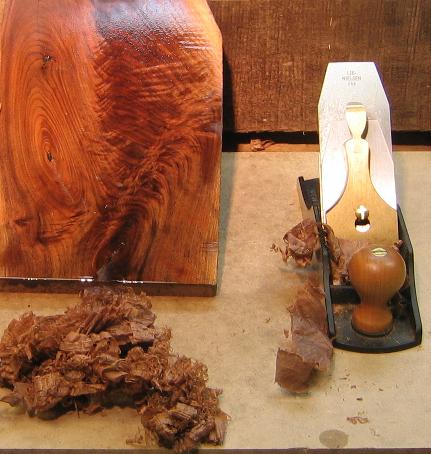
The experiment: The data was collected as part of a planing class hosted by Holston Woodworking Club, Tri Cities , TN. The wood was a walnut crotch;the plane a LN 4 1/2 with 50 degree frog (although we repeated with 45degree frog with no obvious difference). The 25 degree iron bevel was sharpened to 6 micron with diamond on cast iron. No secondary bevel. (A significantly shaprper edge can be had by going to 1 micron but at the time we didn't have a 1 micron charged plate). The wood was wet with naptha for the picture to show the grain better.

Results and conclusions: This crotch planed without tear-out in a bottom to top direction. There was some tear-out in a top to bottom planing direction. For my purposes a light sanding with 220 and this piece would have been ready to finish. It was essential to have the mouth tight to get a smooth finish and the weigth of the plane aided traversing the grain changes with their different planing resistance.

This is a much more challenging planing task than I encounter in typical furniture building. I conclude that this plane will suffice for typical planing applications in furniture building with domestic woods. It may well be that other similar priced planes, or even cheaper planes, will deliver similar results. I leave it to others to provide these data.

img

Re: A data point for plane selection

#2

Re: A data point for plane selection

Frank Mutchler

>Hi Bill, I would also reach for a high angle smoother to finish that piece. Can you tell me about the horizontal lines that look like chatter...on the upper right where the sap wood is?? There are corresponding lines that are obviously part of the grain structure lower down. Also, where the flash is reflected, the grain looks like there is an area of small tear out or perhaps it's just porous grain??

Did you have a scraper available to use on the piece? Could you clarify you comment, "I am not convinced that a planed surface with a finish is superior to a planed or scraped one." I didn't understand what you said. Thanks for an interesting post!

Re: A data point for plane selection

#3

Re: A data point for plane selection

Bill Tindall, E. TN

>There isn't any tear out but you are correct that there is a bit of chatter and some remaining band saw marks on far right side. It was hard to photograph. The naptha was too volatile and it was running, soaking and evaporating and that may have caused different parts to appear irregular. Where the grain is standing on end it was difficult to keep the piece wet. The point is that the plane, if not the planer, handled this acceptably. We weren't intending to use this piece for anything. It was just a test to see whether the plane would handle it, and it did to my satisfaction(amazement).

On your second question, a freshly planed surface does look more attractive than a sanded one, but this difference becomes insignificant ( by my eye) when a finish is applied, or at least the finishes I use. So I have no reluctance to sand after hand planing. I use the hand plane to quickly get the thickness planer and jointer ripples out if the task is small. If the task is large I sand outside the shop with a clouds of dust generating air driven sander that doesn't care what way the grain is running.

Re: A data point for plane selection

#4

Re: A data point for plane selection

WoodburnBob

>Like Frank, I also stumbled on the sentence: "I am not convinced that a planed surface with a finish is superior to a planed or scraped one."

From context and your sanding comments, I take it you intended to say: "I am not convinced that a planed surface is superior to a sanded one with a finish."

Last night I was looking at crotch and branch grain diagrams in Bruce Hoadley's book, "Understanding Wood". Seeing the walnut piece you used made me think you were in effect mostly planing end grain. It's those little swells in the grain or interlocking grain bundles just off parallel to the surface that frustrate me about tearout.

👍 This page answered my questions

Your vote helps other woodworkers quickly find the answers and techniques that actually work in the shop.