WoodCentral Forums

Est. 1998 — 27 years of woodworking knowledge

Plough Plane

Posts

Plough Plane

#1

Jim in Burlington Ont.

Plough Plane

Jim in Burlington Ontario

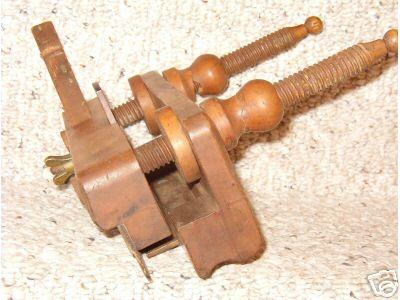
>This is a pic of my first wood plane purchase. I have a few questions. Do you oil or wax the plane. Should I remove the metal parts and zap them or just a little metal cleaning and polish. Did I get taken at $40. Can you buy other blade if so what would they be called. Both knobs are cracked the one can be glued together easy but the other should I just epoxy or endevor to make a new one. As alway all help appreciated cuz the slope is gettin steep thanks Jim


img

Re: Plough Plane

#2

Re: Plough Plane

joel

>One important point for anyone owning a screw arm plow plane is to ALWAYS loosen the screw nuts when storing the plane. if the screw nuts are tight a change in humitity can crack them- that's why we see so many that are cracked.

Herb Kean's book on restoring antique tools has a lot of information on reconditioning ploughs.

Please don't use epoxy.

Re: Plough Plane

#3

Re: Plough Plane *LINK*

Ed Mulligan, Cape Cod

>Jim -

On the plough planes I've seen, the wood nuts are on opposite sides of the main body. See link for an example. On yours, the nuts bracket the fence. Maybe it's a French or Canadian form? Or has it been assembled incorrectly?

Ed


Plow

Re: Plough Plane

#4

Re: Plough Plane

Todd Hughes

>Jim's plane looks to me to be certainly Europeon,[not British but from the continent].These planes have the nuts placed like this as well as being the strange "Urn" shaped. LOTS of these are being brought into the USA right now coming in with all the furniture and stuff flooding out of Eastern Europe.Was in a shop a while back that specilized in this stuff that had bins of tools like this.Also Had a 20X20 ft room filled to the top with old watering cans just like you see in antique shops labled "Old Amish Watering Can".....Todd

Re: Plough Plane

#5

Re: Plough Plane

Adam Cherubini, NJ

>European plows are characterized by their arms fixed in their bodies (No Jokes! I mean it). The fence slides on the arms. This is an older design.

Anglo american ploughs have their arms fixed in their fences, and they slide through the body.

The advantage, if you could call it that, of the european design is that the arms are always off bench, while the anglo-american arms hang over the work. If the arms were long (no practical reason why they should be) the anglo american planes would bump into clamps, sticking board fence, or if you are working some big molding, the work itself.

Its a different design than we are accustomed to, but a good one. It also eliminates those crazy screwed in place "L" shaped arms. Subsequently, the arms stay nice and perpendicular.

Good luck with your plow. Gentle cleaning is appropriate, but a dry looking tool doesn't "need" oil. You're not actually "feeding" the wood. Whatever you are doing, you're probably damaging the tool and you're doing it for cosmetic reasons- not that there's anything wrong with that.

Adam

FWIW I oil and wax some of my tools. I've unapologetically submerged planes in linseed oil.

👍 This page answered my questions

Your vote helps other woodworkers quickly find the answers and techniques that actually work in the shop.