Major versus minor rust
Moses Yoder in White Pigeon, MI
>I am certainly not a high dollar collector; I'm what is commonly referred to as a "bottom feeder". If you look much at tools and learn to how to look at rusty tools you will soon see the difference between major and minor rust. I'll take both types if the price is right.
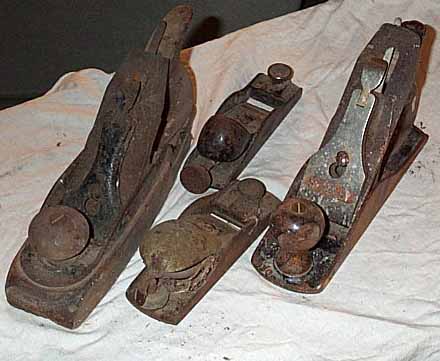
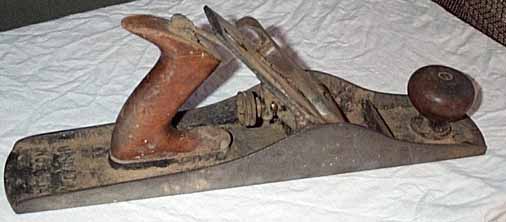
Jonathan Peck wrote a pretty good post about rust removal, and his process works fine; I use a similar method for minor rust removal. Minor rust has no pitting, major rust does. The Union #5A plane that you saw in the pic above was covered with sawdust and grunge, but had very little rust. I cleaned it up last night in about an hour, completely dis-assmebling, spraying with Simple Green, scrubbing with a small plastic brush similar to a toothbursh, rinsing, drying, and waxing , and will probably leave it just like it is without sharpening the blade or doing any other messing with it because I have other planes to use in it's stead. Someday when I feel like playing with it I will sharpen it up and see how it works. This plane is very similar to the Stanley version, but with minor differences. The biggest difference is the design of the lateral adjuster; the part that catches in the blade slot and moves the blade laterally is above the pivot point of the adjuster instead of underneath it. It seems to me this would be a good move. The blade is also thicker than the Stanley version, about the same thickness as the LN but I haven't measured it. And the most attractive feature I found on this plane is the fact that it cost me $10. One of the things I hadn't noticed when I bought it was the tote has a not so well repaired break in the top, but that just adds to the character. A few pics after it was cleaned.
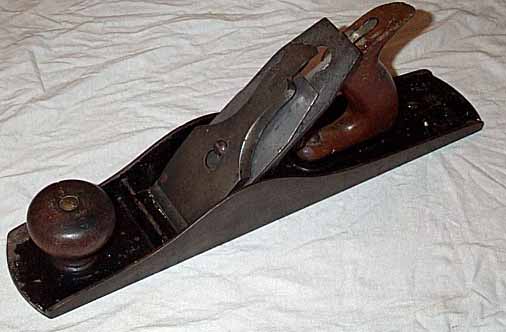
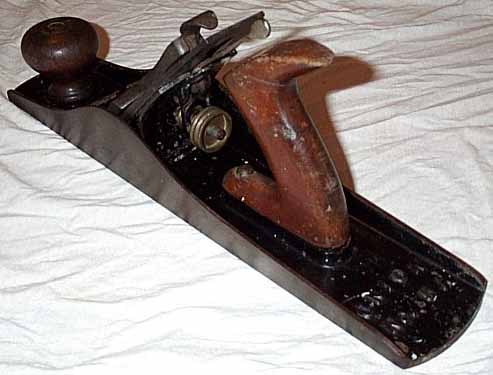
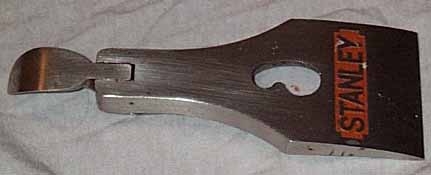
The #4 plane I got at the same auction also has minor rusting and a lot of grunge. I sprayed the lever cap with Simple Green and scrubbed it lightly with a green scrub pad, reveals small faults in the nickle plate but a pretty good sample overall. I'm thinking of collecting one of each type of the Stanley #4 plane listed in Walter's book, which would make 20 different #4 planes. This is a version I hadn't had, so I will probably clean it up and stick it on the shelf. It will clean up nice in 1-1/2 to 2 hours. It cost me $5.
The other planes you see in the pic are not so good. I got the #19 becuase it was an early type and I am partial to block planes, and for $7 I will throw it in the electrolysis tub to remove the major rust, and will set it on a shelf and perhaps someday will need some of the parts to replace broken parts on a nicer body and cap. This plane is complete and if taken apart carefully will be perfectly functional and with a replacement Hock or similar iron would make a very nice user plane, and I'll probably have 3 hours into it. The #35 is a plane that I am particualrly partial too and also want one of each type. It will get thrown into an electrolysis tub and also rejappaned, the wood will get refinished. If this is restored right and then kept over a period of time I think it will have a lot of value to collectors in the far future. I will probably spend 8-10 hours on this plane over a period of several weeks when I start restoring it. None of the parts are broken, and the plane cost me $10. This type of bottom feeding is not for everyone (thank God for that!) but I enjoy putzing around with planes when I have the time. I bought a #606 that will be my go-to jointer plane after re-jappaning, for $65; tools are much cheaper if you don't have the best.
I also have a small collection of tools in the box, and get one whenever I can, but that is a whole different field.