WoodCentral Forums

Est. 1998 — 27 years of woodworking knowledge

Recycling an old hand saw *LINK*

Posts

Recycling an old hand saw *LINK*

#1

Recycling an old hand saw *LINK*

L. Hanson - N. Idaho

>Hope you all don't mind, I'm not a regular poster, but lurk here all the time. I just feel like sharing some of my stuff after have gained so much from reading the posts here.

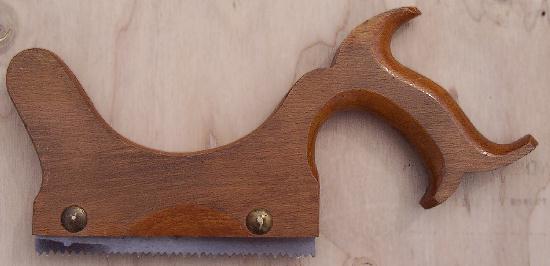
I've needed a compass saw and wanted a stair saw for myself for some time, but didn't want to spend the money for them. I did have an old saw I wasn't too fond of and was getting past the point of useful anyway, so thought why not use the blade from that? Here is what I came up with. I set up a few pages on my website with a blow by blow on how I made them, if anyone's interested.

Thanks for looking!

L. Hanson

aka Nordic

http://www.norsewoodsmith.com


img

Recycled Hand Saw

Re: Recycling an old hand saw *LINK*

#2

Re: Recycling an old hand saw

George Makowski

>Fine work! I am inspired.

Thanks for you post,

George in AL

Re: Recycling an old hand saw *LINK*

#3

Re: Recycling an old hand saw

William R. Duffield on the Cohansey

>Now, why do you think we would mind? That's beautiful work, and an excellent tutorial. Thanks for sharing it with us.

The only thing about your saws that would worry me is the shape of the Disston style stairsaw handle. Because of the grain direction, it appears to be really fragile at the "neck" where it rises at the back of the blade. If one were building another, one might want to consider modifying the shape a little to strengthen this area.

Note that I am not suggesting that you rip your handle off and chuck it over the fence. It will probably work well for a long time. Just be prepared for a possible down-the-road replacement. The problem could have been serious if you had chosen a quarter sawn, ring porous wood for the stock.

Re: Recycling an old hand saw *LINK*

#4

Excellent!

Tom Huett

>

Re: Recycling an old hand saw *LINK*

#5

Re: Recycling an old hand saw

L. Hanson - N. Idaho

>Thanks...

You know, I thought of that part of the "neck" on that saw looked a bit weak myself, and wondered if I shouldn't change the shape of it to compensate. In the end, I didn't - as the saw I copied it from is the same way. The wood I used is flat-sawn beech (I don't know if the original was flat-sawn), and I picked the best part of the board I started from just for that reason.

The photo below is from disstonianinstitute.com, and is the photo I patterned the saw after - you can see the grain looks the same:

L. Hanson

http://www.norsewoodsmith.com


img

Re: Recycling an old hand saw *LINK*

#6

Jim in Burlington Ont.

You should be a regular

Jim in Burlington Ontario

>Fantastic work like that. WOW.

Re: Recycling an old hand saw *LINK*

#7

Re: Recycling an old hand saw

Brad in Ottawa

>Have you used the Stair Saws yet... if so which handle do you prefer?? I have been debating such a project myself and your saws certainly do inspire!!!

Brad

Re: Recycling an old hand saw *LINK*

#8

Nice work!

Scott Burr in Ben Lomond CA

>I was going to post a question on cutting blades up (scrapers for me) thanks for the info. Great directions on your web site. Very nice saws.

Re: Recycling an old hand saw *LINK*

#9

Jack Guzman from Maine

inspiring

Jack Guzman from Maine

>That makes me want to start on my hand saw handles. Not yet,the wood's not ready. I'm drying some apple I found last year.

So many things to do,so little time it seems.

Great job.Thanks for posting it.---Jack

Re: Recycling an old hand saw *LINK*

#10

Re: Recycling an old hand saw

L. Hanson - N. Idaho

>Thanks...

Used them? Umm, err, uh...

Actually, I only finished them last night - but I can't see where there would be a big difference between the two in using them. I've only used the disston type one to make a test cut, it seemed to work great.

Mr. Duffield brings up a good point in his post about the strength of the "neck" of the Disston saw, so you might want to consider that if you plan on putting one to heavy use. I honestly don't know if that will be a factor - it might be, if it's used a lot, but who knows? Mine seems pretty solid, and the Disston I copied didn't seem to worry about it, but mine's pretty young yet, and Disston might have had better lumber to work with than I did.

AND, to tell the truth, I am waiting until they are fully finished before I put them to too much use. I'm waiting for the linseed oil to dry for a couple weeks, then I've got some amber shellac flakes that are begging for me to dissolve them that I plan on using for the saw handles.

I was just too thrilled with them to wait for the bloody oil to dry before I posted about them... :-)

Re: Recycling an old hand saw *LINK*

#11

Re: Recycling an old hand saw

William R. Duffield on the Cohansey

>Beech or maple or cherry or apple should be plenty strong for years of service. OTOH, if you drop it down a stairwell, and it lands on the horn, the old Olkahoma Guarantee* may need to be invoked :^)

Oklahome Guarantee: If it breaks in two, you get both pieces.

Re: Recycling an old hand saw *LINK*

#12

Re: Recycling an old hand saw

Roy from Cincy

>Absolutely awsome. Now I know what to do with those old saw blades of mine. By the way, I also have lost a lot of my infatuation with Japanese saws and am using my western saws more and more.

Re: Recycling an old hand saw *LINK*

#13

Re: Recycling an old hand saw

Jim Crammond in Monroe, Mi

>Terrific work on the saws you made! As others have said it is inspiring.

In your narrative you show putting a rake angle of 12 degrees for the leading edge of the tooth. How did you decide on that angle? I have a Disston stair saw with approximately the same angle and I found it very agressive when cutting, to the point of making it hard to use.

I turned the blade so it cut on the pull stroke and that helped but it is still hard to use. You said that your saw worked well, any tips on technique?

Again, great work.

Jim Crammond

Re: Recycling an old hand saw *LINK*

#14

Thanks All!

L. Hanson in N. Idaho

>Thank you, everybody, for your kind words... I appreciate it greatly. This was an extremely fun project, and I can only hope that everyone enjoyed reading about it. There's some other stuff on my web site about making planes, floats, restoring an old saw - if anyone is interested in reading some of it, the links to them are on my home page at www.norsewoodsmith.com.

Jim - I have little actual experience with stair saws, just these - and they aren't really even finished yet. I'm waiting for the oil to dry on them so I can give them a coat of shellac, so I haven't really put them to any real use yet. So any tips on technique that I give would be premature - I should be asking you, since you have one!

For the rake angle, I just chose one that seemed appropriate and looked like the angle I've seen on other stair saws. It could well be that its too aggressive, but it didn't seem so when I tried it out in some hickory. The first couple of passes seem a bit tough to control (it wants to wander over the top a bit, but easily solved when using a small board as a fence to start the cut), and as soon as I have it tracking in its own path, it cuts really well, and fairly easily.

I didn't use any sort of a gauge to set the rake, just eyeballed it, so it might not exactly 12 degrees. I used a 20 degree fleam angle, which is more than I generally use by about 5 degrees. That might have made a difference. Sorry I can't be more help than that...

But again - thanks all!

L. Hanson

http://www.norsewoodsmith.com

Re: Recycling an old hand saw *LINK*

#15

I just added norsewoodsmith.com to my "Favorites"

Greg B�tit, Vergennes, VT

>Thank you so much, your step-by-step sequences are some of the best I've seen!

Greg

Re: Recycling an old hand saw *LINK*

#16

Re: Recycling an old hand saw

nhlett

>You are the first I've heard to go back to western style saws. Care to share your reasons?

I am considering trying Japanese saws.

Peter

Re: Recycling an old hand saw *LINK*

#17

Dozuki vs. Backsaw - long

L. Hanson - N. Idaho

>Not Roy, but my 2 cents...

Why did I switch back from Japanese style to Western style hand saws? Short answer- sharpening, fragility, and most importantly - personal preference.

Long answer - sorry for the length.

First off, I was trained on Western style saws, when I was a teenager. Never even held a japanese saw until I was in my thirties. I was tool poor, and only had one back saw, and couldn't sharpen it properly (never tried, actually). I had a few larger saws that I regularly sharpened, but couldn't see the finer teeth well enough to properly sharpen them, so it got dull...

So it was either sharpen the old one, or catch the wave dozuki that was spreading like wildfire across the land. I wanted to be on the cutting edge, so to speak, so the backsaw got stashed, and I bought a somewhat inexpensive pull saw. I liked its performance well enough that after a couple years I bought a good one from LV. A new one because the old one I had was getting dull, and if I had trouble sharpening a western style backsaw... well, I wasn't even going to try on the japanese style.

Had good luck with the dozuki from LV. It cuts faster, leaves a thinner kerf, is controllable enough. Great quality saw, no doubt. That old back saw was calling, though, its voice getting louder and louder, though I couldn't figure out why. But I kept on with the dozuki, and one day was cutting off a dowel with it when I hear a *tink*. I look, and all the teeth were still there, but a sliver of wood had broken off the dowel and bent 3 teeth, one of them quite severely. "Geez", I thought... "this surely wouldn't have happened with the old back saw..." as the roar in my ear emanating from under the bench where the old backsaw was became deafening.

I looked at the dozuki closely, and saw it needed a bit of a sharpening. "Ack, the old ways are much easier" I thought - so I went and bought myself a magnifying lamp to help me see better, sharpened the old back saw up - and haven't looked back. Bought more back saws for different tasks because they were available on the cheap. I now have like 5 or 6 for the cost of that single dozuki.

Still have the dozuki, it's a good saw, and it has a great many uses - and I still use it occasionally. I still can't sharpen the teeth on it worth a rat's patootie, but that's just me. I guess I just find that I prefer the old ways better. At least for now...

Re: Recycling an old hand saw *LINK*

#18

Why I'm not overly infatuated with Japanese saws

Roy from Cincy

>Peter,

You asked why I am loosing my infatuation with Japanese saws. Well, here goes.

Japanese saws certainly have some advantages. They have a thin kerf and they cut very smooth. However, I find that I can get my back saw to track more acurately. Also, when I get a lapse in concentration and drift a little off line, I can retrack the cut (if things haven't gotten too bad) with the stiff back saw. Not so with the willowy Japanese saw. This probably has more to do with my abilities than anything else.

I had recent need to cut up a bunch of pine 2x4's, making some horse jumps (cavaletti) for my daughter. I couldn't stand to do it with my table saw. I just hate all that dust. So I settled in for some serious cross cutting. I used both saws. Both were successful, but the western back saw was just eaiser to use. Also, my cross cut bench hook is designed to hold on the push stroke. I would have to design a different bench hook to hold on the pull stroke. The other reason is that, as I understand it, the Japanese saws are intended to be held with two hands, not leaving a free hand to hold the material. Sawing with one hand with a Japanese saw is certainly possible, but I find better success using two. That, of course means you have to clamp every piece. Maybe some of the real experts on this message board can detail the approved technique for using the Japanese saw.

More about the better tracking of the back saw: In making cavaletti, it is necessary to screw two 2x4's together and saw the ends off in 45 degree points. At the place where the 45 degree chip falls off the upper board and you have to transition to the lower board and maintain a smooth cut, the stiff back saw made the transition easier. It was doable with the Japanese saw, juse a little more tricky.

I'm going to include a picture of the end pieces of the cavaletti just so this description will make sense. As you can see, this project was all about working with dimension lumber -- not necessarily what I like to do most of the time.

I have found that the tote grip of a western saw requires a bit of practice to avoid getting off verticle. The difference in strength of the top of the hand and the bottom of the hand tends to make the saw blade cant one way or the other, but once I learned to point my index finger and not choke the grip like choking a chicken, this problem went away. However, the linear handle of the Japanese saw made this problem non existant, at least for me.

I've been terribly long winded in my answer, and I am not much beyond a beginner. But that's been my experience.

I feel that both can have good success, but there is no need to be over enthusiastic about either.


img

Re: Recycling an old hand saw *LINK*

#19

Re: Why I'm not overly infatuated with Japanese sa

nhlett

>Thanks Roy and L.Hanson.

Your insights, while much appreciated, haven't help me me much.

Let me explain: hand sawing is one skill I never mastered. Using a hand saw meant that I would not saw a straight line and a verticle cut was iffy.

When I read about Japanese saws cutting on the pull stroke, it made sense to me. I do a lot of cooking and have found that cutting with a knife seems more consistant if I pull the knife.

Your responses have convinced me that I need to try both and give both techniques a chance to work for me. I am pretty sure that technique and the sharpness of the tool are my problems.

I guess I need to practice with both styles to figure out what works best for me.

How do you get to Carnegie Hall?

Peter

Re: Recycling an old hand saw *LINK*

#20

Re: Why I am infatuated with Japanese saws

Pam Niedermayer - Austin, TX

>I just made my bench hook big enough so that it would work hooked to either side of the bench. Of course, I never use western saws anymore...

As to two-handed use, I find that position quite comfortable but not necessary. One-handed works just fine, you just need to train yourself to hinge both shoulder and elbow to maintain a straight line with your forearm and hand. Same with western saws, although their thicker kerf helps a bit, also requires much more muscle work.

Pam

👍 This page answered my questions

Your vote helps other woodworkers quickly find the answers and techniques that actually work in the shop.