WoodCentral Forums

Est. 1998 — 27 years of woodworking knowledge

Plane blade making (sorta)

Posts

Plane blade making (sorta)

#1

Plane blade making (sorta)

John Meikrantz

>Howdy all.

I am bound and determined to eventually have the time and energy to make

a few of my own handplanes. As I've been researching the topic, I've had

most of my questions answered. The one thing I can't seem to find in the

archives or by DAGS is on steel for chipbreakers. Figured on making the

blade from O1 tool steel, and then hardening/tempering. But what kind of

steel would one use for making the chipbreaker? I assume it doesn't need

to be hardened. Excuse my ignorance on metallurgy in general, but I've

seen reference to cold rolled steel for this purpose, but that doesn't

get specific enough to enable me to order some iron from McMaster. There

are a bewildering array of choices!

Thanks!

John

Re: Plane blade making (sorta)

#2

Re: Plane blade making (sorta)

Steve knight

>why do you need a chipbreaker? just make a decent thickness blade and your fine. I have made thousands of planes without a chipbreaker.

Re: Plane blade making (sorta)

#3

Re: Plane blade making (sorta)

John Meikrantz

>How thick of a blade would you recommend? Is O1 still the way to go? What about making replacement chip breakers for metal planes?

John

Re: Plane blade making (sorta)

#4

Jim in Burlington Ont.

Re: Plane blade making (sorta)

Jim in Burlington Ontario

>If you use 01 1/8" you need to ever so slightly file out the mouth of older planes. As for making the upgraded chip breakers it's trickier to make them fit in older planes I tried using my improved LN chip breaker on a 1/8" blade for my 608 seemed awful tight. I'm not sold that they are a big improvement over thiner ones when using 1/8" 01 blades. You should be able to find cold rolled steel just about everywhere they repair machinery or welding.

Re: Plane blade making (sorta)

#5

Chipbreakers

jim_reed@marietta

>Pretty good piece of marketing from planemakers. The extra piece of iron on Stanley planes is for blade adjustment and stiffening. Use a thick, stiff blade and you don't need one. As for steel, O-1 is pretty good.

Re: Plane blade making (sorta)

#6

Re: Chipbreakers

Todd Hughes

>Wooden plane makers who used thick blades also used chip breakers for about 150 years befor stanley ever did.With these wooden planes the chip breaker had no function other then to aid in the "breaking of the chip" To anyone who thinks that chip breakers were a marketing ploy or done just as a way to make stiffer cheaper blades i suggest you make one and then tell me it is easier to make a chip breaker then it is to just make a thicker cutter. In my experance making a chip breaker is much harder to make then just a plane blade and this is reflected i guess in why originaly wood planes with chip breakers were more expensive then plain planes though the wood workers were willing to pay the addaitional costs for them.Actually in wood plane made after 1800 or so ,[other then homemade examples]it is uncommon to find ones that don't have a chip breaker

Most if not all original chip breakers used in Vintage wood planes were made out of wrought iron and this is what I used when I made mine. A tradtional material and easy to work.....Why is it you just don't want to buy a firewood wood plane for a couple of bucks and use it's Cast Steel blade and original chip breaker? Imagine it will work better then anything you could make.......Todd

Re: Plane blade making (sorta)

#7

Re: Chipbreakers

Wolfgang Jordan

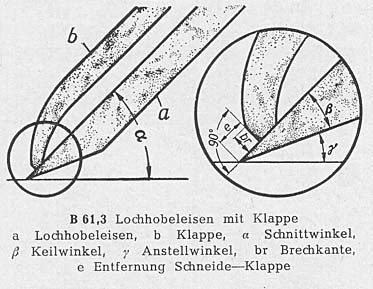
>According to old German woodworking books the chipbreaker should make a small step (about 1/32") right behind the cutting edge instead of a smooth transition. This step is supposed to break the chip. If I understand it correctly this makes the blade perform like a scraper, but without it's disadvantages. The books also say, that a chipbreaker is much more important than a tight mouth.

I have to say however, that I have never found such a step in any of my old planes.

Wolfgang in Munich (Germany)


img

Re: Plane blade making (sorta)

#8

Re: Chipbreakers

WoodburnBob

>Really interesting illustration. Intuitively looks like a formula for jamming up the mouth with shavings, but I'll play around with the idea just to see what I learn. Anyway, thanks for the effort in putting this online. How old is the book?

Re: Plane blade making (sorta)

#9

Interesting points

jim_reed@marietta

>I respecfully submit that just because it is called a chip breaker does not mean that it actually performs that function. Plow planes do not have them and actually perform quite well. Ditto with wooden H&Rs, wooden dados, and wooden moulders. Shoulder planes do not have them. Japanese planes usually do not have them. In spite of the literature and common folklore, shavings (chips) do not need to be broken. Just an observation from someone who shaves wood daily.

Re: Plane blade making (sorta)

#10

Chipbreaker Function

Steve Elliott

>I've used chipbreakers with a small flat surface at the front edge as shown in the diagram, although the flat was only about .005" wide instead of 1/32". The shaving produced was "broken" in the sense of being micro-corrugated, but was still continuous. Jamming of shavings in the plane's throat was not a problem, although now and then I needed to turn the plane over and dump them out.

Japanese chipbreakers typically have a small flat surface at the front edge. I believe the saying is that the chipbreaker should be set back from the blade edge by the breadth of a hair, which would be about .002" if taken literally. I've been able to set the chipbreaker within about .005" and plane successfully, but it takes careful tuning of the blade edge, chipbreaker, and mouth.

So far I haven't made up my mind about whether the surface produced by a smoothing plane taking a very thin shaving is better with a chipbreaker. I'm sure it depends on the wood species plus all of the variables involved in plane performance, such as bed angle and mouth dimension.

My point here is that it jamming of the shavings isn't inevitable, so experimenting with closely-set chipbreakers is possible, and maybe useful.

Re: Plane blade making (sorta)

#11

More Info & Pic

Steve Elliott

>I've found a microscope image of the blade and chipbreaker, showing that it was set .003" back from the cutting edge. Here it is:


I also found the quote about setting the chipbreaker "a hairs breadth" from the edge:

The distance between the edge of the main blade and the chip breaker should be "kami no ke i pon" the thickness of one hair!--Harrelson Stanley

Re: Plane blade making (sorta)

#12

Re: Chipbreakers

Wolfgang Jordan

>This illustration is taken from a book published in 1954, but I've found similar instructions in books from 1924 and 1961. The height of the step varies between 0.5 and 1.0 Millimeter, which corresponds roughly to 1/64" and 1/32". A more recent book shows this step as a ramp with 60 degree angle.

I did not yet play around with chipbreakers shaped like this. But I think that a step would work best if taking thick shavings like with a jack plane. A smoothing plane with its silk shavings will probably not benefit.

Wolfgang in Munich/Germany

Re: Plane blade making (sorta)

#13

Re: Chipbreakers

Rolf Schmid

>I have made the same experience, that a thick blade and a tight mouth is more important than a chipbraker. In my infills I retracked the chipbreaker an the experience of the plane doesn�t differ.

One of my best planes the infill with a japanes blade has no chipbreaker and performs very well! You can see in the picture the differnce to a standard Record blade! For this thin blade a chipbreaker is surely neccacery to stabilize the blade.

http://www.hobel-und-eisen.de/holz/japanese_infill.htm

Another plane wihtout chipbraker is a wooden plane with a 7mm thick PM HSS blade and it also performs very well.

http://www.hobel-und-eisen.de/holz/holzhobel/holzhobel_optimieren.htm

regards from Germay

Rolf


img

Re: Plane blade making (sorta)

#14

A bit more chipbreaker lore *LINK*

WoodburnBob

>Wolfgang, I read this very lucid analysis a few years ago and still admire it. You may find it interesting as well. Bob


Clark/Williams essay

Re: Plane blade making (sorta)

#15

Re: Plane blade making (sorta)

Steve knight

>I use 1/4" but a bit thinner is fine too. )-1 works well and is easy to heat treat.

Re: Plane blade making (sorta)

#16

Thanks

jim_reed@marietta

>for the link. Those C&W guys are geniuses.

Re: Plane blade making (sorta)

#17

A bit left out

Todd Hughes

>While it was true that steel was expensive in the 1700's as the C&W folks pointed out they sort of conviently left out that plane blades made during this time, whether with cap irons,[chip breakers] or single was made not out of solid steel but were laminated being made out of iron with a steel bit forge welded on the end.To make a thicker iron would not involve the use of more steel as they said but only the use of more iron. Just like if the iron was used to make a cap iron though instead of the labor intensive work to make the cap iron it would just be used up as raw material.I don't see how it would be cheaper or easier to forge out a seperate cap iron, file it to fit, slot the cutter, drill and tap the chip breaker, make the bolt that holds the two together and then fit everything then it would be to just use a bit more cheap iron to make the blade thicker.Would be like to tell a wood worker if you need a board 4 in. thick it would be easier to cut two boards 2 in. thick dovetail and fit them together then make some pegs to hold them then it would be start out with a 4 in. board....just doesn't make sence!

Are slightly thicker blades really that much harder to mantain? Do thick blades take much more time to routinly sharpen then thinner ones? How come later , after 1800, thick blades with chip breakers were popular? Didn't wood workers still have trouble sharpening them? Of course even though C&W said they didn't they did have grinding stones back them but how many people today use or feel a need to put a blade they dulled from use on a grinder instead of just using a sharpening stone......Todd

Re: Plane blade making (sorta)

#18

Re: Plane blade making (sorta)

Frank Mutchler in Colorado Springs

>John, I can highly recommend "Making Traditional Wooden Planes" by John M. Whelan ISBN 1-879335-69-7. I got my copy from The Collector's Bookshelf; www.mjdtools.com Ph. 607.566.2617. No affiliation, yada, yada.

Also, the video by Jim Kingshott "Special Planes" is extremely informative & entertaining.

I'm also looking forward to the day when I have enough spare time to make my own planes ;>)!!

Why make one when used ones are so cheap?? If you have to ask, you just wouldn't understand. (Spoken in good fun, Todd!)

Re: Plane blade making (sorta)

#19

I think

jim_reed@marietta

>You have some valid points. I also think the term chipbreaker is a misnomer. The piece of metal with the blade is often used as an adjuster.

Re: Plane blade making (sorta)

#20

Re: I think

Todd Hughes

>True on most metal planes an additional function of the "Cap Iron" is to be used with an adjuster but is this the main purpose? Would have been very easy to make a a non chip breaker that didn't go all the way to the cutting edge or was curled up at the end so it wouldn't act as a "Chip" breaker if the purpose was just to act as a way of adjusting the blade.Of course some designs such as the Stanley Gage and Sargent Autoset planes didn't use chip breakers and made the Blade itself capable of engaging the adjustal.Don't think many would say that calling these blades "Blades" would be a misnomer since they act as an adjuster too......Todd

👍 This page answered my questions

Your vote helps other woodworkers quickly find the answers and techniques that actually work in the shop.