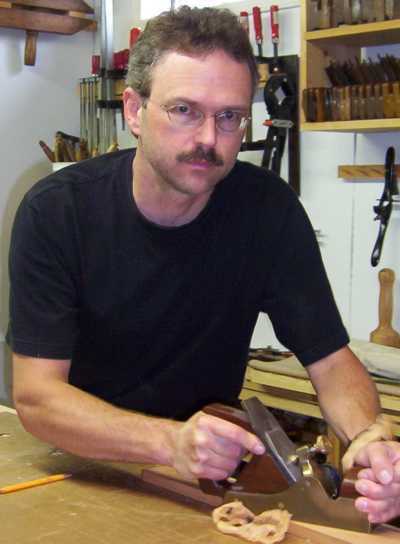
>I've got a couple of simple molding planes I have purchased at antique stores and I just got a real nice one from a dealer. I've played with the small ones, but the new one is an ogee. What is the procedure to use one? Or can you point me to a good reference? I'd like to get some more if I can figure out how to use them!
>Make sure your blade is sharp. Get some poplar or soft pine to play with. Set the blade to take wispy shavings. Use your hand and fingers for a fence and carefully move the plane down the board. After a few passes, you should have enough of a profile for the plane to follow. If you want to do lots of hardwood mouldings, look for planes with a York pitch (50 degrees). The higher pitch works better on hardwoods and has less tearout. Good luck.
I found that it helps a beginner to clamp a straight edge to the work piece, as a guide fence. At least until one gains control of the plane. Then easy does it. Many light passes is faster and easier than a few hogging cuts.
To make a quirked plane work as an unquirked one, you simply need to add a small strip of wood to the bottom of the plane sole. This will act as a depth stop and prevent the quirk from being cut. A removable one can be made by including a strip of wood at the front and back of the sole strip. This makes a saddle that clips in place.
>The standard advice is generally 1) Sharp and 2) work back from the far end.
Sharp we all understand. Might be a bit difficult for those not used to honing stratge shapes at first, but the irons will get sharp eventually.
The working back from the end is often left unexplained. Yes it works, but sometimes it isn't obvious why it works. Imagine your stock does not have the mythical rising grain all the way along, like a 'normal' board, it has reversals. When you plane across one of the reversals you get tearout. Not good. But, imagine if you start at the far end, and the cut you are following is sloping downwards to the end. A slight grain reversal is more likely to be parallel to your cut now, instead of going against you. Clear as mud?
Hope this explains why you start from the end and work back. If it staill ain't clear, ask, and a diagram can be drawn...
Darrell
Wood Hoarder, Blade Sharpener, and Occasional Tool User