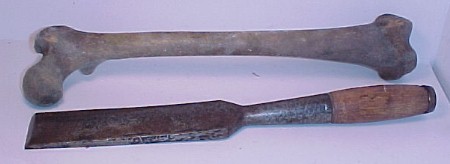
>Is it a registered ? a fermer? it had sides that are paralell and it is thicl from the bevei it is 3/16 thick and goes to just under 3/8" thick a real heavy socket chisel by PEXTO it feals good in the hand.
>There was t thread on this awile back (I think) If I remember correctly chisels with stright sides are "Registered" because you can register the chisels side with the mortice, or whatever your doing. Fermers are a bone and should not be used as a chisel, too brittle. Firmers on the otherhand I do believe are the same as registered chisels just a different name (I could be totaly off the mark here).
I think you're confusing "fermer," a phonetic spelling for a guy who farms, as pronounced by someone with a strong French accent in English, with "femur," the bone that keeps our hips from crashing into our knees.
Can't answer the original question, though my Audels books, resting at home, might be of use. I'll look tonight, if I can still think when I go home.
Bill, wishing he didn't have to work for a living...being a shop bum for a living would be so much more fun.
>According to my Audels "Carpenters and Builders Library" of 1965 (once considered one of the bibles of the trade), there are the following chisel types: paring, firmer, framing or mortise, and slick (well, and gouge too, but that's off-topic). The illustration of a framing chisel, however, resembles what Sorby calls a "registered mortise" chisel more than it does a pigsticker type mortise chisel.
I've got a 7/8" chisel that sounds similar to Ernie's, which I've used for serious chopping out of framing members on our house - I guess I was using it right all along and didn't know it.
Digressing: Audels also says that, independent of those classifications, chisels can be classified as to length, with three classes: butt (short), pocket (medium), and mill (long); as to handle attachment; and as to edges (bevel or plain). This implies a considerably wider diversity of chisel designs that we find in the catalogs today.
Digressing yet further: I've also got a couple of interesting very thick (but, again, thinner than what we think of as mortise) chisels, one 1" and one 3/4", on which the top face (that is, opposite the back) is curved like a slick's. Not sure exactly what advantage this gave - theoretical added strength? This feature goes unmentioned in the Audels book.
>As far as I can remember Sorby does not list "Registered mortise chisels" in their catalog. I know some retailers do but the last time I looked in a Sorby catalog they were just called registered chisels.