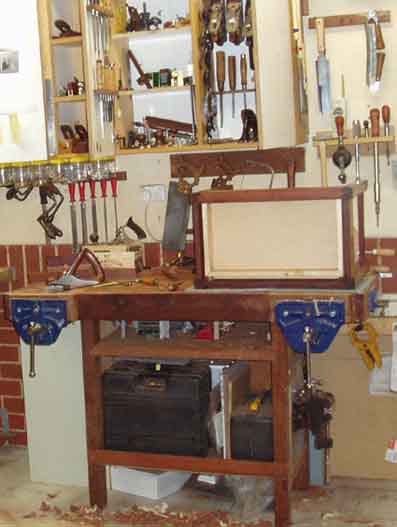
I've pondered this at length
Garrett in Victoria BC CA
>After seeing the photos of Ellis' bench, I decided it was finally time I had a proper one. I, too, will build rather than buy, but only because I've decided on a unique combination of requirements.
A bench is essentially a humongous multi-purpose clamp. A classic joiners bench such as Ellis built is a beautiful thing. But, it's very much intended for those who haunt this forum rather than power-tool users.
A bench is also a very personal thing.
My present 6 year-old 84 x 24 bench was literally thrown together in a few hours when we moved into the house, and is based on some recycled kitchen base cabinets, i.e. a unit of drawers and a double shelf unit that stores a lot of my tools. The top is 2 layers of 3/4 MDF faced with maple and drilled for Lee Valley's round bench dogs, hold-down, and Wonder Dog. (Altogether, a great system that could eliminate the tail vise.) I have 2 quick release Record clone vises on it, one for face and one for tail.
I mention all this because I'm trying to draw on my experience with this bench to build a better one.
My needs:
1) A little bit of every kind of work. Although I use power tools more than hand tools, I find myself reaching for the non-powered alternatives more and more often. (A consequence of more time and less hurry, I think.)
2) I desperately need under bench storage, but shelves are an unruly solution, especially for corded tools, and it's often awkward to get to the back of the bottom shelf.
3) At present, the bench, deliberately made at the same height as the Unisaw, sits behind the infeed end, and can serve as a prop for large panels. I now use a circular saw to cut panels to within 1/4" of final dimension and finish on the Unisaw, so rarely need this facility.
I have a similar series of cabinets on the outfeed end of the Unisaw with a single sheet of melamine particle board covering it and serving as the right hand extension table as well. (A vast space that quickly becomes the place where everything gets dropped.) However, I could really use more floor space and since those cabinets contain mostly non-woodworking stuff - plumbing, electrical, welding, etc., - I'm coming to the conclusion, however, regretfully, that they have to go and space found for this other stuff elsewhere.
Which, finally, brings me to my new bench.
It will have an Emmert pattern-maker's vise. The Emmert is the basis of Lee Valley's excellent Tucker vise, but is much less expensive. The one I've purchased from Woodcraft is an excellent clone. I might use one or both of the Record-style vises as tail vises - see more on this below - and will continue to use the Lee Valley round bench dog system. (Useful Tip: wine bottle corks are great dog hole stoppers to prevent small objects and dust from going down them.) A bench assistant - a vertical board that slides along the front of the bench and uses pegs to support the ends of long workpieces held in the face vise - is an absolute must.
The top will be a solid maple glue-up 24 x 78 - I'd like longer and wider, but the shop dimensions rule and it's enough - the thickness to depend on the Emmert's requirements. While MDF is stable and heavy, it can't stand moisture and is relatively fragile. No tool tray, because I've never felt the need and the ones I've seen just fill up with junk.
While I appreciate the merits of the classic heavy, open trestle base, I can't afford the space they require. My base unit will be the largest heavy-duty plywood cabinet I can squeeze between the vises. Since the Record clones require 12" free under the bench, if absolutely necessary, I'll eliminate them and use only Wonder Dogs instead even though they're much less convenient. The cabinet will consist of 4 drawers with full extension slides. The deeper bottom drawers to hold as many of my corded power tools as possible, the shallower uppers for planes and other hand tools not already hung on the walls. Under the Emmert, I'll attach a drawer unit to the side of the base cabinet using Lee Valley's sheet metal drawers with carpet underlay liners since they provide the largest amount of usable storage in the space available.
Finally, the whole works will be on lockable casters so the bench can do double duty as an outfeed table for both the Unisaw and the 20" bandsaw - fortunately both have the same table height.
And that's where I am to date. I collected a lot of information on benches from the internet, and recommend you do the same. There are lots of good - and not so good - suggestions and ideas, and they stimulate one's own thought processes. My bench will in the end be none of the ones I saw, but will incorporate bits & pieces from most, and reflect my own specific needs and priorities. I will start on it in a couple of weeks (as soon as I finish building and installing the Bill Pentz cyclone which I know I wouldn't need if I were to switch entirely to hand tools.)
Cheers, Garrett