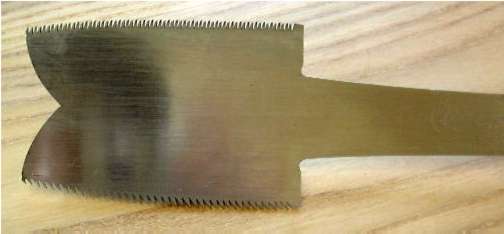
>I have an ECE veneer saw, which is the standard style that you see everywhere, with a double sided blade held on by two screws. The problem I'm having is that the blade is warped, both when it's installed on the tool, and when it's off. I tried flattening it on a stone, as well as flattening the mounting face. I even tried warping it back, all to no avail. The warp gets worse after the blade's secured on the tool. Anyone have any ideas? I see there's a french style of veneer saw that's different, and there are other styles, but they are rare.
>Common problem with those blades. Rather than having a simple bend where one side's convex, many of these have a maddening twist to them that's almost impossible to remove. If you can't tap it flat (I've used a rounded mallet over a lead block with limited success), then you can snap it in half and sandwich it between two pieces of wood, epoxying it in place, very much like the French saws you've seen. The advantage here is that you can get your hand over the cut, which to me is much more stable. Using a straightedge thick enough to give a good bearing surface against the blade (also, make sure your handle is low enough so that your fingertips can lightly press the blade against the straightedge), pull smoothly with a gradual rocking motion to slice veneer without following the grain. I hope this isn't too confusing.
Don't forget to sharpen these blades so they have a one-sided chisel-like cutting edge, and no set. What you're really aiming for is more a one-sided serrated curved knife than a saw. You can make a better blade yourself from a thin scraper or scrap sawblade if you're so inclined.
>you need to saw both on the forward and backward stroke, and there must be absolutely no set whatsoever. Then there's the problem of keeping the hand close to the cutting edge (if not over it, for that matter) for control and to get it to bear along the straightedge and restrict it from following the long grain, so it'd need a very short handle, too.
I had the same problem with this saw. I tried to beat it flat. Didn't work. I found that the formed dimples for the screw holes were slightly different width than the screw holes on the handle. I tried to file the holes and dimples so that they would line up better. Didn't work.
Then I found the saw linked below. Your knuckles get in the way of a tall straight edge if you use a chunk of MDF as a straight edge like I do. But it's straight and usable. There must be a supplier somewhere that has the traditional style veneer saw that's not a stamped out pile of crud.
I never did get very proficient with this. All my cuts require some dressing up before they were usable. I never did find an approach where I could consistently use the pieces right off the saw. I found that for easy to cut woods, I prefer using a knife. Only on really hard woods (wenge is horrible to cut with a knife), does the saw work a lot better.
>The only Japanese veneer saws I've ever been familiar with were of this type, and I was told that they are a modern adaptation (for today's thin veneers) rather than of antecedent design.
>I'd ask why must you? (That's a real question, not trying to be sarcastic.) Handles are no real issue, you can make them as short as the tang. As to control, there's plenty of it. Mind you, not trying to convince you on method; but the azebiki, which comes in several sizes, is a fine little saw for cutting into the middle of things.
>"I'd ask why must you? (That's a real question, not trying to be sarcastic.) Handles are no real issue, you can make them as short as the tang. As to control, there's plenty of it."
I think the problem here might be one of experience vs. theory/conjecture. If you were to try to slice one or several veneer sheets lengthwise, including 'lapped' sheets, I think you'd see why in a heartbeat. That gradual rock'n'roll of the blade is an oscillation (cutting about 1/3 to 1/2 in the 'away' direction before resuming the longer 'toward' stroke) that prevents the teeth from dragging; clearing them to avoid tearing the grain, and deepening and easing the saw into subsequent layers. As such saws generally cut through two sheets at a time, both edges to be butted together, even the slightest tear leaves a glaringly obvious gap. This is also why the blade is sharpened with one long chisel-like bevel. It yields the finest kerf, far less thick than an azebiki's .011".
Anyway, a chopper-style (hand above the cutting edge) seems very natural and intuitive. As for control, I find even the most common type of veneer saw with the short angled round handle less stable and controllable, but to each his own.
The azebiki, useful though it is, would be beyond my skills for sawing matched veneers and would not be my first choice to drag along a metal, phenolic, masonite, or hardwood straightedge. Great for sawing in the middle of a floor, however. You cut a lot of trapdoors?
(My apologies if all the above is incomprehenible. I rarely get interrupted so often in a week as I have been in the last hour. When it rains, it pours.)
>I see, thanks. I tend to use a splitting gauge for long cuts in thin wood. The cool thing about the azebiki I just got is that it's a really good saw, made by Miyano del Endo (Yataiki), designed so the teeth clear properly, they don't tend to get clogged. As to cutting in the middle of a board, there are all sorts of reasons, such as patching with veneer, starting long slots, cutting the inboard side of various cuts, and so it goes. I don't cut any trap doors.
Pam, who intentionally waited a couple of hours to reply so it wouldn't interrupt you so often
>A saw like that is a thing of austere beauty. Although I was grateful for the opportunity to try handmade Japanese saws, I found them stark, alien and intimidating, and there are very few things that have that effect on me. I'd tried the usual suspects before, of course; the replaceable blade dozuki and the obligatory ryoba, and I am fond of dozuki for cutting up small stuff at the bench, but these are just saw-shaped objects compared to handmade saws.
As for interruptions, thanks for the kind gesture. I have no right to complain, as I live almost entirely free of mundane responsibilities other than to pursue my various interests. In Massachusetts, I went nearly two years with my telephone ringer turned off, and it's been twelve years since I've been to shopping mall -- probably my two greatest personal accomplishments to date.
>Oh, oh, didn't know you were complaining, thought you were just getting a little over excited with all the activity; so I decided to parcel it out at longer intervals. I tend to be somewhat perverse, myself, so completely understand and empathize. :)
>Paul Sch�rch's site below shows a picture of what David is talking about. Paul and the sharpening technique are mentioned in the April Woodwork- without a picture. A google later I understood. I haven't had a chance to try it yet.
>Thanks Russ, I knew how to sharpen a veneer saw. Paul Schurch does amazing work! My problem is that the whole blade is warped. I may just buy another one, or try a different type.
>Thanks a bunch Paul! Yeah, they just punched those two holes for the screws in my blade also. Of course, there are cracks around the holes as well. I tried filing the hole's projection down, still didn't help. I'm giving up on this blade, it's too warped and won't twist back. Rockler has replacement blades, but I don't know if they are any better. What I find interesting is that all of these veneer saws of this type have what looks like identical metal support parts, so they must come from the same manufacturer. Only the handles are different between manufacuturers. Apparently, the blades are a bit different also, since Dieter Schmid offers three models, all with different teeth.
I see that the Pax Inlay saw could be used also, but I have big hands that would get in the way. I may email Dieter Schmid and ask him if he has any replacement blades that are flat. Of course, this is the high dollar method of fixing this problem, given the high value of the Euro at present.
>That's a really nice little saw David, but I have doubts about it being good for trimming veneer. I have big hands, and they'd get in the way of the fence if I tried to flush cut a couple of sheets of veneer with it. I would guess that the saw's teeth would have to be re-worked also, but I wouldn't really know without having one. Thanks again.
>Just to followup, last night I worked on the saw blade some more and got it very straight. I twisted it, I put it in a vise and yanked on it, I hammered it, I filed it, and it finally submitted to my will. The problem as I see it is with the dimples for the two screws. They aren't shaped right, and they make the blade twist and cup when the screws are tightened. As it stands now, I have the blade mounted on straight, but the screws are not flush. I need to pound on it some more.....
I decided against ordering another blade, figuring a new one would be just as bad. I want to try and fix this one before I go through the effort to make a new one from scratch.