WoodCentral Forums

Est. 1998 — 27 years of woodworking knowledge

Joint help needed

Posts

Joint help needed

#1

Joint help needed

John Johnston, West TN

>I am planning to reproduce an 18th century officer's camp bed. Plans for same are not abundant. I have located two possible designs.

In his 1803 The Cabinet Dictionary, Thomas Sheraton includes an engraving of a folding camp bed (showing limited detail), but includes the following text: "The pillars [bed frame corner]have each of them two rule joints, one for the part of it [bed post] above the seat of the bed, and the other for the stump part [leg] below it. And thus the pillars will fold upon each other, and the stmps turn up to the under side of the rail; andobserve, when the stump is turned down, as when the bed is in use, there is an iron hook and eye to keep it from turning from its place at K." So, Sheraton talks about a Rule Joint.

In the second case, I've come upon a photograph (attached) of one of George Washington's folding camp beds. I think I've also found a set of measured drawings of this very bed. The photo and drawings show a folding joint for the bed posts and legs that I think is called a Knuckle Joint.

Two questions: First, could someone direct me to a source for how to make by hand a knuckle joint? Second, is Sheraton's rule joint the same as a knuckle joint--just a different name?

Thank you for your help.
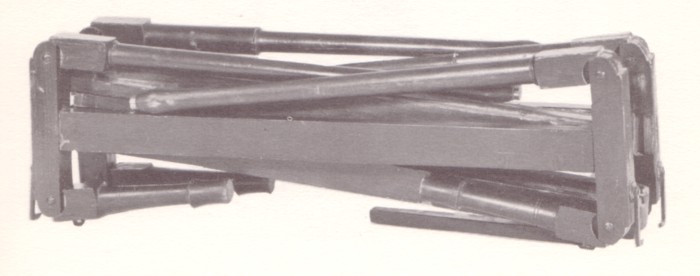

img

Re: Joint help needed

#2

Re: Joint help needed

Ed Mulligan, Cape Cod

>John �

British Campaign Furniture by Nicholas Brawer has many clear photos of collapsible furniture of all kinds, including beds. Brawer references your Sheraton info and has excepts from Chippendale�s book as well.

On a rule joint, the hinge and therefore the pivot point are mounted on the wood surface. That�s what Sheraton�s sketch shows. On a knuckle joint such as shown in the photo you post the pivot is �inside� the wood. Think of a finger joint with a metal pin placed through the fingers so they can pivot (and with appropriate wood removed to allow this to happen). Knuckle joints were commonly used on flying or pivoting legs supporting drop leaves on tables.

My experience with knuckle joints is that they must be very carefully made so there is no slop between the fingers. Also, they are quite weak because stress is carried by short grain. Using one on a bed leg as shown in your photo would be an iffy proposition. Of course for a repro which received little or no use it would be fine. The Encyclopedia of Furnituremaking by Joyce has a diagram of a knuckle joint,

Ed

Re: Joint help needed

#3

Re: Joint help needed

Sam simpson

>Hi Y'all,

John, Ed describes it very well. The analogy of the drop leaf table is a good one to use. The rule joint is the one that is on the table leaf itself (also known as a cope and bead) and requires metal hardware to act as the hinge. Whereas the knuckle joint is the one used by the leaf supports, whereby the hinge is created by interlocking the wooden knuckles, and only a metal pin is required as the pivot.

I would suggest that the knuckle joint would make a more handsome bed in appearance, but for durability and repair in the field, the rule joint is more serviceable and could bear more weight.

Regards Sam Simpson.

Re: Joint help needed

#4

Re: Joint help needed

John Johnston in West TN

>Ed, Thank you for your helpful reply. I've got Brawer's book, which is what led me to our local library to check out the Praeger reprint of the Sheraton book. The engraving in the reprint is clearer than in Brawer, but for the life of me I can't see evidence of any particular type of joint. I see the hook and eye to hold it, but there is a hook and eye on Washington's knuckle joint bed too. At any rate, I now know that a rule joing and a knuckle joint are different, and what a rule joint looks like.

As regards your second issue, the strength of the knuckle joint, I'm confused [which is certainly not difficult in this case!]. It seems that when the bed is unfolded, the weight on the legs would be on the long grain. I'm assuming the the pin through the center of the joint is not load bearing, but rather just serves to keep the joint together, that the load is borne by the mating of the corner frame, which would be in a long grain orientation, with the leg which would also be in a long grain orientation. I guess I don't undertand where the weak part would be.

Sorry to be so dense; thank you for your help!

John

Re: Joint help needed

#5

Re: Joint help needed

Ed Mulligan, Cape Cod

>John �

I'm glad you've found the Brawer book. Pretty neat, eh?

Referring to the Brawer illustration of the Sheraton engraving, for the legs I�m guessing the hinge for the �rule� joint is on an inside surface (opposite the hook and eye) and so is not visible in the drawing.

The knuckle joint will be vulnerable when side loads are present such as when the bed is being dragged across a floor or when someone �tosses and turns� while sleeping. The side loads compress wood fibers making the joint looser. Once it�s loose it will quickly fail. If only static vertical loads are applied it will be ok, as you suggest.

I�ll send a sketch of a rule joint via email.

Ed

Re: Joint help needed

#6

Re: Joint help needed

Charles

>The book Good Wood Joints provides instruction and very good pics on making a knuckle joint with hand tools.

Re: Joint help needed

#7

Re: Joint help needed

John Johnston in West TN

>The book Good Wood Joints provides instruction and very good pics on making a knuckle joint with hand tools.

Excellent! Thank you very much Charles, I'll get the book.

Cheers,

John

👍 This page answered my questions

Your vote helps other woodworkers quickly find the answers and techniques that actually work in the shop.