>I am about to start building my work bench in beech. I want a rather large bench with a traditional tail vise and the scandinavian style dog leg vise on the front. My starting point is Frank Klausz' workbench from Scott Landis' book on benches.
However, I am still uncertain about whether to include the toolwell or to aim for the integral flat top.
I only use handtools so it seems like a good idea to have the well to keep the cutting edges out of harms way (and away from my fingers). On the other hand it seems to compromise versatility when it comes to assembly operations.
>Wish I had added one. The whole benchtop becomes a junk collector. Also, I'm in constant fear of moving a project across the top and knocking tools to the floor.
>I made a similar bench just a deeper top with a tool well otherwise too much stuff is on the top. Your going to need a seperate assembly bench because when you need to work on a piece you get tired of taking everything off the table. My one tip is I will make the next bench lower 36" is to high for me.
>Build the a little wider but with a tool well - gives you the best of both worlds.
I like tools wells. A couple folding rules, an ECE scrubber, three or four chisels, dovetail template, scraper blades, mallet, extra fine ceramic stone, and some other stuff permanently reside there. Most everything else other than saws and clamps reside in two big, deep, hastily built but sturdy drawers in the workbench.
Tools wells and drawers benefit the working woodworker. They are anathema to the crowd who spends most of their time building storage/display projects for their shop.
>As someone mentioned above, discipline is the key to getting the best out of a tool well. My first bench had one and I junked it up. My current bench doesn't have one and I would like to have a safe place to set a plane, chisels, marking gauges, etc....If I had the room, I would like to have a larger bench with tool well and/or a rolling tool cabinet to keep my hand tools handy.
>What about a cabinet underneath that does not reach the bottom of the bench top. Then tools can be placed underneath to avoid having them inadvertantly knocked off. I'm sure there is a proper name for that type of space
My bench has to sit agaimst a wall. I built it initially without a tool well and used it in this way for a couple of years. I never seemed to have enough room to work frustration-free as there was always a couple of tools in the way. So I added a tool well at the wall side. It is easy to collect tools in this (and they do for a short while) but with a little dicipline it does tend to be a place of safety for tools in use. On balance I must say that a tool well is a very valuable part of the bench, particularly when you predominantly use handtools, and your bench is where you work.
>My bench base is a plywood box with three bays filled with shelves. I regularly have to dismount something in the vise to get to some tool. You can't rely on tools in a cabinet under the bench as storage you can get to in the middle of working.
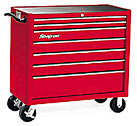
>When I (briefly) worked as an auto mechanic, we all had rollaway toolboxes beside our hoist, with no toolbox on top - see the link for an example. The top of the rollaway served as a workbench and place to set down tools (most procedures on a VW called for three to five tools - you got those out when you started, used them, then put them away before moving on to the next service procedure, just the way I keep thinking I'd behave if I worked in the shop full-time).
My current shoplet is too small, but if I moved, I'd consider either buying a rollaway for this purpose or, if I lived in a more humid part of the country, making a wooden equivalent or (I wince, but round tuits are sometimes in short supply) seeking out one of the plastic equivalents if time was limited, and having it near the bench where I could turn around and reach out for a tool.
Or, simpler and cheaper, you can get two- or three-level carts that are basically well-type shelves on wheels, most often in metal but sometimes in plastic, from the discount houses (in the U.S., the best one for this is Harbor Freight, aka Horrible Fright), that could be used the same way. Or you could make one cheaper than a lot of drawers.
Of course, if I got rid of the table saw, I could do this now - but I don't think I'm likely to do that...
>You can work with or without a tool well and have a good time. My current bench top is built pretty much like the Klausz bench in the workbench book, but without the tool well. I have cabinetry underneath as a base, similar to a Shaker style bench, and I have a pretty big wall hangiing tool box on the left end, about two steps from the center of the bench. I positioned the bench to be able to walk all the way around it, giving me storage room for crap behind it against the wall. This works good, but that being said, it would be more convenient to have a tool well in the bench top. I plan on building another bench this year, as I was given a maple tree a few years back that I had cut into 3" thick stock just for this reason. I hope to make it small enough to be reasonably portable, but big enough to work comfortably, and it will definitely have a tool well, because the tool well is more convenient. If you use the bench for working the wood and assembling the project, you can always put a cover sheet on the top if you need to have a larger area. Ideally you would use the bench only for working the wood, and a lower assembly bench beside it to assemble the project.
>My bench top is mounted on a Noden Adjustabench. It can be adjusted from a height of about 26" to around 44". There isn't room underneith for a cabinet and it is also on castners. It's an extremely versatile bench, but versatility comes at the expensive of some storage area, perhaps. (I'd still have a problem with something under my bench because of my big holdfast.)
I keep almost all my tools in a steel tool box just like the one you posted. (Heretic! Radical!! Get the kindling; tie him to the post....)
I glued up a panel of 3/4" pine that fits right into the little recess in the top (meant for another tool box to sit on). Tools that need to be kept near at hand rest on the pine top. There's room for lots and lots of them.
Having the tool box a step away I find I return more tools to their proper place than I would otherwise.
>I picked up a Craftsman top chest a couple of years back, and many small hand tools live happily in its drawers - pencils, layout tools, Yankee screwdrivers and push drills (the ones I use - the backup supply lives elsewhere), rasps, staplers, various junk like putty knives, etc.
I understand that, in more humid parts of the country, this might not be a good solution, as the metal can develop condensation; but it works well here. Surprisingly, the drawers stay dry even in the wet winters of the North Coast here, but it's cold when it's wet, so I think the condensation problem is probably less of an issue.
>A strong yes on the tool well and an echo of the advise to have a seperate assembly surface.
Don't give in to the clutter argument, just put things away as you change from one task to the next. That way you can stay focused on woodworking instead of breaking your concentration to look for tools.
The only tool that stays in my tool well is a small wisk broom that I cut to the width of the well.
>William provided a link to Geoffry's website. Geoffry offers different options in purchasing the bench legs. The legs are the primary part of the system. They easily adjust from around 26" to 44" in height. They weigh around 75-80 pounds (combined). You supply the bench top. I put a 66 in. Sjornberg bench top on mine. I bought the top from Woodcraft, but you can build your own. I also made the stretchers. I think he will custom build the stretchers if you tell him the exact length of the top you plan to use. Castners are also an option. He custom builds these also. I ordered the legs and the castners from him at a woodworking show in Nashville last fall and really like the bench. The ability to adjust the height, in effect, is the equivalent to having more than one bench.
>It's the stock clamped in the vise across the face of the bench that I've had to dismount, not the vise itself. I suspect I'll always have stuff stored under the bench, both because I can't imagine having a shop big enough that I don't need to do that, and because the stuff provides useful ballast - but if/when my shop gets larger, I don't plan to store stuff I need frequently under the bench.