Handtools for fluting?
Wendell @ Murphy, TX
>I've included a picture of some fluting I did on the face frame of a bookcase with a router. I would like to do fluting with hand tools in the future. What is the best handtool to do this with?
Wendell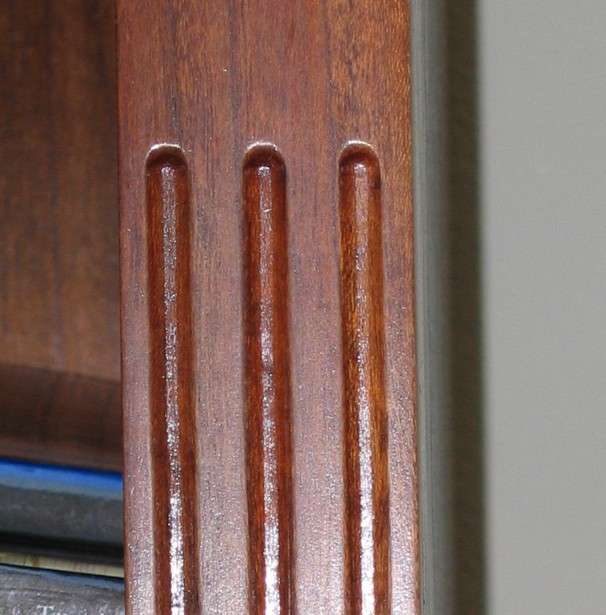
Est. 1998 — 27 years of woodworking knowledge
Handtools for fluting?
Wendell @ Murphy, TX
>I've included a picture of some fluting I did on the face frame of a bookcase with a router. I would like to do fluting with hand tools in the future. What is the best handtool to do this with?
Wendell
Re: Handtools for fluting?
William R. Duffield, on the Cohansey
>Lie-Nielsen #66 Bronze Beading Tool
Re: Handtools for fluting? *LINK*
walt quadrato
>Simple hand beader like a Stanley 66 or a Windsor beader would get you there. There's a L-N repro of the stanley and L V makes a dandy little beader; the Windsors are expensive when you can find them. But you can make one easily enough; "scratch beader". Can't find a link right now, maybe someone else can help out on that. What you want is a sturdy "L" shape. The short arm is your fence to register against your work..the long arm is split to accept your scratch stock. You can make any profile with some scrap bandsaw or hacksaw blades.
You can also do this with a Stanley #45 or #55 combination plane..though I don't recommend this because of the large cash outlay.
Another possibility is a small radius gouge and a very steady hand.
There's many ways to skin this particular cat....
walt q
simple beader
Re: Handtools for fluting?
Bill Houghton, Sebastopol, CA
>There was a discussion of scratch beaders a week or two ago. Search on "scratch," I imagine, and you should find it. Bugbear (Paul Womack) has a fabulous design on his website, referenced on one of his messages in that discussion.
Re: Handtools for fluting?
dennis mcdonaugh
>That cove looks rather large. I think you would do that with a wooden moulding plane rather than a Stanley 66. Some moulders need an auxilary fence, others have a built-in fence that follows the first cove.
Re: Handtools for fluting?
Wendell @ Murphy, TX
>They may look large because I zoomed in. The face frame is only an 1-1/2" wide. The flutes were made with core box bit with a 1/8" radius and 1/4" cutter width. Is this too large to do with scratch stock?
Wendell
Perhaps you could use this LV tool *LINK*
Angus Barclay, in New Zealand
>
Hand Beader
Re: Perhaps
William R. Duffield, on the Cohansey
>We discussed the relative merits of beaders, and of scraping vs. planing just a little while ago, and back a while ago, and several whiles ago, too. I would have provided the L-V link and, depending on my mood, the link to BugPear's better tool, and the links to these various and sundry discussions, as well. I even considered suggesting the Windsor Tool Works Unobtanium Scratch Beader, even though there was a really good chance that it was not the right tool for the job, due to its limited distance between the scratch and the fence. Neither the Windsor tool site not the query provided these specifications. Had my mood been different, I might have suggested searching for "scratch" or "66" or "bead". However, the question was for the "best" method. Therefore, IMHO, there was no other answer, especially since no information was provided in the query as to what might have really been important, other than RESULTS without a ROUTAH.
I still think the Lie-Nielsen is the best recommendation, because I know it works well, is very well made, and has the greatest probability of cutting the required flutes, at the surmised distances from the edge of the stock.
By now, you may have guessed that one of my pet peeves is "shoot from the hip" unequivocal requests for "the best".
Wendell, please don't take this rant personally. It's not really your fault that I went off the deep end on this one. Consider the potential for righteous indignation had you asked for the quickest solution or the cheapest solution to your problem :^) One serious shortcoming of the routed flutes in your photo, that should be easily correctable by just about any hand tool flute methodology, is the flat bottoms. And none of them will leave burnt wood that you will have to scrape or sand away later. So even if you don't find the best tool, or the best method, you are sure to find one that is better than the routah.
Re: Perhaps
Wendell @ Murphy, TX
>Sir William, I never take your rants personally. It's nice to see someone so passonite about tools. I probably should have phrased question more like : "What handtools can be used to do fluting?" Asking for the best tools is a very subjective question. I kind of suspected a scratch beader was the answer before I asked, but I wanted to make sure there wasn't some other tools that might be better.
Wendell
Re: Perhaps
William R. Duffield, on the Cohansey
>You might be able to use a molding plane, specifically a small round, but it will not be as easy to precisely start and stop the flute. Whatever tool I use for cutting the flute, I find that a small carving gouge, and the scraper blade removed from the beader, are usually necessary to clean up the flute ends.
If you study fluted quarter columns closely, you will find that most of them do not use stopped flutes. Instead the flute continues all the way to the end of the quarter round column and the capital and base are turned separately. That's why I usually use a router, or a laminate trimmer to cut mine when I want stopped fluted. But I always clean them up with a hand held scraper blade, which gets rid of the flat burnished bottom, and all other evidence that electrons died in their construction.
