WoodCentral Forums

Est. 1998 — 27 years of woodworking knowledge

Nails and Cross-grain Construction...

Posts

Nails and Cross-grain Construction...

#1

Nails and Cross-grain Construction...

Scott in Douglassville, PA

>Hey, all -

I posted this on the general message board, but am posting over here, too, 'cause I think y'all might have some specialized perspective on this.

I'm (foolishly) about to start, yet again, a Shaker blanket chest, based somewhat on ones that both Glen Huey and Norm have built. I've piddled with this for several years, making all my major learning-experience-type mistakes on each venture. Wanna believe I've ironed out the big kinks (jinx); I've got a stack of wood that's been collecting dust for years, more'n enough for this, and figure a Friday-chest kind of arrangement, smoothed over with milk paint, will make the wife smile for her birthday next month.

Ok, so my question is, and has always been, this: How reliable, or how appropriate, are nails for a project like this? There's a ton of cross-grain assembly here - the front and back panels of the chest, the web frames for the drawers, the shiplapped back boards. Is there enough give with nails (which both Huey and Nahm use for this project, with Huey citing historical accuracy) that the panels will last, split-free? Will the nails eventually loosen and slip, causing the thing to fall apart?

This'll be my first project using nails as a joinery technique - is it a good application here?

Thanks,

Scott, planning the maple/magnolia/poplar blanket chest
Re: Nails and Cross-grain Construction...

#2

Re: Nails and Cross-grain Construction...

George D. Huron

>I made one of these about 4 years ago using nails. It is still together.

Re: Nails and Cross-grain Construction...

#3

Re: Nails and Cross-grain Construction...

William R. Duffield, on the Cohansey

>With a traditional "five board chest" I know of no other joinery technique that works better than nails. That's the way the old ones that are still intact were joined. The nails provide necessary flexibility for the cross grained joints.

A frame and panel (or post and frame) chest is a different story. Mortises and tenons should allow that design of chest to remain intact for several centuries.

Re: Nails and Cross-grain Construction...

#4

Re: Nails and Cross-grain Construction...

Mark Harrison -- in Sydney, Australia

>This form of construction is called Steel Dovetail in Australia :-)

I've seen lots of real old country furniture (as distinct from the crap made today that is called country furniture) made with steel dovetails still holding together. With modern glues as well, I don't see any problem if this is what you want to make.

Re: Nails and Cross-grain Construction...

#5

Secret tricks

Adam Cherubini, NJ

>Hi Scott,

There are tricks to these pieces:

1) use repro cut nails- when aligned correctly, cut nails react tension better keeping the cross grain face from walking off the piece.

2) that face board must be quartersawn- This is a good example of how we get things wrong. We're right that the face is nailed to the side. But the originals used wide heartsawn boards for the fronts. Gluing up rift sawn crap isn't going to cut it.

3) The back should be a horror of nasty narrow scrap wood. Ship lap optional, especially through drawer area. Most authentic would be a really awful back. For a nice inside, glue fabric inside there.

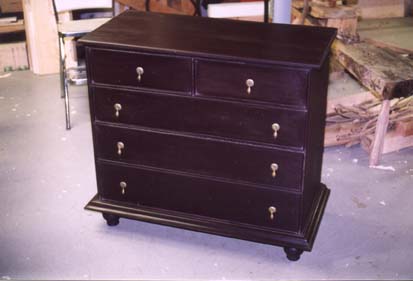
The chest over drawers below is similar. The bottom two drawers are real, the top, all fake. The front is simply nailed in place. A double arch molding covers the nail heads. The top of the chest hinges open and is "clinched" with an applied batten. It too is essentially quartersawn. To sink the nail heads under the moldings, I applied a countersink. Don't bash them into the case. It took me 4 days to make this case, so get cracking.

Adam


img

Re: Nails and Cross-grain Construction...

#6

Re: Secret tricks

Fred West in West Chester, PA

>Adam, beautiful work. Four days to make it but how long to finish it? Fred

Re: Nails and Cross-grain Construction...

#7

Re: Secret finishing tricks

Adam Cherubini, NJ

>Fred,

I finish pretty fast. I try to give myself a day to finish, but I sharpen my tools on finishing day, so its closer to half a day's work.

For whatever reason all my stuff seems to be painted. This guy has three coats of milk paint, rubbed out with scotch brite after the second and third coats. These three coats can go on in less than three hours. This is followed by linseed oil mixed with turpentine, then beeswax mixed with dry black milk paint.

When I can, I prefer to:

-add black to any milk paint. The black shines when rubbed.

-wax the following day to give the oil more drying time

Adam

Re: Nails and Cross-grain Construction...

#8

Thanks!

Scott in Douglassville, PA

>I feel a little more confident about it now. Checked yesterday, and I have nearly enough material for this. Gonna be an ugly mutt before the milk paint goes on, but I've got my fingers crossed.

Thanks again, and I'm sure I'll be posting many inane questions along the way.

Scott

Re: Nails and Cross-grain Construction...

#9

Re: Secret tricks

Scott in Douglassville, PA

>Thanks for all the info, Adam. Some additional questions for you:


1) use repro cut nails- when aligned correctly, cut nails react tension better keeping the cross grain face from walking off the piece.


I was already thinking along these lines. Any suggestions for sources and sizes for 3/4" stock?

2) that face board must be quartersawn- This is a good example of how we get things wrong. We're right that the face is nailed to the side. But the originals used wide heartsawn boards for the fronts. Gluing up rift sawn crap isn't going to cut it.


Surprisingly, much of the maple I have is quartered. Not sure why. I'll put aside those pieces specifically for the front. Good tip.

3) The back should be a horror of nasty narrow scrap wood. Ship lap optional, especially through drawer area. Most authentic would be a really awful back. For a nice inside, glue fabric inside there.


Don't worry - I've got some pretty scary stuff I'm using on the back boards. Question about finishing the interior, though - I know better than to finish with oil-based finishes on the inside, but would milk paint and wax be ok? There'll a bunch of clashing wood visible from the inside; I'd kind of like to minimize the migrane factor. Other suggestions?


It took me 4 days to make this case, so get cracking.

Oh, yeah - I'm fast in the shop. I'd like to actually deliver a present on time for once, though...

Thanks again,

Scott

👍 This page answered my questions

Your vote helps other woodworkers quickly find the answers and techniques that actually work in the shop.