WoodCentral Forums

Est. 1998 — 27 years of woodworking knowledge

Krenovian planes

Posts

Krenovian planes

#1

Krenovian planes

Clay Craig in Miami

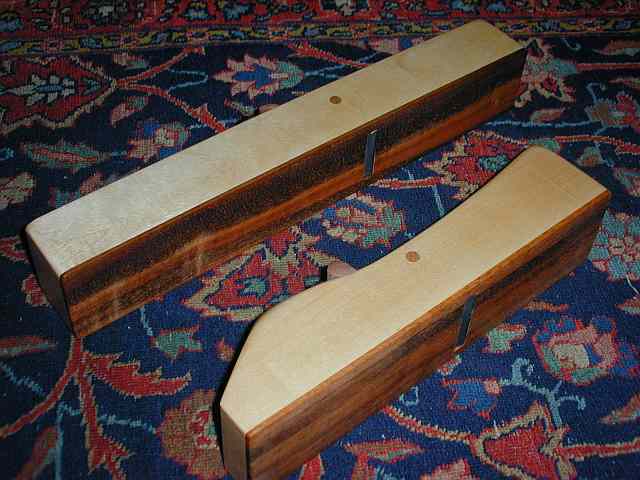
>I haven't sorted out enough yet to know whether this is properly a 'shop shot' or a 'sighting' or what - but they are definitely hand tools, so here they are!

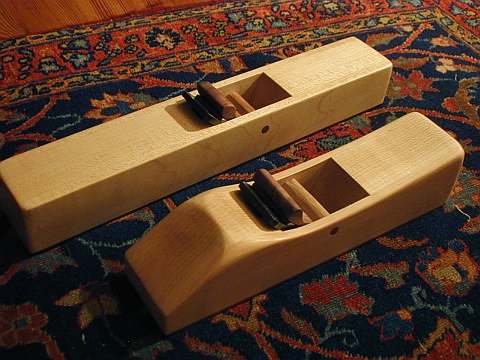
Maple bodies and cheeks, goncalo alves soles, hickory pins and loquat wedges, Hock blades, finished with shellac. Made these in CA last summer at CofR, and they shave like a charm. If this works, I'll also try to post a shot of the soles.


img

Re: Krenovian planes

#2

the soles

Clay Craig in Miami

>Here are the soles, for whatever they may be worth seeing.

Clay


img

Re: Krenovian planes

#3

Re: the soles

Pam Niedermayer - Austin, TX

>They are gorgeous, Clay. How do they work?

Pam

Re: Krenovian planes

#4

Re: Krenovian planes

Steve Knight

>looking good. quite a collection of woods for sure (G) but why goncalo alves for the sole? not super hard or oily. but I have seen it used before.

Re: Krenovian planes

#5

Re: the soles

Clay Craig in Miami

>Pam,

I assume you are asking "Do they work well?" rather than "On what principles do they work?"

If so, they work very well indeed. Not enough use yet to tell how the soles will wear, but they will draw translucent hard maple shavings. I got some kudos on these from the guys at 'my new shop,' and they seemed to earn me a smidgen of wood cred. (I admit to some trepidation when Simon, a British 30-year woodworker, asked to try them and clamped up a piece of cypress. Cypress is no particular challenge, but I hadn't set them since they were shipped out here from CA recently. Happily, they performed as hoped for him. I just started renting bench space at an amazing shop here in Miami, I promise I will get around to writing up those details. Among other eye-poppers, the owner has what must be thousands of board feet of Cuban Mahogany (mahogani sweetensia or something like that?) stickered up in the rafters. Cuban mahogany grows in S. FL, and he gets it when the trees are cut down or hatracked. Some of it is over 2" thick, 30" wide, and 12+ feet long. Truly drooly.

Steve - In truth, I am going from my (deeply flawed) memory and guess work from appearance in calling the soles goncalo. Doesn't look like ipe or lignum - I just think that's what they are, and the material was chosen because that's what the school issued us to make soles from! (After this, when they issued us some very muddy green-gray poplar to make a wall cabinet, I trotted out for a wood run and bought myself a piece of (rowed and fuzzy) mahogany - didn't want to put in all the effort and end up with a piece that I found unattractive. I ended up putting quite a few woods in that one too - cedar shelf, redwood burl door panel, etc. I'll post a pic of that cabinet next week when I have some time at the computer.)

The wedges were made from loquat just as a little piece of home - loquats are common down here. Indeed, there are lots of tropical fruit trees of which I rarely if ever see mention of the wood - guava, avocado, mango, sea grape, gumbo-limbo, etc etc. Some (papaya, palms, I think most citrus) would be too stringy/pithy, but others seem to have promise.

Anyone work with any of these tropicals and have some guidance?

Clay
Re: Krenovian planes

#6

Re: Krenovian planes

Jeff Schmidt (KY)

>Goncalo Alves is specifically recommended for plane soles by David Welter (of CR) in his article in FWW on making Krenovian planes.

Re: Krenovian planes

#7

Re: Krenovian planes

R.J.Whelan

>Craig ... most elegant; how appropriate to show the planes on a Persian carpet. I spent some time @ CofR several summers ago and still remember the thrill (and trepidation) when invited to try out a couple of JK's personal planes .... rj

Re: Krenovian planes

#8

It is goncalo.

Ed Snow

>Thy might be able to get something else here but goncalo meets the needs and is the most available of the sole woods.

Re: Krenovian planes

#9

Re:performance

Pam Niedermayer - Austin, TX

>Great that they passed the test. And your new shop sounds great, too, very smart way to get going quickly, have some help, all that good stuff. And the mahogany, what a treat.

Pam

Re: Krenovian planes

#10

Re: It is goncalo.

Steve Knight

>it's a nice looking wood but for a sole a oily wood does a better job. I rather see it as a body it looks very nice.

Re: Krenovian planes

#11

Re: Krenovian planes

Richard

>What issue of FWW does David Welter's article appear?

Re: Krenovian planes

#12

Re: Krenovian planes *LINK*

Jeff Schmidt (KY)

>Fine Woodworking No. 126

September/October 1997


FWW #126 Contents

Re: Krenovian planes

#13

Ask William Duffield

Don Thompson, Cutler Ridge, South of Miami FL

>He has an amazing amount of information about SoFla trees, including the imports and so-called "undesirable" exotics.

Re: Krenovian planes

#14

Re: Krenovian planes

Don Thompson, Cutler Ridge, South of Miami FL

>Great looking planes, Clay.

...and the rug makes a good backdrop, now that we know you are an oriental rug conservator!

Re: Krenovian planes

#15

When were they applied?

Dan Moening

>My understanding of this technique is that a blank is sawn into three pieces: the "body", and two checks. The throat is then sawn out, the checks glued back on and viola!

Ok, thats the Readers Digest version ;-)

Did you glue the sole on before the checks were cut, and thereby cutting the throat into the sole at that point? Or if the sole was applied later, how did you cut the throat into the sole?

Dan.

Re: Krenovian planes

#16

Re: When were they applied?

Clay Craig in Miami

>Sorry, I missed this question when you posted it - sole was applied later, and mouth was cut into it, before attaching it, with a plunge r**ter and chisel (IIRC).

The David Welter article in the 10/97 issue (#126) of FWW lays out all the details (and measurements, such as they are) and is almost exactly the way they teach it at CofR in the summer plane-making class.

Clay

>>>>>>>>>>>>>>>>>>>>>>>>>>>>>>>>>>>

My understanding of this technique is that a blank is sawn into three pieces: the "body", and two checks. The throat is then sawn out, the checks glued back on and viola! Did you glue the sole on before the checks were cut, and thereby cutting the throat into the sole at that point? Or if the sole was applied later, how did you cut the throat into the sole?

Dan.

👍 This page answered my questions

Your vote helps other woodworkers quickly find the answers and techniques that actually work in the shop.