WoodCentral Forums

Est. 1998 — 27 years of woodworking knowledge

Angled Chair M&T's

Posts

Angled Chair M&T's

#1

Angled Chair M&T's

Pam Niedermayer - Austin, TX

>According to a Homestead Heritage class, using hand tools, when confronted with a non-90� M&T, you should angle the tenon and keep the mortise 90� to the leg.

According to the Frank Klausz video "Making Mortise & Tenon Joints", in the project using mostly a mortiser and table saw, he says to angle the mortise and keep the tenons at 90�.

So, my questions are:

1) Is this a difference in the tools used? I know I'd hate to have to chop a precisely angled mortise with chisels; whereas it's quite easy to cut an angled tenon. With machines, it's quite easy to cut an angled mortise, much more difficult to cut the tenon.

2) Or is there a structural dimension to this decision? Is there some strength preference for one method or the other?

Thanks,

Pam

Re: Angled Chair M&T's

#2

Re: Angled Chair M&T's

Jeff Tapke

>Pam, I'm a like, real new to woodworking, but from a strength view, I would think leaving the Tenon alone, and change the angle of the mortise would be the strongest joint, rather than angling the tenon and having the grain of the wood at an angle, if this doesn't make sense, it could be because I can never remember which is a mortise and which is the tenon. ahh, the male part should be left as aligned as possible I would think. There, better said. I hope...maybe..OTOH...

Re: Angled Chair M&T's

#3

Re: Angled Chair M&T's

Pam Niedermayer - Austin, TX

>Thanks, Jeff, the tenon is the male part. I just don't know, it could be that the internals of an angled mortise could be just as vulnerable as an angled tenon, which could make cheek blowout more likely.

Pam

Re: Angled Chair M&T's

#4

Re: Angled Chair M&T's

William R. Duffield, on the Cohansey

>Are you concerned about chairs such as those in the Chippendale style, where the back legs are angled both horizontally and vertically? In these, using a mixture of hand and power tools, I angle both the mortise and the tenon.

Angling the mortise vertically is easy with any number of techniques, using the curved cutoff from the back of the leg as a jig. This cutoff is needed even if you are hand chopping the mortises. The minimal amount of strength lost from the tenon by doing this is inconsequential. Angling the mortise in the other direction, so that the tenon can be cut on the tablesaw before putting the twist in the side rail is a really bad idea. This would significantly reduce the strength of the back leg. (If you look at a Philadelphia style chair, which are characterized by a through mortise and tenon, the alignment used in this direction is obvious.) For the side seat rail, I start with stock that is about an eighth wider than you would use for a front or back rail. Then, I figure out how much I need to twist the back of the rail to meet the angle of the back leg, and draw three diagonal lines, one on the face, one on the bottom edge and one on the back end, and plane a flat to these lines with a #7. (Sometimes, I start with a belt sander to remove most of the waste.) I use this flat, against the saw fence to cut the cheeks, and against the saw table to cut the outside shoulder. I cut the inside shoulder, whose fit is not as critical visually, with a backsaw and trim it with a shoulder plane. After fitting and assembling the side rails to the back legs and back seat rail assembly, I remove the aris in the outside surface of the side rail with a card scraper.

There are probably lots of other ways to do it, but this works for me.

Re: Angled Chair M&T's

#5

Ditto William.

R. J. "Sam" Simpson.

>Hi Y'all,

Excellent answer William. Both ways it is.

Regards Sam Simpson.

Still pondering bees eating carnuba wax.

Re: Angled Chair M&T's

#6

Re: Angled Chair M&T's

Pam Niedermayer - Austin, TX

>I wasn't concerned with both horizontally and vertically angled mortises yet; but since we're there, I see that Kingshott recommends cutting the bearing end of a vertically angled M&T to 90� so the tenon won't slide ("A Woodworker's Guide to Joints", last paragraph in the M&T chapter).

Thanks for the info about angling both mortise and tenon, makes perfect sense. I don't understand Angling the mortise in the other direction, so that the tenon can be cut on the tablesaw before putting the twist in the side rail is a really bad idea. at all. Are you saying that angling the mortise vertically is OK but not angling the mortise horizontally?

And why would you twist the back of the side rail? (I'm interpreting twist to mean the rail will no longer be straight.)

Thanks,

Pam

Re: Angled Chair M&T's

#7

Re: Angled Chair M&T's

Richard Gillespie

>Pam

Until last May, I worked in a local furniture factory doing small production runs with furniture. Some of those runs were chairs, rocking chairs and sofas. We used machine cut mortises and and machine cut tenons. The mortises were cut at 90 degrees and the tenons at whatever angle or compound angle that was required.

In my opinion, doing it this way keeps the tenon cheeks perpendicular to the tenon and gives a better fit. It would seem to me to be the same for hand cut tenons.

On rare occasions, I would have a tenon break off, usually just behind the cheeks, because of a contrary grain pattern. That risk was covered in a production run by making a few extra pieces just in case. Of course, the break off would occur during glue up and you would have to scramble a little bit.

Re: Angled Chair M&T's

#8

Re: Angled Chair M&T's

Pam Niedermayer - Austin, TX

>Thanks, Richard, that's great that the tenons that were going to fail did so during glue up, rather than after delivery. And it also seems that maybe this is not a tools-used driven decision. Very interesting.

Pam

Re: Angled Chair M&T's

#9

Re: Angled Chair M&T's

Adam Cherubini, NJ

>Pam, William

Angling the mortise in the other direction, so that the tenon can be cut on the tablesaw before putting the twist in the side rail is a really bad idea. This would significantly reduce the strength of the back leg.

While I sincerely don't doubt what you say, here is another opinion (not mine).

"The back rail mortises entered the leg at ninety degrees, but the side rail mortises had to be angled into the leg to match the outward spread of the chair's side rails and stretchers. Angling the mortise rather than the tenon left maximum woo at the point of a chair's greatest stress. The angle of the chisel making the cut could be checked with a precisely angled piece of wood set on the surface being mortised."

Chairbuilding by Mack Headley Jr.

published in "Colonial Williamsburg Historic Trades volume I"

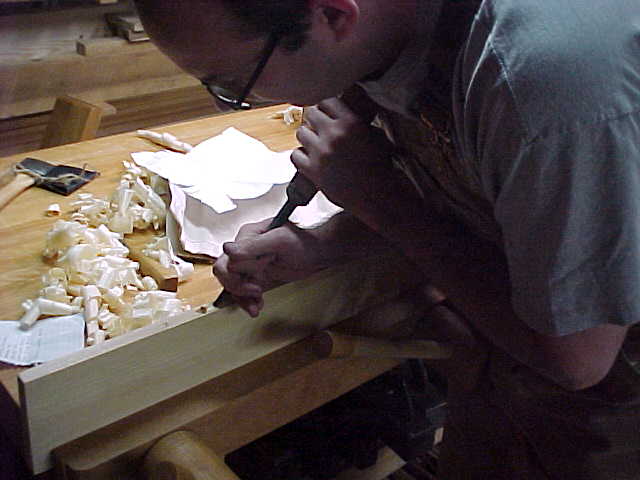
Here's a picture showing the technique I use for mortising. In the case of an angled mortise, its good because pounding is kept to an absolute minimum and the chisel is easy to control. You'll never need to pare mortise sides when they are prepared this way.

Adam


img

Re: Angled Chair M&T's

#10

Re: Angled Chair M&T's

William R. Duffield, on the Cohansey

>Pam,

Adam, and Headley (and also Eugene Landon) are correct. I got a little ahead of myself when I was writing the description. I will try again. There are three angles you have to worry about when laying out and cutting the mortises and tenons joining the side rails and the side stretchers to the back legs, not two as implied by my hastily written response.

The bottom of the legs are much closer together than the crest rail. The twist that must be put in the stretcher is as I described it. The cheeks of the mortise and tenon must be parallel to the side surfaces of the leg. As I stated, to facilitate this, it is easier to layout and cut the tenon after the corner has been removed from the outside face of the side rail.

Viewed from the side, the back legs are for all practical purposes, vertical at the point where the seat rails join them. Therefore, the angle of the ends of the mortise and the tenon is moot, as long as the tenon is somewhat shorter than the mortise. Glue and pins will hold it vertically. When viewed from the side, however, the side stretchers are not perpendicular to the back legs where they meet. I still think sufficient support is provided whether you cut the top and bottom of the stretcher mortise at an angle to match a straight tenon, or trim the top of the tenon to fit a mortise cut perpendicular to the front face of the leg at that point.

My explanation fell apart in attempting to address the third angle. The seat is significantly narrower at the back than at the front. Therefore, the side rails and also side stretchers do not meet the front surface of the back leg or the back surface of the front leg at the perpendicular. I think it is important to the strength of the chair for the grain to run straight from the base to the end of each tenon in its entirity.. Therefore, the long shoulders of the tenons must be cut at other than a right angle, and the mortise must also be "chopped" (or better, use the technique Adam suggests) or drilled and pared at an angle that is not perpendicular to the face of the leg. It has been a while since I have done any of these, and maybe my memory has been getting a little mushy. I looked up an old reference from FWW, Sept 1986, where Eugene Landon explains his methods for making the mortises. It is worth looking up. In any case, the saw kerf for the shoulders of these are not perpendicular to the faces of the rails. Scribe them before you cut them, cut them close, and then pare to the line with a chisel. You can undercut the inside of the shoulder, closest to the tenon a little, so you get a tight fit at the surface. But be very careful how much you undercut, because you may have to remove some of the surface of the rail after you have glued it to the legs.

Let me know if you any more information from the Landon article I have, which is reprinted in Traditional Furniture Projects, the Best of FWW.

Re: Angled Chair M&T's

#11

Re: Angled Chair M&T's

kees laan

>I think graindirection is the startingpoint.

Look at the way greenwood post and rung chairs and welsh stickchairs are made.

Never an angled tenon.

I also know of a old chairfactory here that they use not totaly dry wood and haven't seen a angled tenon in their chairs.

Chairmakers who use angled tenons often use epoxyglues to make the joints stronger.

And they work -most of the time- with KD wood.

kees

Re: Angled Chair M&T's

#12

Re: Angled Chair M&T's *LINK*

Pam Niedermayer - Austin, TX

>You don't need angled M&T's in post and rung chairs. All the members are round; so all you need to do is make sure the angle at which you drill 90� is correct (my take on John Alexander's "Make a Chair From a Tree" video). As to factories, Tony in the general message forum commented on the furniture in the Ethan Allen catalog which had had all its angles removed.

Thanks,

Pam


Tony's message on Lonnie Bird/Ethan Allen

Re: Angled Chair M&T's

#13

Re: Angled Chair M&T's

Pam Niedermayer - Austin, TX

>Thanks, Adam, pretty clear that Headley thinks the angled mortise is preferable because it leaves the most wood, cool.

On your motising technique, that's quite a right hand grip you've got there, not something I'd want to do with a Japanese mortising chisel due to extreme blood loss. :) Other than the grip, what is this method and how is it different from chopping?

Pam

PS I tried to find "Colonial Williamsburg Historic Trades" and found only a number of pamphlets on every trade except woodworking.

Re: Angled Chair M&T's

#14

Re: Angled Chair M&T's

Jeff Schmidt (KY)

>The other advantage of Adam's technique is that it is easier to establish a square mortice than by pounding from the beginning of the process. Once the shoulders are established, they will continue to guide keep things square, even if you decide to get more agressive with use of a mallet.

Re: Angled Chair M&T's

#15

Re: Angled Chair M&T's

Pam Niedermayer - Austin, TX

>I honestly can't tell what that technique is, Jeff. It's clear that Adam's not pounding. Is he picking out the first bits by using a mortising chisel as a paring and digging chisel? I do know there's no way I'd hold a Japanese mortising chisel that way.

Thanks,

Pam

Re: Angled Chair M&T's

#16

Re: Angled Chair M&T's

Pam Niedermayer - Austin, TX

>William, thank you, wanted to let you know I'm working on parsing your message and will go to the library tomorrow to get the FWW book. I suspect the only problem with your previous message was giving my knowledge of traditional furniture more credit than was due, Sam and Adam seemed to understand it immediately.

Pam

Re: Angled Chair M&T's

#17

Re: Angled Chair M&T's *LINK*

Jeff Schmidt (KY)

>I hope Adam won't mind if I provide a link to his OLDTOOLS post in which he describes his technique.

Jeff


Adam on Mortising

Re: Angled Chair M&T's

#18

Re: Angled Chair M&T's *LINK*

Pam Niedermayer - Austin, TX

>Thanks, Jeff, I'll give it a try. That link also led me to Old Mill, home of Gene Landon, where some amazing sounding classes are given.

Pam


Old Mill Cabinet Shop

Re: Angled Chair M&T's

#19

Gene Landon

Jeff Schmidt (KY)

>In the infamous FWW no. 23, which is dedicated to period furniture, there is a section focused on Landon in which the author writes,

�Landon�s attentions take him close to anachronism. He doesn�t use sandpaper. He owns and uses more than 500 molding wooden planes, having sold his shaper long ago because �you don�t get the little tear-out imperfections the old guys did.� His other power tools he expects similarly to get rid of; he uses them rarely and always obliterates their markings with traditional hand tools. If the glue blocks in an original were split or hewn out with an ax, Landon gets out his 18th century hatchet. The result is a piece that, as Ionson [Harold Ionson] might say, is rather rough inside. I ask Landon about the constructional shortcomings that initiated my search. Does he glue panels crossgrain to leg posts as they originally were? Of course. Does he not expect them to crack? �It delights me when they crack,� he says. �It makes them more authentic.�

That should warm your heart, Adam. :-)

Now, I know that Mr. Landon did not discard some his power tools because I have seen him use them in FWW articles over the years. I wonder to what extent hand tool techniques (outside of carving) are still emphasized in his seminar classes? I would love to hear from anyone who has attended his classes. He is certainly in a class by himself in terms of understanding 18th century construction techniques as he has restored many originals � a great source of learning.

Re: Angled Chair M&T's

#20

Riki Tiki Tavi alert

Pam Niedermayer - Austin, TX

>Jeff, thanks, now you've got me drooling to take a class. You've also helped me highjack my own thread, which must be some kind of low vis a vis Riki. :)

Pam

👍 This page answered my questions

Your vote helps other woodworkers quickly find the answers and techniques that actually work in the shop.