WoodCentral Forums

Est. 1998 — 27 years of woodworking knowledge

Bishop combination backsaw

Posts

Bishop combination backsaw

#1

Bishop combination backsaw

Tom Huett

>Hi All,

Just picked up a Bishop combination backsaw (Wuest's patent of 1/9/06) for $12.00(plus tax)). Does anyone out there utilize this saw for everyday woodworking? Any info about it would be appreciated. I have already looked at DATAMP. Thanks in advance.

Tom
Re: Bishop combination backsaw

#2

Re: Bishop combination backsaw

Ernie Miller Topeka

>I used to use maine all the time but after getting a couple disstons sharpened rip and cross cut I sold it off on ebay couldn't see using what some people consider colectors items. Mine was sharp and worked great. The handle didn't fit my large handes and was a little uncomfortable. I knnda miss it for the gizmo factor but not realy.

Re: Bishop combination backsaw

#3

Re: Bishop combination backsaw

Tom Huett

>Thanks for the info, I will probably sharpen it and use it.

Tom

Re: Bishop combination backsaw

#4

Re: Bishop combination backsaw

Roger Nixon

>Good price! You have a gloat there. One of the neat things about that saw is the built in depth stop. Ought to be very handy for sawing grooves, dados and sliding dovetails.

Re: Bishop combination backsaw

#5

Re: Bishop combination backsaw

Tom Huett

>Thanks Roger,

I was beginning to think no one would notice! The amazing thing is, that it is still pretty darn sharp. Since I don't have any other back saws it was a very fortunate find.

Tom

Re: Bishop combination backsaw

#6

Dummy me....

Dan Donaldson

>I don't know what it is. Could you post a picture?

Just curious;-)

Re: Bishop combination backsaw

#7

Re: Custom Handle Simmonds *PICS*

William R. Duffield, on the Cohansey

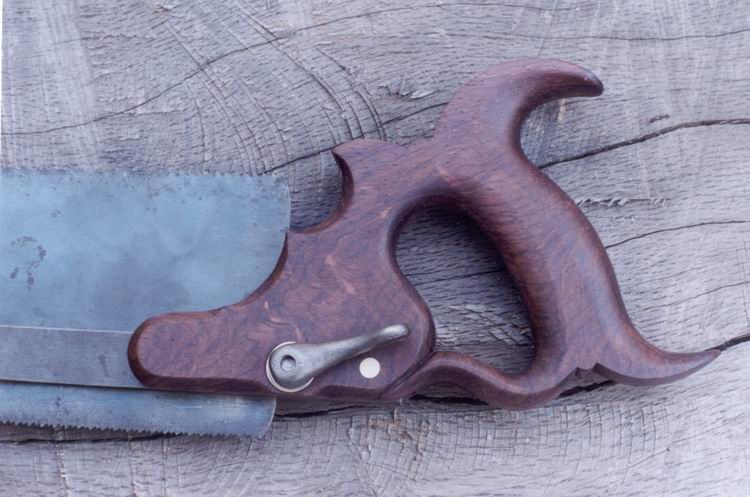
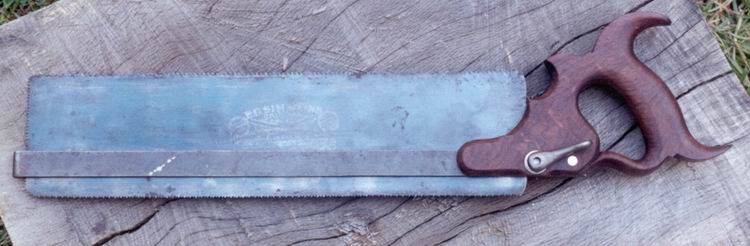
>These photos, of one with a custom handle, are Brian Buckner's, whose tools are hosted on Sandy Moss's website.


Re: Bishop combination backsaw

#8

Re: Custom Handle Simmonds *PICS*

Tom Huett

>Thanks Mr. Duffield. Thats it (except for that great handle). It is a lot like a Disston #14 backsaw EXCEPT that the toe of the blade is located relative to the back by a set of rack teeth whereas the Disston has a bolt and wingnut. You can see the rack teeth if you look closely at the toe end of the blade. (probably way more than anyone wants to know)

Tom

Re: Bishop combination backsaw

#9

Re: Oops - Simmons, not Simmonds

William R. Duffield, on the Cohansey

>

Re: Bishop combination backsaw

#11

It's 'cause he couldn't find it in a dictionary

Bill Houghton, Sebastopol, CA

>

Re: Bishop combination backsaw

#12

Re: OH MY GAWD!

William R. Duffield, on the Cohansey

>Google almost couldn't find it either, and a large plurality of the references were also misspelled. I did find someone that thinks it was made by Disston for Simmons.

Re: Bishop combination backsaw

#13

nice handle

Jack from Maine

>I saw one of those on ebay yesterday. For the first time. That is a neat lookin saw.---Jack

Re: Bishop combination backsaw

#14

Re: backsaw for a project

Ashley

>If any one of you could help me, I am doing a project for my stagecraft class and I was wondering if any of you could tell me what the proper procedure is for using a backsaw and safety tips. It would be a lot of help. thanks.

Re: Bishop combination backsaw

#15

Re: backsaw for a project

Joe Rogers, Northern Virginia

>The procedures are...well... don't try to cut anything but wood:-). There are some subtle skills that using a back saw require other than the strength to push the saw through wood. Several user aids are:

Always try to cut with the blade vertical. Orient the workpiece to allow this.This aids making a straight cut.

Don't try to hurry the cut. Let the weight of the saw drive the action. This is very important during the start of the kerf.

Add no pressure to the saw on the back stroke.

Keep your lower arm in line with the handle. Hinge your elbow and shoulder to move the saw.

Some sawyers use a mirror to watch the off side of the cut to verify the lineup of the kerf with the lay out line. Speaking of the lay out lines...be as precise with your layout as possible. Cutting to a line is the goal. Make sure the line is accurate.

Some people knife lines to lay out cut lines. This may reduce ragged edges and are definately more accurate.

Use a sharp saw. This reduces energy expended.

Use a properly toothed saw. Use a rip saw with end grain cuts and a crosscut saw to cut cross grain.

Other posters may have more tips and more important tips that I may have omitted.

Practice!

JR

👍 This page answered my questions

Your vote helps other woodworkers quickly find the answers and techniques that actually work in the shop.