Home Articles Forums Gallery Marketplace Videos

WoodCentral Forums

Knowledge You Can Build On — Est. 1998

Exotic Hardwood, Personally Sourced Worldwide. Inspected at Origin. Shop Rare Stock.

Power and hand together (4): preparing the drawer parts

Posts

Power and hand together (4): preparing the drawer parts

#1

Power and hand together (4): preparing the drawer parts

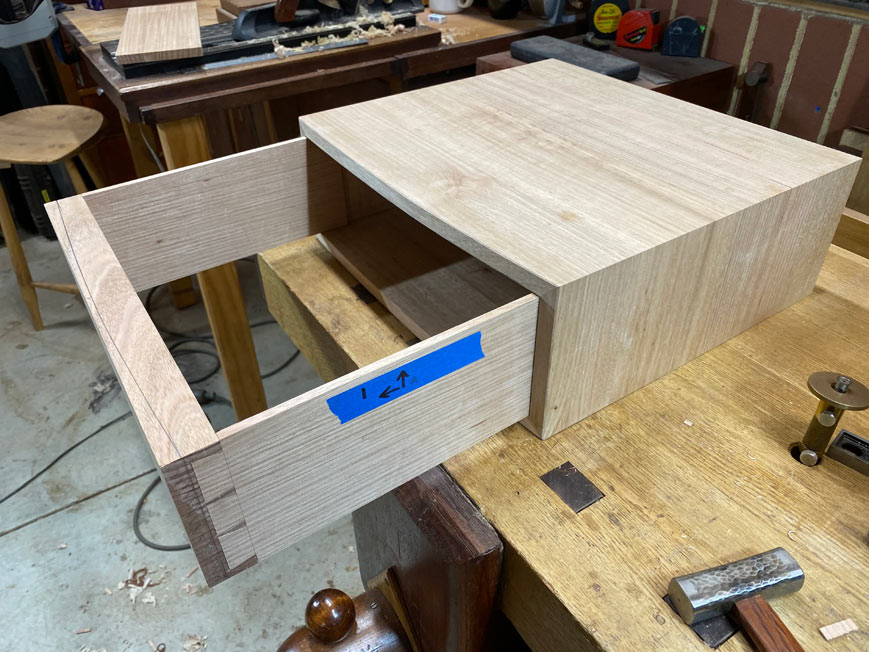
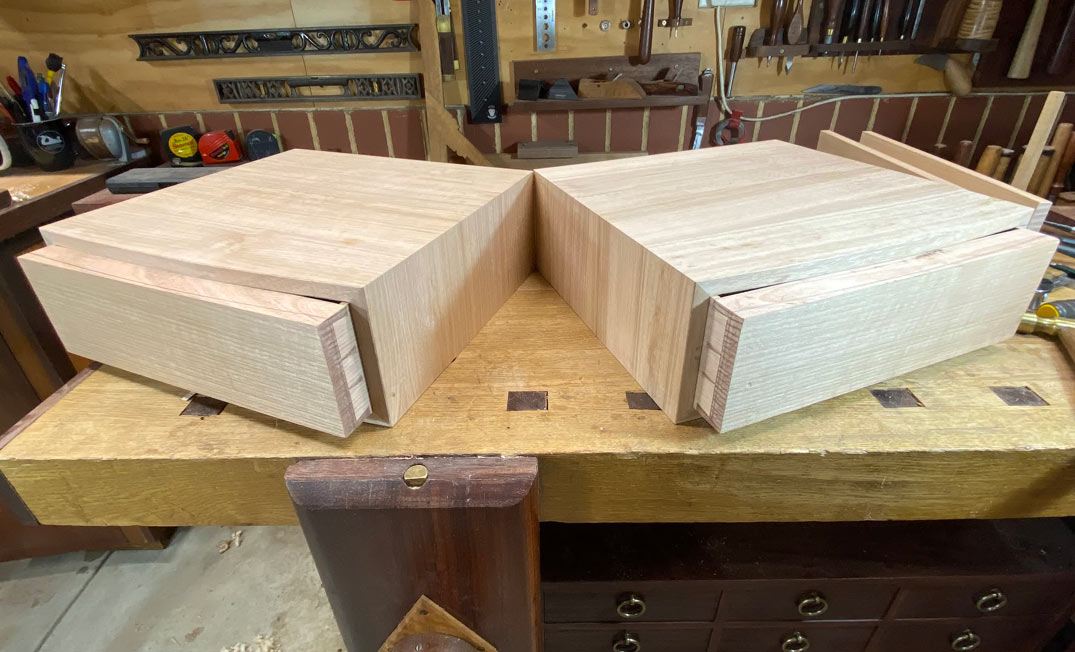
The night stands have two drawers each. Last time we looked at the Tiny Drawer. The main drawer will be bow-fronted. 
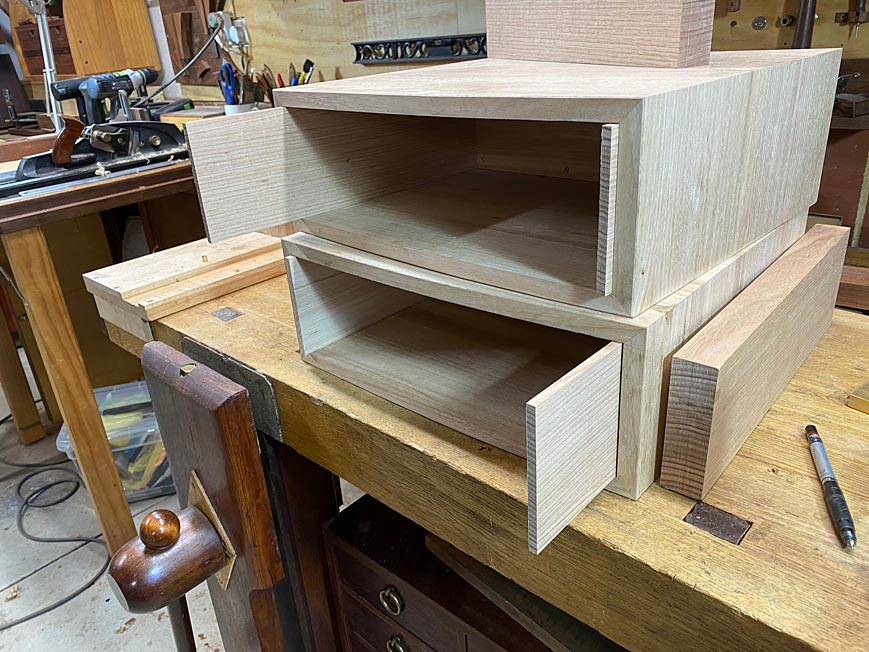
This post is about preparing the drawer parts - sawing them to size, and the tools and process used. Tomorrow I will be dovetailing the parts together to make the drawer, but I thought some here would be interested in seeing the machines and planes used to create a piston-fit drawer.

The usual way to rip boards to width is with a table saw, against a rip fence. This one is a Hammer K3, and the rip fence is augmented with the JessEm Clear Cut Stock Guides. They do a fabulous job of forcing a board against the fence, and this prevents any wandering.
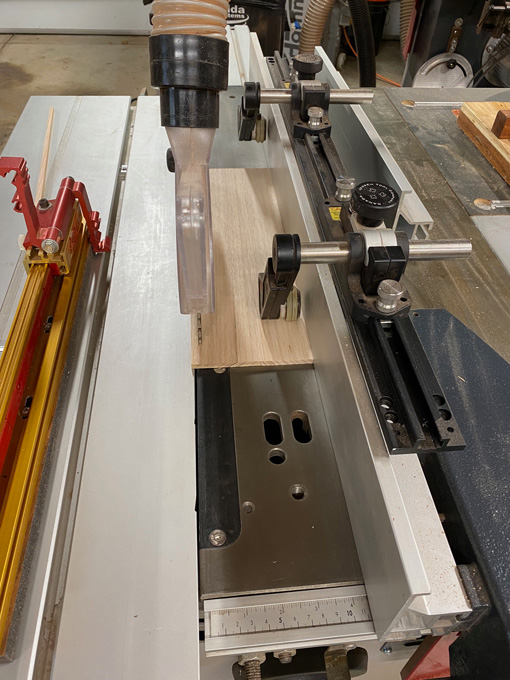
 

But another way to do this is to use a parallel guide on the slider. This is a particularly safe way of sawing, and is a lot easier to set up.
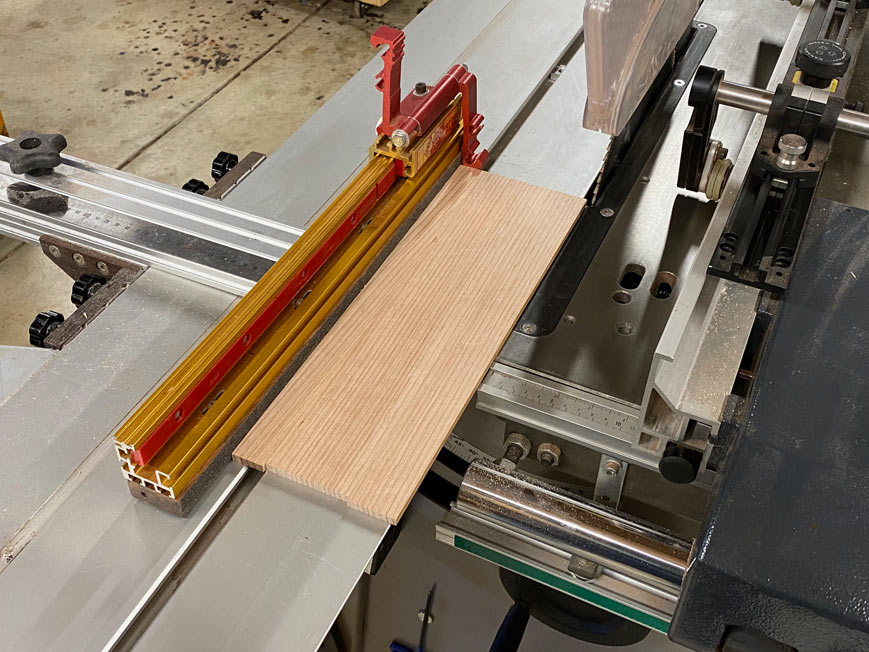


Crosscutting to square one end on the slider ...
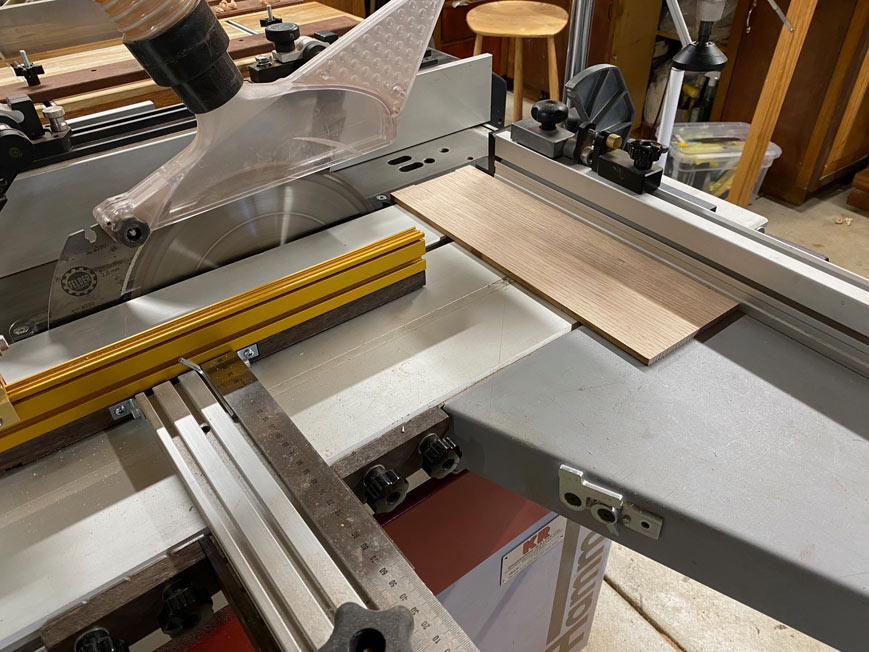
 

... and then cutting to size with the depth stop ...
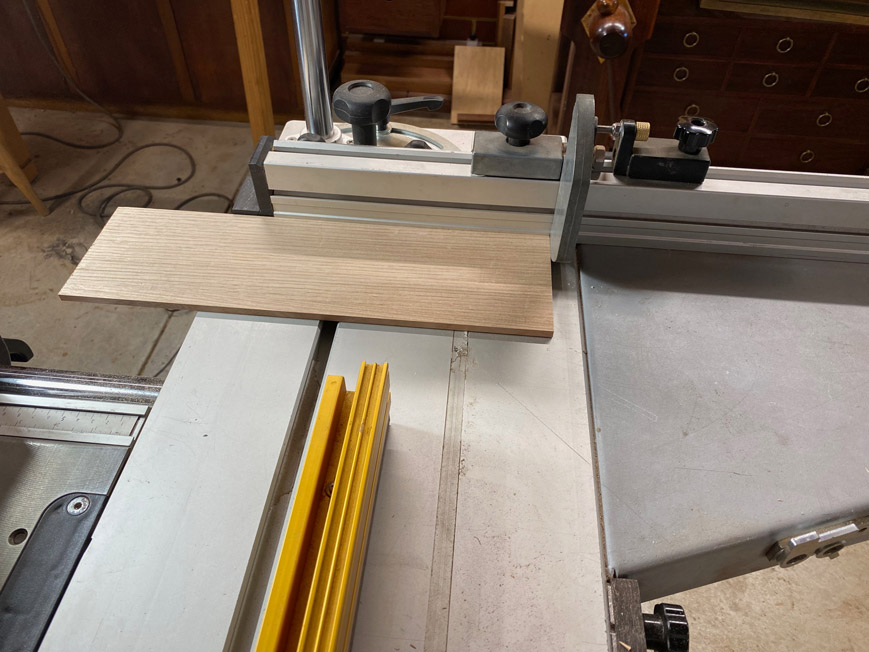


The machines do the coarse work, getting the boards close to size. The fine fitting is done with hand planes.

A Stanley #52 shooting board cleaning up the ends ..
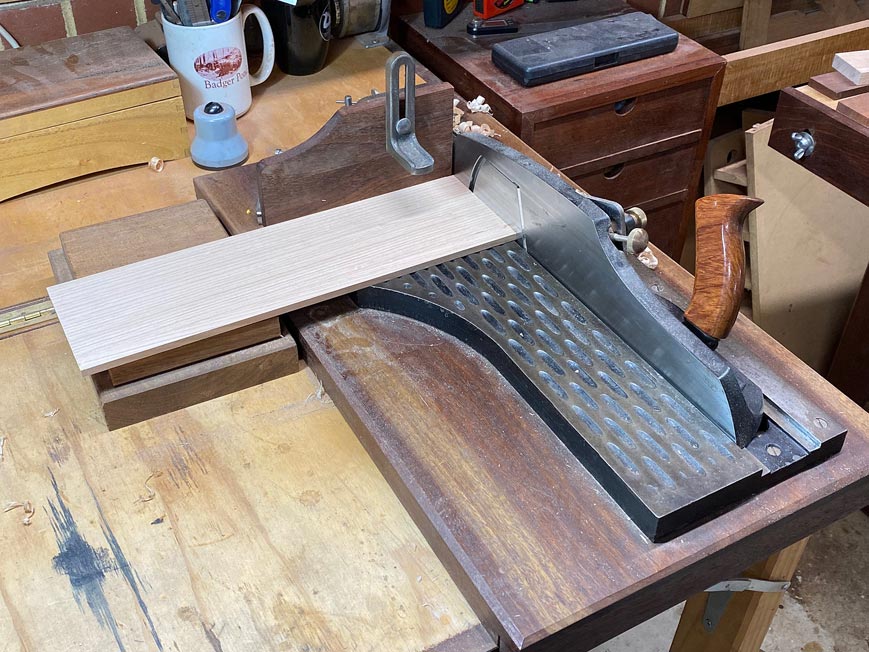
 

Here is a large shooting board planing the height of the drawer sides to fit the case (it sits on the outfeed of the K3 today) ...
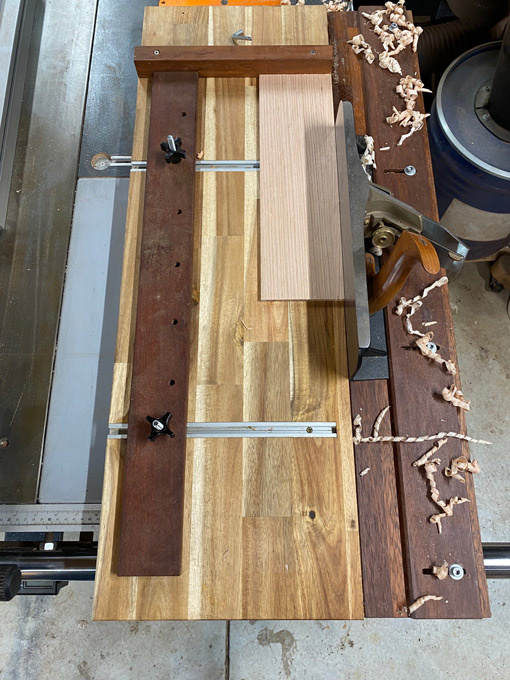
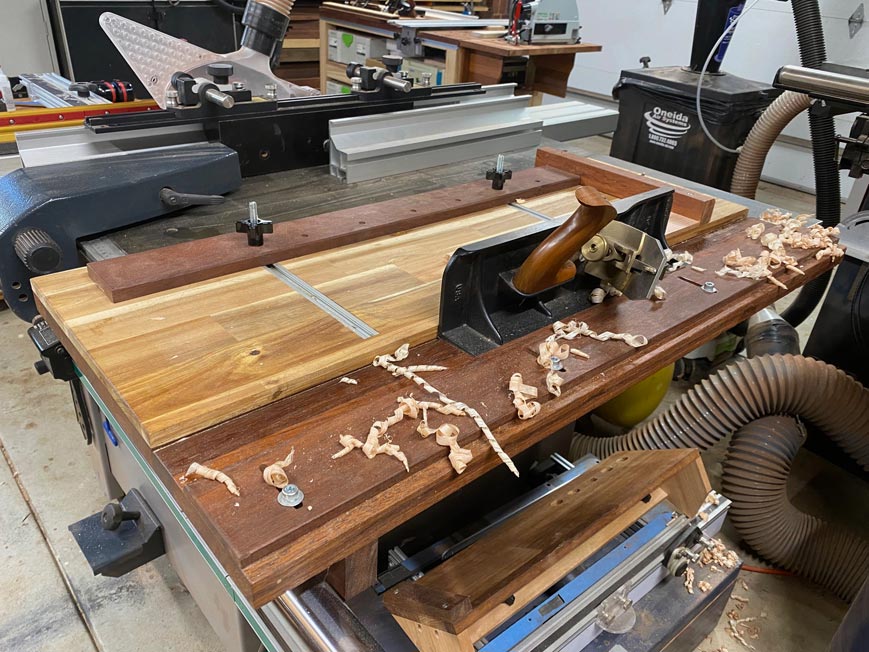


Removing any machine marks and smoothing the faces ..
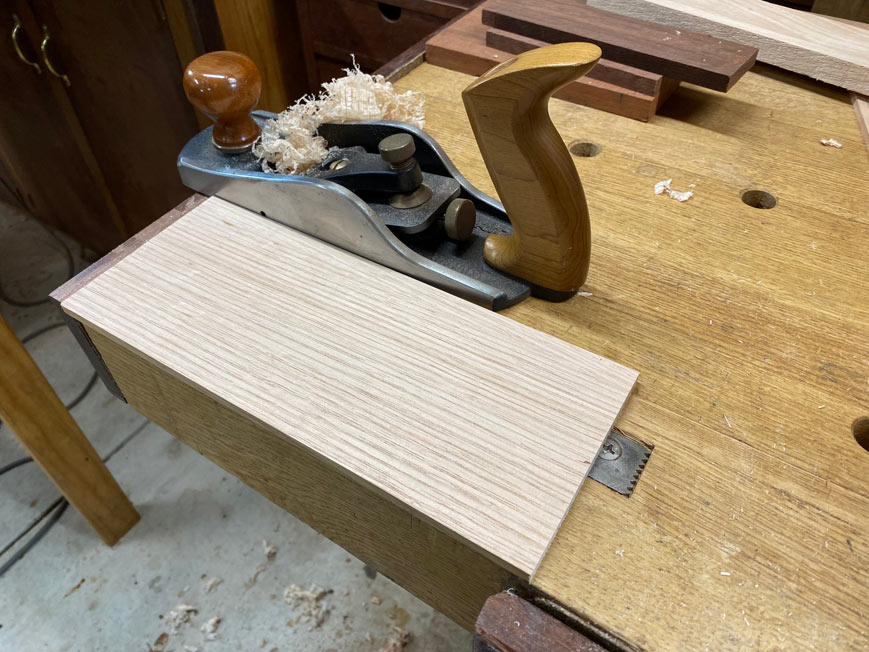
Labeled and ready to go with the next stage ...
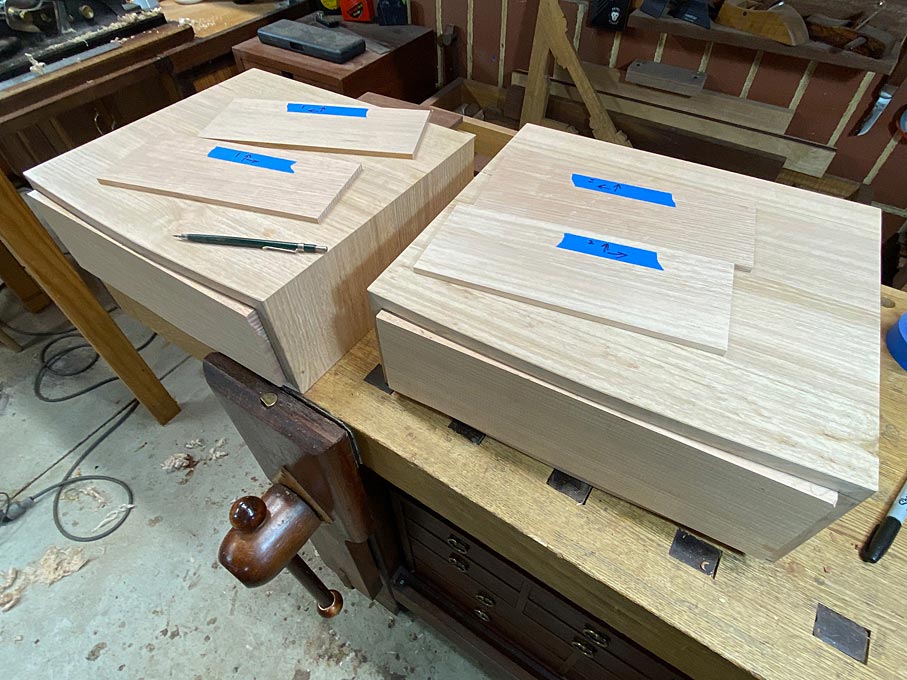
 

Tomorrow ...
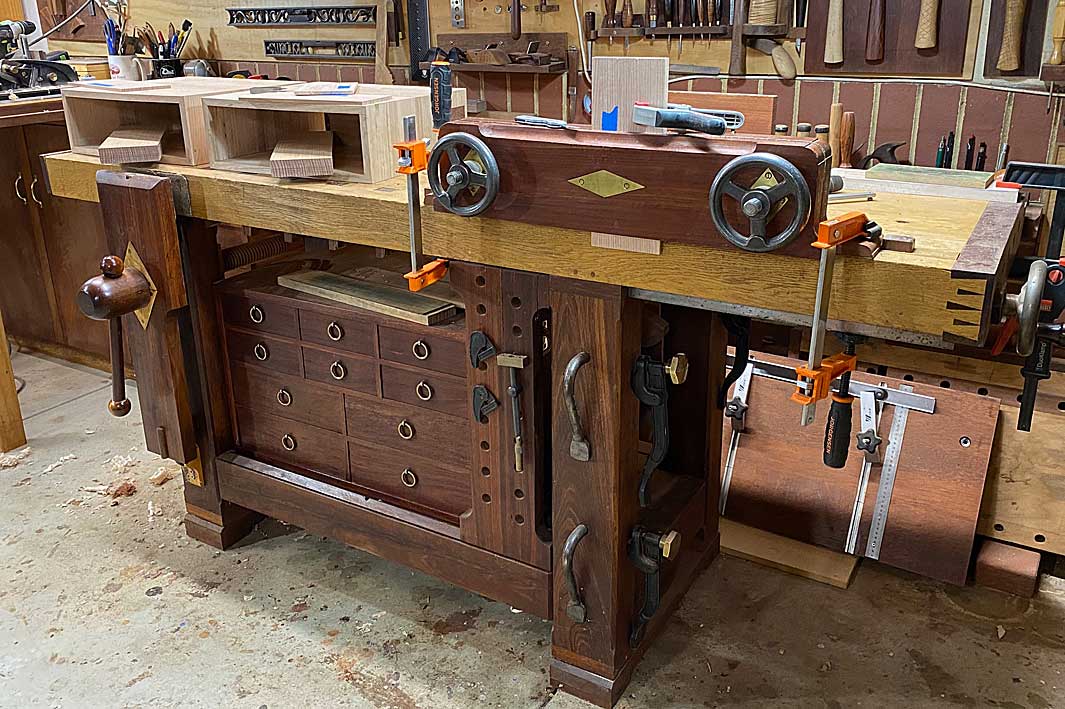
 

Regards from Perth

Derek


Re: Power and hand together (4): preparing the drawer parts

#2

Re: Power and hand together (4): preparing the drawer parts

How will you do the bow? Steam or bad saw the shape?


Re: Power and hand together (4): preparing the drawer parts

#3

Re: Power and hand together (4): preparing the drawer parts

Hi Ralph

If I was building the drawer first, it would be appropriate to laminate a curve, and then create the curve at the front of the case from this.

However, with the case built, the drawer front will be bandsawed to shape and finished with hand planes.

Regards from Perth

Derek


Re: Power and hand together (4): preparing the drawer parts

#4

Ellis Walentine

Decisions

I think the headline here is that making a piston-fit drawer is all about precision, from constructing the case accurately, to selecting drawer stock, to making and joining the parts, whether you do it with hand or power tools. 

Regarding this type of drawer construction, I wonder how you decide on the finish width of your drawer sides relative to the case opening dimensions. To what extent does it depend on the wood's grain orientation and its moisture content relative to the time of the year and ambient conditions where the piece will live? 

Your slider certainly simplifies stock prep. Regarding that parallel jig on your sliding table, is there an adjustment for the jig fence to keep it dead parallel to the blade? Why is the flip-down stop ahead of the board instead of behind it? 

Looking forward to the rest of this discussion. I recall editing an article by Ian Kirby on this same topic. Maybe I can dig it up for comparison. The nice thing about forum discussions is that diverse views add understanding.

Ellis


Re: Power and hand together (4): preparing the drawer parts

#5

Re: Decisions

Regarding this type of drawer construction, I wonder how you decide on the finish width of your drawer sides relative to the case opening dimensions. To what extent does it depend on the wood's grain orientation and its moisture content relative to the time of the year and ambient conditions where the piece will live? 


Ellis, "piston fit" does not mean tight. for me it means close tolerances without compromising function. I see this as more important when the drawer dimensions vary from the ideal.

The ideal drawer dimensions has the width less than the depth/length. If wider than long, there is a greater chance of racking. A tighter tolerance reduces racking.

To reduce wood movement, which could cause a drawer to stick, quarter sawn stock is the most stable. Also wood must be in equilibrium with its physical environment, as we all know. 

All these were considered before starting out.


Regarding that parallel jig on your sliding table, is there an adjustment for the jig fence to keep it dead parallel to the blade? Why is the flip-down stop ahead of the board instead of behind it? 

I built this parallel guide, and the design included adjustments to ensure that the fence would be perfectly parallel with the blade and square to the crosscut fence. http://www.inthewoodshop.com/Powered%20Tools%20and%20Machinery/ParallelGuideMk3HammerK3.html


The reason that the flip stop is at the far end is that (1) the slider moves forward and past the blade, and (2) the work piece is pushed forward into the stop, which is a more natural movement (for me). Plus it is trapped there, and there is less chance of it moving sideways. 

Regards from Perth

Derek


Re: Power and hand together (4): preparing the drawer parts

#6

Ellis Walentine

Pistons

..."piston fit" does not mean tight. for me it means close tolerances without compromising function.

Understood. To me the test of a perfect piston fit is to be able to push it in with one finger near an outer corner of the drawer front, and that the fit is close enough to push a puff of air out without any binding or racking.

Cheers,

Ellis


Re: Power and hand together (4): preparing the drawer parts

#7

Re: Pistons

Understood. To me the test of a perfect piston fit is to be able to push it in with one finger near an outer corner of the drawer front, and that the fit is close enough to push a puff of air out without any binding or racking.

Yes, that is my thought as well. 

Don't you love great Japanese masters who demonstrate their mastery of drawer making by pushing in a drawer and others pop out? You could do this forever, and slowly go mad! :)

From the 8 min mark ...

https://digg.com/video/japanese-joinery-drawers

Regards from Perth

Derek


Re: Power and hand together (4): preparing the drawer parts

#8

Ellis Walentine

Re: Pistons

Thanks Derek.

That was an amazing video. I hadn't seen a Japanese rabbet plane before. Wonderful workmanship.

Ellis


Re: Power and hand together (4): preparing the drawer parts

#9

Progress on the drawer front

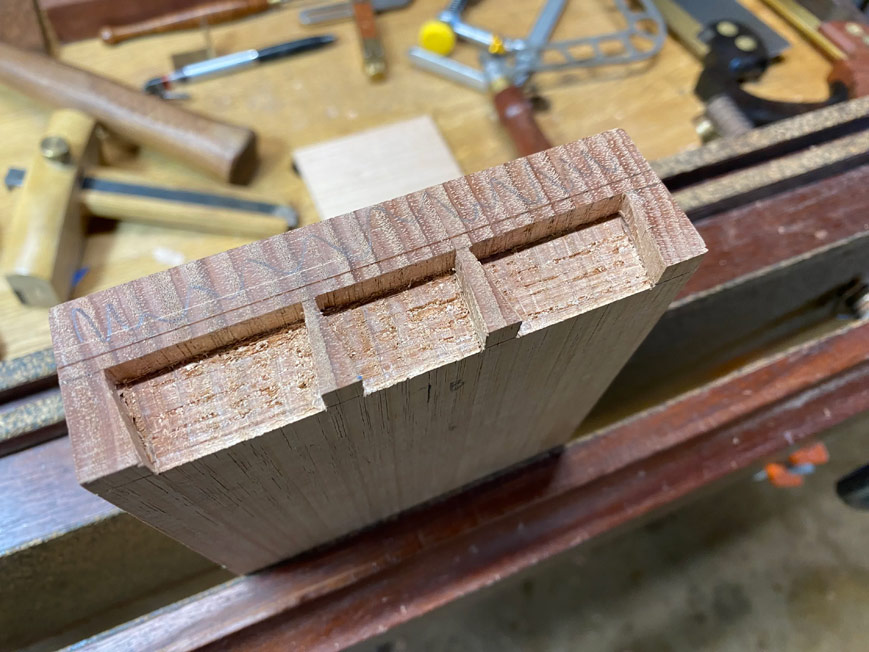
The half-blinds at the front are complete. It can be seen here that they are cut well back on the board to allow for the curve to be shaped ...


These are self-explanatory ...


Drawer fronts will be curved, first on the outside, and then the inside curved parallel to the front.

Regards from Perth

Derek


Re: Power and hand together (4): preparing the drawer parts

#10

Re: Progress on the drawer front

The use of quarter sawn (or at least rift sawn) boards for the drawer sides is a great point......one which I did not always do in making drawers; but, will be doing in all future drawers.......

Are you also careful in orienting the grain of drawer sides away from the drawer front to facilitate hand planing during final fitting??


Re: Power and hand together (4): preparing the drawer parts

#11

Re: Progress on the drawer front

Hi Roger

Tasmanian Oak (which is really a Eucalyptus) is supplied in quarter sawn lengths. I have taken advantage of this over the years to prioritise it for drawer sides. I this case (pun not intended), the cases and drawers are all Tassie Oak, as it is affectionally called in Oz. I find it particularly stable, which was another reason I believed the mitre ends could be un-reinforced. For example, I have re-sawn and jointed plenty and only got to it a few weeks later, and it has remained dead flat.

With regards the orientation of grain for drawer sides, I always prefer to run away from the fronts, if possible. However, a double iron plane has no difficulty in going against the grain.

Regards from Perth

Derek