Is this in reference to the fence? If so, it's something you can figure out with use (it wouldn't bother me) if the front of the blade is closer to the fence than the back.
If it pinches shut at the back, though, you're biasing things toward the back catching material and lifting/turning it (and kicking it).
Sounds like you're measuring between the fence and the blade front and back?
I would say 0.005" is trivial for woodworking, my saw has an old speed lock fence on it and I do this measurement every time I set the fence, aiming for parallel to slightly open at the rear using a tape measure. I can probably eyeball to the nearest 1/3 of 1/16" which would be 4 times the amount you're talking about.
The real test is in saw performance - is this proposed adjustment aimed at fixing a problem you are experiencing, or is it an adjustment looking for a problem to fix? That said, fence adjustment is easy on a Biesemeyer style fence and trivial with a unifence, if you have either of those go to it if you like. Won't do any harm other than consuming time you could spend on cutting wood, but the time is yours and understanding gained from spending the time that way is a plus. No downside really.
I measured the blade's relationship to the mitre slot using my calipers and a device to hold the calipers - wasn't measuring the blade's relationship to the fence.
Howard, others are talking about fence alignment but it sounds to me like you're describing the alignment of the blade to the miter slot -- measuring from the slot to the same tooth at the front and rear position.
So, assuming that's the question, it should be easy enough to tweak. The motor carriage on a contractor's saw is held to the underside of the top by bolts. If you loosen them enough to tap or nudge the carriage slightly, you can get rid of that small discrepancy. Whether or not you should is another question.
A .005" discrepancy shouldn't significantly affect anything you do -- rip, crosscut, etc. -- but it can make a difference in the quality of the sawn surface, if that matters to you. What happens is that, when the blade is out of alignment, the teeth don't follow each other perfectly through the cut, and you get tiny circular tooth scratches on the cut edges. Personally, I never use the sawn surface as my finish surface; I always plane or sand or joint or something to refine it, so I don't mind if it isn't almost perfect off the saw.
Fence alignment to the miter slot is a different parameter to check, and should be fairly easy to adjust, depending on your fence.
The tracking of the crosscut sled is one issue, the fence that is on it being perpendicular to the blade is a separate issue.
Deal with the two issues one at a time.
Get you sled / mitre slot aligned and sled tracking correctly first, then get your crosscut fence set to 90°after.
Make your sled.
Put a temporary fence on it. (The angle to the blade is irrelevant for this test)
Put your sled on the table saw and clamp a scrap of wood to trim against the fence.
Crosscut / trim the scrap of wood.
Pay attention to how it is cut, are the teeth touching at the front and the back as the wood passes by?
Check the crosscut end-grain look at the scratch pattern from the teeth. Are the scratches made by the front teeth, rear teeth or a crosshatch from both?
You can tell by feel and observation if the sled is toeing into the blade as it travels along, or toeing out or running parallel. If it is toeing into the blade a lot it press hard into the teeth at the rear of the pass and will probably leave burn marks.
On some table saws you can adjust the alignment of the mitre slot, by loosening the bolts that hold the table top on and giving the top a good smack with a mallet.
One way or another you need to get the mitre slot parallel to the blade, and you don't need any fancy equipment to measure it
Once you get you mitre slot and sled running parallel to the blade, then you set up your fence to cut perpendicular.
you're measuring from the miter slot to the blade. The slot and the blade have to be dead-nuts parallel. The problem you have with a contractor saw is that to adjust the slot-to-blade-tooth distance you may have to shim the motor mount points that are bolted to the table top. That will get fussy.
Keep in mind that .0005 variation from the blade to the fence is ok so long as the longer measurement is at the rear of the blade and you're using a splitter.
Just for laughs, I'd pull the blade and lay it on your table top (unless you happen to have a reference "flat" stone handy) and make sure that your blade's not bent or warped.
The same logic holds, 0.005" is pretty trivial in woodworking and the best test remains quality of cut. If you are having a problem with the saw not cutting well, then I would do this kind of measurement, but only then.
The blade will deflect far more than 0.005" in a miter cut if it's dull in any case, based on what I've seen before with miter saws. Carbide fools us easily, it keeps cutting long after its dull enough to do things like cause blade deflection in a heavy cut, which happens before burning clues us in.
There is no dead nuts. I dislike that expression because it gives people the wrong idea about measurement and encourages them to waste time on pursuit of the impossible.
The best machinists I've known were never much interested in the dimensions spec'd on first glance at a plan - they were always interested in the tolerance spec'd. To understand why that was is to understand that there is no dead nuts, among other nuances of metrology.
Sorry Mark, I'm not trying to be offensive to you personally, I'm just venting a bit about a pet peeve. It's just a peeve and shouldn't be taken too seriously.
There is a long and complicated discussion to be had in this. Suffice it to say, depending on how one works, this alignment should be as accurate as your measurement tools allow you to get. If you have a caliper, that is probably around 0.001", if it repeats well. If it doesn't repeat well, that is a whole other discussion, and probably not a relevant one.
You and Ellis both reminded me that not everyone works as I do, not everyone considers the table saw to be a roughing tool (as I do). I should go back and change all my answers to "it depends"
.perhaps the acid test for how good someone is with hand tools or how much of a hand tooler they are is asking them which need to be accurate vs. tolerable.
I don't mind hit or miss power tools. I can't stand substandard hand tools (which has nothing to do with cost with hand tools, beyond reasonability, but rather function and ability to stay set).
The mid grade market (what's the name for the saws that look like cabinet saws that aren't quite, and the now $2k bandsaws) never cut it for me - some of them could, but you couldn't just order and get good enough to trust the tool (my delta TS had a hundredth of runout at the tooth tip, which meant a swirled board, and the cast trunnion jet 18" bandsaw had a top wheel 8 thousandths out of round, which meant that it could hammer the top guides loose often and would then sand a cut about 3 to 4 thousandths, which isn't trivial to remove if you aren't good with a plane. It needed someone to market an uneven thickness tire to cancel it out.
Over and over I see people isolate one tiny error in a machine and attribute all sorts of faults to it without applying any further critical thinking. That is why I have that pet peeve about dead nuts.
Take that bandsaw wheel. On an 18" wheel, 0.008" is pretty bad, but if it's just out of round that should present no problems - the tension mechanism should prevent the guide problem you describe by allowing vertical movement as the wheel spins. The problem you would see in that case is variable tension, which should not be much of a problem unless you are going for a cut that needs no further attention (and completely missing the point of power equipment).
I don't understand why this would cause you to have to sand (?) the edge. You were going to have to finish that edge anyway - bandsaws that cut so cleanly as to not require further dressing are a sales tool for bandsaw manufacturers at trade shows, not something that should be pursued for an every day working shop. The reason is that it takes an unsuitable amount of time to tune and then maintain a bandsaw to do a job it is not well able to do. It impresses people, but it is a time waster because you can dress each cut quickly and efficiently by a variety of other methods.
I suspect that the problem with cut quality you saw had other causes and that an out of round top wheel was simply a contributor to the cut you found unsatisfactory. For example, the variable tension that would result could aggravate that thumping and lousy cut we normally get with badly welded blades. It would also aggravate tracking problems seen with some of the more flexible saw frame designs (I avoid steel framed saws and even cast iron C frame saws because I find that cast body saws are vastly stiffer and simply a better design - but they all still cut wood).
Same with the table saw you mention, but that one at least is closer to being unreasonably bad. I had an ancient Craftsman saw with visible blade wobble, probably about as much as you describe, but I never measured it because static measurement is only a predictor of loaded runout, it is not the same thing. In spite of the runout, the saw cut fine really. Just had to make an allowance for the imprecision in the cut. I don't recall the cut being especially rough however.
I've also never once flattened a hand plane sole after the first one I foolishly did after reading of others doing the same. There is no need to chase that accuracy because the wood will not and cannot hold it for long. The hand plane need only be as accurate as the wood will stay, and almost any vintage Stanley will meet that requirement (not making claims about Buck Brothers or similar imports).
Now all that said, I will add two caveats - first, it depends. A person can certainly organize their work in such a way as to make all these things matter. I do the opposite, but there are infinite ways of skinning this cat (ok, that's wrong, but it leads to the old joke of how ways can you skin Schrodinger's cat ).
Second - good tools are a pleasure to use. I own some LN stuff simply because its pretty and I like using it. If a woodworker likes using a plane that he/she tuned the heck out of just for the pleasure of doing it, that is reason enough to do it. I recently paid for a contractor's saw I don't really need - I can use a jobsite saw but I don't need it - simply because I wanted the unifence that was on it. Going to swap that onto my unisaw and put the speedlock on the jobsite saw. There is nothing wrong with the speedlock, I just enjoy using a unifence. For whatever reason, it matters to me to recognize these as pleasant luxuries rather than requirements.
The irony, or contradiction even, is that at some point the lack of those pleasant luxuries does interfere with one's work. I'm sure we've all had one of those days where having to fuss with that speedlock fence or deal with a fussy bandsaw is just too much and we give up and do something else. Where that point is varies for everyone and varies for me every day, so perhaps those luxuries are requirements. That is one to ponder (probably over whiskey so the conclusion is not taken too seriously or better yet not even remembered the next day )
I too dislike that language as it only provides confusion. It doesn't give me the information that i need.
This has been a constant frustration for as long as i can remember.
One time, 40 years ago I was renovating an old building that I had bought. I was putting new showroom windows.
I had made a large mortise and tenoned frame about 30' long and 8' high. It had a couple of large windows and doors and a filler panel. I made it laid flat on the floor inside the shop. It was made with heavy timbers maybe 8" x 10"x 30'for the top and bottom and 4"x 8"x 8' for the uprights ( not 100% sure on the timber size, it was a long time ago). All of the uprights were triple-mortised into the tops and bottoms.
So the idea was to stand the frame up. Slide it up to the front wall. place jackposts behind to support the ceiling, then cut the front out of the building and push the frame into place, install the windows and it would be done. With minimum time having the front of the building open. This was to be a one day show, prepare everything the day before, chop out the front of the building shove in the new frame, install the windows and seal it up. done. It worked out really well.
When I called to order the windows, I explained What the openings sizes were, and asked what tolerance the company could guarantee for windows this size; The answer was "spot on" That simply does not compute, it is not something that I understand, I have absolutely no idea what that meant. When you get an answer what can you say when you are talking to someone that apparently doesn't understand the concept? And this is their business, this is what they do all day every day! It doesn't fill you with confidence when you have to explain the concept of tolerance to the company whos job it is to know this stuff. If you order windows 90" x 80" what size are they going to be? + or - what?
The building is now an art gallery. Still painted the same colours that we painted it, they have replaced the windows, and the big shop door that i made. I put the post and beam in the shop, I tore down the old stud and gyproc partion wall to open up the showroom space. I also had to put in a new level floor, as the old one was badly slopped down the hill.
Accuracy and Precision in machine tools, jigs, set-ups and process is not just an impractical obsession's of those of us with "problems" it has a very practical benefit, in that it ensures that all parts are cut and fitted together without any struggle or wasted time, to an acceptable degree to you.
This is simply the way to get the best job done in the most efficient way.
I've also never once flattened a hand plane sole after the first one I foolishly did after reading of others doing the same. There is no need to chase that accuracy because the wood will not and cannot hold it for long. The hand plane need only be as accurate as the wood will stay, and almost any vintage Stanley will meet that requirement (not making claims about Buck Brothers or similar imports).
Er ...No!
Let's break it down;
Flattening a hand-plane sole. It is not quite that simple. Yes, you need a very accurate sole to do accurate work, but you don't need the sole to be flat.
"There is no need to chase that accuracy because wood moves.."
That's just Nonsense!
Metal moves also, yet machinists manage to do some high tolerance parts.
Granite moves also, yet they use granite surface plates for referencing all of the highest grade metrology equipment.
The fact that materials move does not preclude them from having high precision parts made.
There is no downside to having accuracy and precision in your workshop.
As you say; It depends different strokes for different folks
..the guides were the carter type or something similar on an eccentric and you finger tighten something on the backs of them to lock them. When the top wheel slaps the blade back and forth, it eventually works them loose and then they're completely loose. If you leave the guide out of the way of the oscillation and it doesn't get slapped, they won't get worked loose.
So, that's what I did. I figure the cut was about halfway between the two wheels and what would normally be a surface that could be planed a couple of jointer shavings needed more (figure the 4 thousandths or so plus whatever a bandsaw would have as an error).
So, why didn't I do anything about it? I just worked around it with hand tools and resawed anything big with a frame saw or hand saw (Which wasn't often) or just didn't resaw. I never even considered the variable tension, but here's why.
The day that I sold the saw, I said something to the guy buying it that it wasn't the most accurate thing in the world and then I put an indicator to the case on the side of the saw to the cast lip of the wheel sticking out. something like 8 thousandths
I had I known that, I would've literally put duct tape over the tire on the low side. not sure if that would've worked, but that would've been my first try (vs. my power tool buddy who would've flipped out and had both wheels taken to machine shop that was one of his clients - a favor).
In terms of the delta saw, it had .025" at the arbor flange - runout, and I sent delta a message and asked how bad it has to be before it's considered bad. they sent me a message back that "that's spec". I don't know if they told me that because I told them the number, but I never had the motivation to try to come up with a cheap fix. How did it actually run? It swirled the side of any cut that went through it, but I was already on my way to using hand tools to correct things, so I figured I'd correct it a little more than a friend of mine would with a PM 66 (his saw left nothing that wouldn't just sand out quickly, but a PM 66 costs more than $1000 shipped new).
It wasn't important to me to keep the saw, and now I have a site saw (hybrid...that's the word I couldn't remember for the type of saw - delta hybrid, bought around 2006 - probably not the peak of quality for them), I have no clue what the runout is because it's not as if the fence is accurate enough for it to matter (nor do I use it often).
I don't agree on plane sole flatness, but I"m the type who expects the plane to dictate flatness and it shouldn't snip the ends off of a flat board. If a sole is twisted or concave, no go. If it's a little convex, no problem. jointing, trying and smoothing should be flat - I'd imagine that soles were kept fairly true 200 years ago because it makes an economic difference if you work by hand to dictate flatness and straightness. I am beginning to think very very very few people actually do. And that's OK.
..I had a guy on the hook to buy it for $800 (which is interesting now that Jet thinks it's a $2500 saw - makes zero sense to me, I hope their quality has improved).
I saw that it was that far out of round on the top wheel and said something to him like "OK - it's $600 now - hopefully $200 covers truing the wheel if you want to, or figuring out how to make an out of round tire.
perhaps the acid test for how good someone is with hand tools or how much of a hand tooler they are is asking them which need to be accurate vs. tolerable.
Your bias is showing, David.
The fact is that machines which leave rough finishes or are inaccurate require further work. One then chooses to do this with machine- or hand tools. Cheaper or less capable machines are a compromise between cost and performance out-of-the-box. All can perform better, although the increase via tuning may have eventual limitations. The choice then is to decide whether to upgrade or to find a work-around.
There is no need to chase that accuracy because the wood will not and cannot hold it for long.
John, inaccuracy in either machines or hand tools is undesirable. But that is not to say that all machine or hand tools are born equal. I have spent more on some because the result permits a higher quality work in the end. That they are nicer to use is a perk, but a desirable one.
My bandsaw cuts accurately and reliably leaves a decent surface that reduces the work needed after resawing. My tablesaw is capable of a glue-ready rip. My handplanes and chisels have all been fine-tuned until they perform at the highest level.
I enjoy using handtools immensely, but take care to maintain machines at their optimum performance level. I do not see a difference here with handtools - all work because they are made to do so.
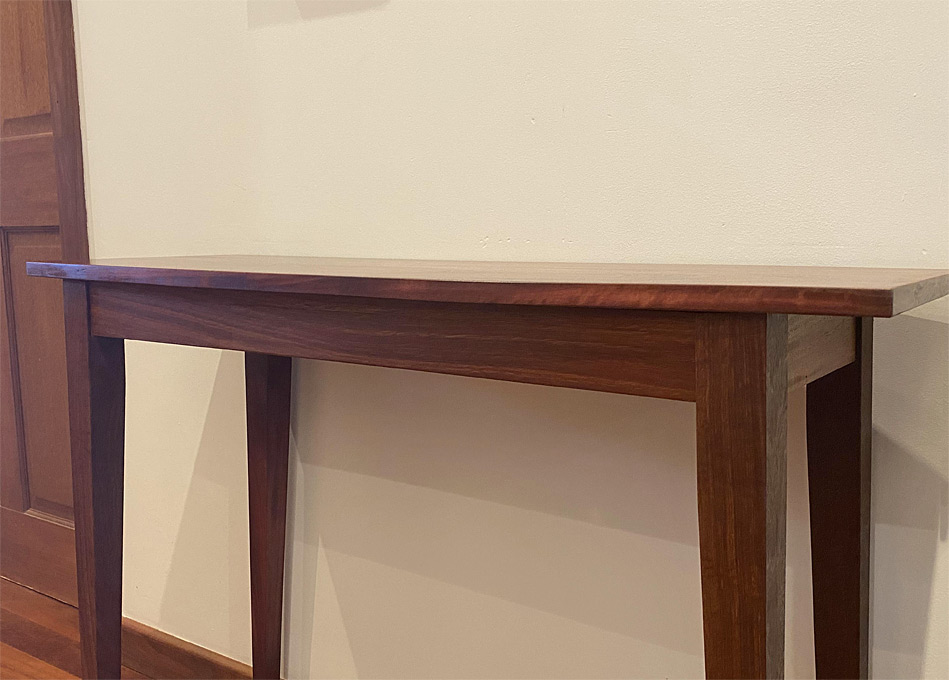
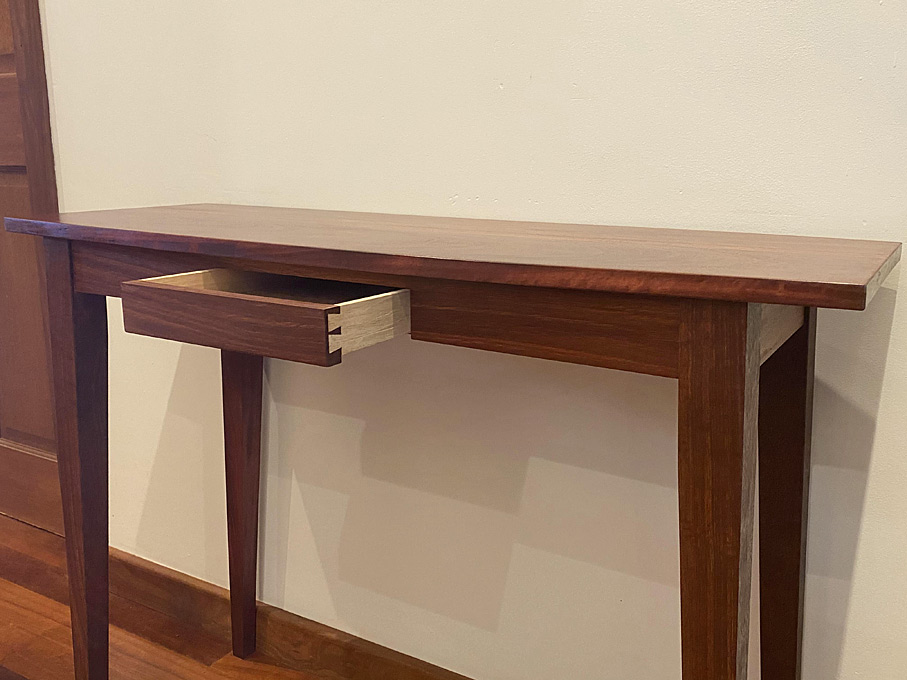
This drawer is an example of attention paid to set up and execution …
Please note that this is not simply due to a more expensive sliding tablesaw, or higher quality handplanes, but the tuning that went into making them perform as wanted. I do not consider it wasted effort.
....for me isn't so much a matter of choosing to upgrade as most would put it (a question of money), it's a matter of not wanting to upgrade because I don't want the machines. Some of that may be because of what I like to make. If I'm to get a machine, it should probably be a mill.
Maybe it's different for other folks, but pushing material through power tools (even when it's set up to be accurate and clean work) is enough to bore me to tears. It feels like being in attendance, not being part of the experience.
If you think that is simply being a bystander while the machine does the work, then you have never worked with machines.
I am guessing that you have never done any work on a pin router or shaper.
The most fun that you can have is running a stack of lumber of a massive jointer to get the maximum yield that is perfectly flat, straight and square and keep all of your fingers.
I guess that you have never cut hundreds of mortises on an automatic mortising machine, that have to be within a couple of thou tolerance, and set-up and cut hundreds of tenons that have to fit, and be perfectly placed with a thou or two. It requires a lot of knowledge, a lot of planning, development of a process and system for error checking, it requires complete commitment and discipline, It is nerve-racking and exhilarating, and I feel sorry for you not even realizing that that exists. There is a huge world of woodworking that you are blind to.
Take off those dark glasses and look around.
I have worked with hand tools and I have worked with machines. I have heard people talk crap about handplanes and chipbreakers, most out of ignorance. I have heard people talk crap about wood, accuracy and wood movement, mostly out of ignorance. I have heard people talk about "pushing wood" through machines for the same reason. I constantly hear the BS about the how handtools add some kind of unmeasurable fairy dust soul to the work.
Good quality work done efficiently is all that counts, all the rest is egotistical BS.
study machines, buy a machine, strip it down and rebuild it, fine tune it, understand it, then when you know a bit about machines you will know enough to buy a better one, strip that one down, every nut bolt and washer , rebuild it to work better than the original, understand how it works, then study the cutting tools that it uses, and how they work and how to regrind and sharpen them....then put it to use, and you will enjoy every minute of using it and marvel at the work that you do together, just like using a hanplane that you have studied, understood and tuned to perfection.
I have also worked with many metalwork machines, I had a Bridgeport mill and tool and cutter grinders etc. and currently have a large metal lathe and surface grinder etc..
all machines require you to be present and involved if you want to get results.
Disclaimer first - this whole thing is only half serious with me. I admit to playing up the crumudgeonly attitudes at times.
The material difference between metals or stone and wood in terms of movement is that wood moves in reaction to atmosphere in addition to temperature and stress relief that the other materials also move wiith.
In general, with metal and stone, the bulk of the movement happens in reaction to the cutting and is then done - easy to compensate for this relative to the lengths we go to accommodating the anticipated future of wood movement. That is why I say working to a thousandth in wood is pointless. It will change far more than that much when the humidity swings significantly in either direction.
That is not what I would call out of round in the wheel, that is actual runout or wobble of the wheel, it was warped. I've had badly welded blades (of my own welding so no one to blame but me) do the same thing too, when the blade ends are not welded co-linearly you get the same effect.