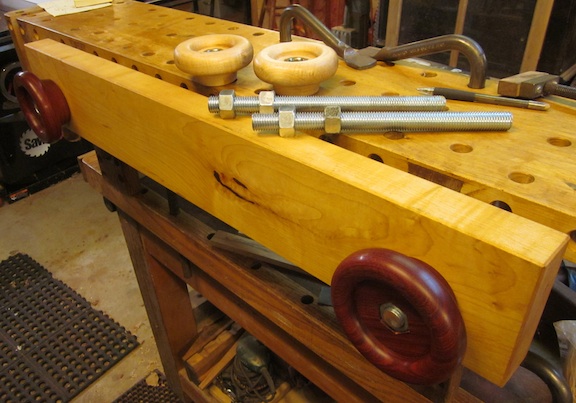
I've decided to make a Moxon vise to take on and off my workbench and have been posting about it and observing other posts over on the Hand Tool site. I am especially interested in what Derek Cohen, who has been very helpful to me, has to say about it. In a recent post by him he indicated that the height of the work on the bench is a crucial issue; e.g. lower height for planing , higher for cutting dovetails. ( Hence the need for the higher-up Moxon for comfortable dovetail sawing.) So it got me thinking: has anyone designed a workbench with an adjustable height feature? Certainly the office worker furniture designers have done it. My thoughts run this way: if the bench was height-adjustable, then, in particular, you wouldn't need a Moxon; you would simply raise the bench.
Geoff Noden is a master craftsman and a good friend of mine. His bench design is excellent. The bench raises and lowers in seconds and is quite solid. Tell him I sent you.
I am 6'4", I bought an old hospital bed for $65 dollars built a solid frame around it and topped with 2 sheets of plywood. Push a button to raise the bench, push another button to lower it. It worked great, I gave it to my son as I needed the space more than the bench
Well, at least I can see here that my mind is not gone yet! I'll probably stick with my old Woodsmith bench that I built ( my first woodworking project) something like 30 years ago. It's hard maple and still works fine. And I really am excited about building my Moxon as per Derek Cohen's photographs. I even sprung for the hardware from Benchcrafted. I know I over spent a bit, but I just know it will feel really good when I get it done.
I have an Adjust-a-Bench and sometimes use another one that was built for our "local" woodworker's association. They are very sturdy, easily adjustable, and serve well as a base for many different woodworking tasks.
I also have a more typical woodworking bench on which I usually have a bench-on-bench installed. The bench-on-bench has a half-a-Moxon vise I can install and remove from either side. It was inspired by Steve Latta's, but I don't know who inspired Steve to put a Moxon vise on the side of his. You can search Google for "bench-top bench" and "woodworking bench on bench" for more examples.
You're going to have to imagine the front jaw of the Moxon vise in this pic of one of Steve's benches, but his pic gives you some good clues to its construction. Note the position of the nut in the front face of the back jaw. It doesn't work by itself, because you can pull it out if you tighten the hand wheel too tightly. The nut you see is mainly to keep the all-thread steady, square and plumb. You need a second nut, behind the jaw. The third nut goes in the front face of the front jaw.
I made mine a bit simpler by skipping the rear jaw, and installing the all-thread through the legs instead. It works fine, since you can always move the board you are holding up against one all-thread or the other. That's why I call it tongue-in-cheek, a half-a-Moxon.
This picture shows my MK-III hardware installed on the bench and MK-II hardware detached and laying on top. I won't distract you with the MKI hardware, which I found disappointing, but still functional as proof of concept. MK-III used 8/4 bloodwood about 5" in diameter, because it was the densest wood in the shop that was large enough. MK-II used 4" rock maple. It worked very well. It's on someone else's bench now. Note also that having a completely clear bench front is an advantage, so using a pair of holdfasts instead of F-clamps can work in your favor.
My front jaw is 1-7/8" thick rock maple. The MK-I jaw was 7/8" thick rock maple. I don't think that is thick enough for a two foot jaw, because it flexes too much to insure a good grip.
Before you start sawing up matereal for jaws, you should consider how wide your dovetailed joints will be. Everyone imagines needed some day to build a blanket chest, which requires at least 24" between the all-threads. But, maybe you don't.
Another good source of info on any Moxon vise is the instructions on the BenchCrafted website for their Moxon.
I really like the Noden bench base, and considered it seriously, but it was just too expensive to send to Canada. I didn't realize till now that there is a hardware package which should make more wooden version, and cheaper version. Not to mention cheaper shipping, potentially.
It is a lot simpler to do just about anything than raise the bench. Fine woodworking has published various articles on benches that can be raised, but most of them work like a planer where there are gears and chains. Theoretically you could adapt the Veritas end vise in vertical format and use that at each end.
There are a lot of lifts that work pretty well, from dentist chair hardware, to motorcycle lifts.
A moxon is simpler, and you can use it to hold wider work than most benches will hold.
One thing to consider is a Moxon that is held in an existing vise, this can range from a board with two clamps, to more elaborate devices. It has the advantage of having simpler and more easily stored components. A lot of the Moxons one sees are more tool porn than serious gear. Once one gets to a certain point, the word "Station" should start to pop up more than colossally awkward and expensive jigs.
I watched the 9 part series on how to build out the Craftsman kit for the Noden bench. I never understood how the mechanism worked, as I had never seen it. I did wonder whether one could make one out of angle iron as that seemed to be the main interface. And that is what they have done with the new kit.
It is pretty easy to see alternative construction options, even all wood options, from the information in the videos. The kit price is very reasonable, it just isn't easy to get stuff at the moment. For the first time in over 40 years I have had major delays and damage to parcels shipped from the US.
I bought an electrically powered hydraulic lift table from Mcmaster in put the maple lemonade with pop on it. It sits on an angle iron dollars so that I can move it around I think it’s the best investment I’ve ever made for somebody that’s over 80 years old.
I also use it as an adjustable height loading table for a sliding plywood onto my tablesaw. I got the idea from a similar one shown in an old issue would magazine.