WoodCentral Forums

Est. 1998 — 27 years of woodworking knowledge

Stool question

Posts

Stool question

#1

Stool question

Bill Tindall, E.Tn.

I have no experience making things to sit on.

The need. A 3 leg stool about a foot high that can stay in the woods for the hunting season. I will park my butt on it to hunt from. So, it needs to survive getting rained on a few times. How to make?

I can saw any shape top and I can fashion legs, round or square. But how to fasten legs to a top such that it stays together for 2 months in November/December?

Re: Stool question

#2

Re: Stool question

Jim O'Connor

I've made several stools, some with a tapered tenon like on Windsor chairs but most with a though tenon through the seat for the legs either 3 or 4. I usually turn the leg tenon so that there will be a shoulder under the seat. If I plan on a 1" tenon through the seat I will drill an 1 1/4" spot on the underside for the shoulder to rest on. On a three leg stool I Usually use a 10 degree splay of the legs. If you will only be a foot high you shouldn't need stretchers if the seat is 5 or 6 quarter thick. I always wedge these make sure the wedge is perpendicular to the seat grain so it doesn't split the seat.

Re: Stool question

#3

Re: Stool question

Bill Tindall, E.Tn.

Turns out a friend has a tapered reamer for a tapered tenon. Should I use a tapered tenon? Legs will be stuck some in the ground so they won't splay any and my butt is not overweight.

The stool is short so I can shoot off my knees as a rest.

Re: Stool question

#4

Re: Stool question

Paul Leuba

It’s been my experience while building more than a dozen Windsor chairs that a tapered tenon is superior to a cylindrical tenon for two reasons. First, in fabricating the tenon it is much easier and repeatable to get the angle of taper correct than to match a cylindrical mortise with a cylindrical tenon within .005”, or so. Even with just modest skill on a lath. The tapered tenon just seems to fit better and be stronger. The second reason is the act of sitting on the stool will have the effect of tightening the fit between the tenon and the mortise with a tapered tenon.

Wedging the through tenon as previously suggested is a very good idea. Cut a kerf in the end of the tenon with a band saw about 2/3 the tenon length for the slightly tapered wedge. Apply glue to the wedge on one side before driving it home.

Paul in Hunt Valley, MD

Re: Stool question

#5

Re: Stool question

Paul Leuba

I would use a leg splay of 15 - 18 degrees considering that you will be leaning and shifting around a bit on perhaps slightly uneven ground. Because the mortises will be drilled several inches in from the edges of the stool it’s important to have the ground contact by the leg well beyond the stool perimeter to ensure that the stool does not tilt when your leaning and shifting. A hunting stand has a more demanding dynamic than other relatively static uses for a stool, particularly a 3 leg stool.

Re: Stool question

#6

Re: Stool question

Joe shelton

Both your posts are concise and correct, in my view. This is good advice across the range of joinery for such stools, chairs and tables.

Thank you, Paul.

Re: Stool question

#7

Re: Stool question

Paul Leuba

Thanks!

👍

Re: Stool question

#8

Re: Stool question

TomD

There is a popular 2 legged stool that sits against a tree, that the boys seem to like. And there are the ones that hang from a tree. I don't mean tree stands, though those can be used at any height. There are milking type seats. Go to http://leatherwall.bowsite.com/tf/lw/THREADSX2.CFM, and enter stool in the search. There are hundreds of listings. I don't think you have to be a member, but I included a few threads at the bottom.

Of course, most of these are commercial seats, but they can be copied in wood, in most cases. The thing that makes metal appealing is in part folding. But if you are leaving it in the woods, that has less practical utility.

In the plein air painting world, the kind of stool that predominates are the 3 legged camp stools. Usually one sees the kind that are made of aluminum.

https://www.amazon.com/s?k=3+legged+stool&ref=nb_sb_noss

Always check the max weight, or assume it is insufficient. Even the ones made by real outdoor companies that may also have engineering departments (climbing gear), are usually sized for Twig Boy.

There is a good plan for that kind of stool in Chris Schawartz's Campaign furniture book. The metal hardware that is available from the likes of Lee Valley, can be expensive (a lot more than a stool itself). Most people do not seem to have adapted to the reality that we now have cordage that is stronger than steel, very cheap, and wears better to repetitive stress than metal fastening do. This has been well understood in activities like extreme long range sailing. So there are plenty of options to expensive hardware. Probably lashing would get you started.

One thing about those 3 legged stools is that you can make them so that the seat slips off, and if it is made of light cordura, it would be easy to carry. That would eliminate concerns about mildew, etc...

https://www.popularwoodworking.com/woodworking-blogs/new-campaign-stool-hardware-from-lee-valley/

You can save a lot of weight on the Chris chair by using Cordura for the seat. You probably have a blown out backpack that could serve as a donor as small amounts of cordura can be expensive.

To some extent soil conditions affect the choice of stool if your forest floor was soft you might need to add some crutch tips. or change the design to a flat contact design.

http://leatherwall.bowsite.com/TF/lw/thread2.cfm?threadid=322772&category=88#4900599

http://leatherwall.bowsite.com/TF/lw/thread2.cfm?threadid=321725&category=88#4875133

Here is a chair you can make of wood:


https://paddlemaking.blogspot.com/2015/01/diy-bucksaw-camping-chair.html

Since you gun hunt you can probably shoot from a laid back wood survival chair:


https://www.youtube.com/watch?v=a0WJYEB2tIw

This kind of thing can be adapted to a number of the popular leaner type hunting chairs:


There are a lot of paracord chairs, at least nobody will steal it:


Re: Stool question

#9

Re: Stool question

Barry Irby

You have gotten excellent advice.

You mentioned you can borrow a reamer. I recently made some stools and made a reamer from and old key hole saw blade to facilitate connecting the legs. In my case I had to figure out what size hole to drill, Make the hole the size of the reamer on the small side. To help with the turning of the tenon, I drilled a hole in a scrap the same thickness as the top and reamed it. Then sawed the scrap in half right through the hole, exposing the taper. It became a gauge for the tenon. Turn the tenon and put the gauge on it from below and you can see what needs to be done. Make the tenon longer and slightly fatter than it needs to be so that when inserted into the hole there is an extra 1/8 or 1/4" that could slide in if it shrinks. Examine the grain on the end and cut the slot across the rings, the opposite of what you might do to split the wood. You can drill a hole at the bottom of the slot to help arrest the splitting forces. The wedge should be the thickness of the kerf at the tip and maybe twice or three times that at the top of the seat. Choose a nice contrasting wood because style is important.

Be very careful if you apply the gauge to the tenon with the lathe running. I tried that thinking it would burnish the surface and show me what needed to be cut away. The gauge can grab the tenon and spin like a propeller. DAMHIKT

Don't be intimidated by my long winded answer. For a short three legged stool this is much easier than I made it sound. Drill some splayed holes, cut cylindrical tenons with a shoulder, slap in some epoxy and call it good. Or Find some large dowels, drill matching holes, stick a cross dowel through the leg dowel as a stop and slap it together, with our without glue. It's a hunting stool you will be abandoning in the woods.

Re: Stool question

#10

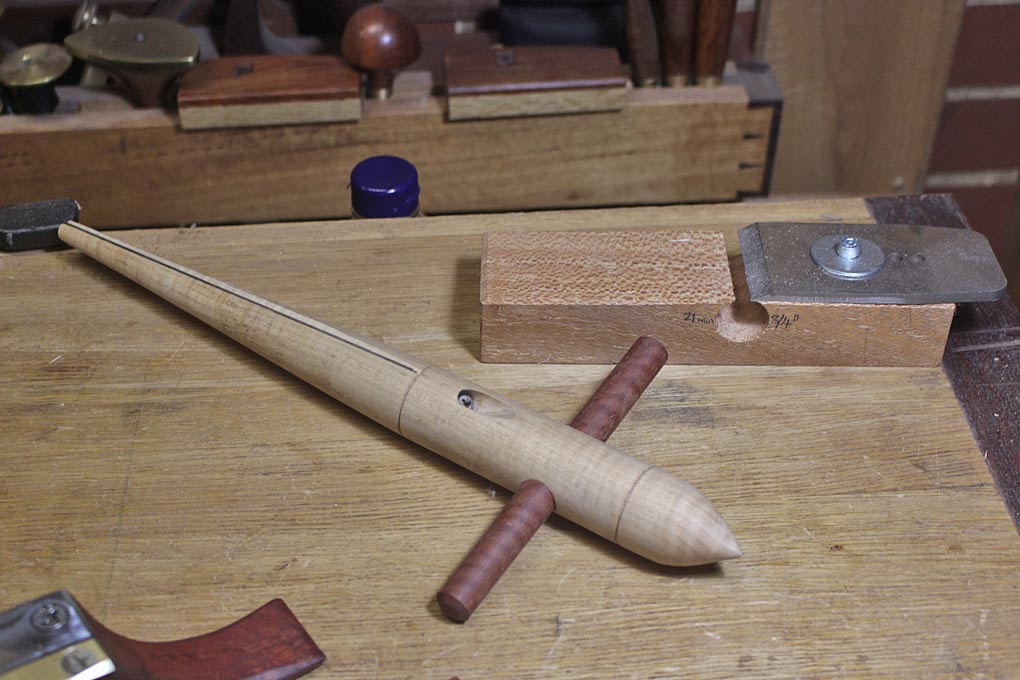
Reamer and tapered tenon cutter

Derek Cohen (in Perth, Australia)

Easy enough to make ...

1. Make the reamer first. Bandsaw a 7 degree taper, and turn. Slice and add a steel scraper (made from a section of saw). The scraper will project about 1mm from the side (which happens when you adjust it downward). The screw forces the blade down.

2. Make the tapered tenon cutter. Drill through a rectangle of hard wood, with the hole size that of the desired end of tapered tenon (at the upper side of the seat). Then use the reamer to shape to fit. Plane away the top of the board until the reamed hole emerged. Clamp a blade across this. A little experimentation to get the precise fit, and you are good to go.


Not my design. Courtesy of Peter Galbert. There are probably blogs about making these.

Regards from Perth

Derek

Re: Stool question

#11

think a picnic table bench; go mini

Henry (Raleigh NC)

Lots of good advice for making furniture - and I will go contrary to the themes so far. In my view this is to be a functional item that will be abused/neglected. If it only has to survive 2 months and not several years, I get one of those precious 2x4s we hear so much about (even a twisty one might work because you will cut it into quite short pieces). Of course use treated lumber if you want it to last longer; BTW there was an excellent treatise on treated lumber posted recently here on WC, so consult that for understanding which grade of treated you should specify.

Anyways with a 2x4, a miter saw, maybe a jigsaw, and a handful of deck screws, this project ought to take about as long as it takes to read all these threads about it (including this one of course).

Design? Seen a picnic table with a separate bench? Make a small bench with one side an X leg, and one a single. Splay the legs for stability.

There are lots of design options/possibilities, but I sure would not make a piece of furniture for the woods - unless you want to. 'Staining' (not a joke asking you how to stain!) with a 'solid color' deck stain (small molecule acrylic 'paint') will help the seat boards shed water. Can even go camo if you want to buy three different colors.

Henry

Re: Stool question

#12

Re: Stool question

TomD

I have a variety of reamers for Windsor chairs. One expensive one is amazing as you can start it any old angle and steer it to the final position. But most of them do not cut as well as the keyhole saw version I made. And the one I made was exceedingly rough as all I had to make it was very basic tools and a spokeshave. It is still one of my favorites, partly because the taper is so long. The accuracy of the wooden bit turns out not to be all that important as long as the saw blade is supported; both teeth and back engage, and it doesn't flutter too much in the cut.

http://www.greenwoodworking.com/SawSteelTaperedReamerPlans

With socket joinery you can whip up a pretty decent stool from a split log that you would not mind leaving in the woods.

Re: Stool question

#13

Re: Low Bench, Knock Down.

TomD

http://www.greenwoodworking.com/low-bench-that-is-light-strong-and-takes-apart

Re: Stool question

#14

A duh moment

Bill Tindall, E.Tn.

Thankyou all for the good ideas. Then Henry got me to thinking practical. A large white pine has crashed nearby. Pine is light when dry and its dry. I am going to whack a piece of this pine off and carry it to where I need the stool. And, a round stool has advantages for swiveling. I put a small lazy Susan on the top of my deer hunting seats. Well greased it is silent rotating as needed to change position.

Re: Stool question

#15

Re: A duh moment

Henry (Raleigh NC)

Well even though you did not implement my (rather outstanding!) idea(s) :) :D :O , I will take credit for getting you thinking. No doubt other responses also prompted you to consider options you had not previously!

I know I learned a few things about inserting legs into a seat.

Henry

Re: Stool question

#16

Re: Stool question

Ron Goldman

On today's episode of NHK's Design Talks Plus, there was the AA stool--similar to a mini-saw horse it can be combined with others to form a bench. It certainly can be modified to fold-up. https://ishinomaki-lab.org/products/aa-stool/

Re: Stool question

#17

Re: Stool question

Jim O'Connor

Reading TomD's reply reminded me of the milking stools we used when I was a kid. A simple T of two foot long boards, usually 2x6 simply nailed together. This would be one that could be left in the woods without much regret.

👍 This page answered my questions

Your vote helps other woodworkers quickly find the answers and techniques that actually work in the shop.