Edited 2023-08-09 05:07:16
by Bill Tindall
As part of rebuilding the RR bridges for the Rails to Trails project I have had to become familiar with lumber treatment. I have summarized what I have learned in what follows. The objective of this primer is to provide a resource for specifying trail lumber. Additionally, it could be useful information for your home projects.
Introduction Wood will last forever if protected from something chewing on it or digesting it. Insect poisons will prevent chewing. Fungicides will prevent fungi from digesting wood. Fungi and many insects are not able to attack dry wood. The first line of defense is to protect wood from getting and staying wet. Where keeping wood dry is not possible it must be treated with insect and fungi poisons to prevent destruction or used in a location devoid of oxygen. Some underwater and underground locations are devoid of oxygen and untreated wood will last forever in these locations.
Wood preservative chemicals Creosote, a mix of toxic chemicals distilled from coal, is a water repellant as well as a poison for insects and fungi. It has been used for a long time and continues to be used for materials such as RR ties where its toxicity is less a problem. Copper is toxic to many insects and fungi. Many wood treatment processes use copper in one form or another. A particularly effective preservative is a combination of copper, chromium(chromate) in the plus 6 valance state and arsenic. It is known and labeled as “CCA” and it kills everything that tries to eat it. The chromium component binds to the wood and the copper and arsenic binds to the chromium to retard loss of the treatment by leaching. (Chromium in the plus 6 oxidation state, called chromate, is one of the few chemicals that are a proven human carcinogen) Preservative formulations less toxic to humans use a soluble copper compound plus a fungicide to kill species of fungi that are not killed by copper alone. While many fungicides have been used, only a family of chemicals called “azoles” are commonly used today. The combination of a soluble copper compound and azole is labeled “CA”. When the copper is added as tiny particles of copper oxide the product is called “MCA”, abbreviating the description “micronized copper azole”. Various kinds of azoles have been used over time starting with formulation CA-A, followed by CA-B and most recent CA-C or MCA-C if micronized copper is used. If a new treatment is developed in the future it will have some different letter code indicating it composition. There are other wood treatments, for example borates for termites and powder post beetles, but they have limited application for outdoor lumber preservation.
How is lumber treated To be effective the treatment chemicals must be driven deep into the wood. Heartwood is not very permeable to water based treatment chemicals. Hence, species with a large fraction of sapwood are preferred for treatment. Plantation grown southern yellow pine is ideal. Trees that have a larger portion of heartwood such as Fir or Oak must be incised to gain access for the treatment chemicals. A common treatment is to kiln dry the pine, seal the lumber in a chamber with treatment chemicals and then force the chemicals into the wood first with vacuum followed by pressure. The process takes about a day. Ties treated with creosote are treated with a combination of high heat, vacuum and pressure without predrying the wood. This process works for species that have a larger portion of heartwood.
History Creosote and CCA (chromate copper arsenate) have been used for many decades because they work especially well. However, these treatments are toxic to humans and the government demanded that they not be used where human exposure was likely, for example residential decks. Companies providing creosote and CCA treated timber are wary about liability from selling this treated timber if there is risk of the lumber being used where there could be contact by the general public. In 2003 the Federal government obtained agreement from wood treatment companies that they would not sell CCA treated lumber for residential use. States and organizations like the Forest Service adapted regulations for other applications of lumber with this treatment. As a general rule if there is risk of human contact the use of CCA treated lumber is prohibited. Following Forest Service and State regulations for our bridges, CCA treated lumber is acceptable for ties, runners, and in ground posts. It is not acceptable for decks and rails. Some combination of copper and a fungicide is used to replace the banned CCA treatment.
The soluble copper in these new treatments is especially corrosive to steel and aluminum. This soluble copper is more subject to leaching and loss. By 2014 it was recognized that the recommended treatment for above ground applications like decks and rails was not providing sufficient protection of the wood to fungal decay. In 2014 the organization that provides standards for wood treatment recommend doubling the amount copper and azole fungicide used in lumber for above ground applications, decks for example. These changes mean that experience with the life of “above ground” approved wood in the time range before 2003, from 2003 to 2014, and after 2014 could be substantially different.
Recently a new form of copper has gained wide usage in treated lumber. It is called “micronized copper”, “MC”. Micronized copper is extremely finely divided copper oxide, fine enough that it can be driven into the wood by the pressure of the wood treatment process. Copper oxide is sparingly soluble, yet sufficiently soluble to kill most fungi and insects. The insolubility of copper oxide substantially lessens loss by leaching and as a bonus lessens corrosion of steel fasteners. MC treated lumber is less green because it contains less green soluble copper.
Specifying treated lumber Lumber is treated with more or less chemicals depending on the application. A support post for a pole barn will require a different treatment than an easily replaced porch rail. To know what to specify requires decoding the treatment language and the corresponding tags on the ends of treated lumber. Treatment is specified in words, by the weight of treatment chemicals retained in the lumber in pounds per cubic foot (pcf), and a letter code describing where the lumber should be used. Examples follow for common applications. “Above Ground”, “ 0.06” pcf, “UC3A” lumber contains the least amount of treatment chemicals and the intended use is above ground. It is this treatment that was found inadequate for typical above ground use. “Ground Contact”, “0.12 pcf” UC4A is a medium duty treatment which after 2014 is recommended for residential decks and rails. “Heavy Duty Ground Contact”, “0.23 or 0.32 pcf” “UC 4B” contains correspondingly more treatment chemicals for applications where replacement would be difficult or in structures were risk of wood failure must be avoided. There can be a letter code preceding the number for the amount of treatment chemical retained that specifies the treatment chemical used. “CA-C” is the most modern “Type C Azole” soluble copper formulation. “MCA-C” indicates use of the micronized copper material. The code for CCA treatment is “CCA” followed by a retention number, usually 0.4% or 0.6%. (there are other treatment codes for sea water exposure, fire retardant etc. which are not of interest to us)
Decoding the lumber tag The tag on the end of the lumber provides a wealth of information about where the lumber was treated, what it was treated with and how much, the recommended use of the lumber and whether it was inspected to ensure it met specification. An example of a typical lumber tag and the “decoder ring” for tags is shown below. If the treated lumber has no tag, “landscape timbers” for example, it is a good bet that the lumber is minimally treated.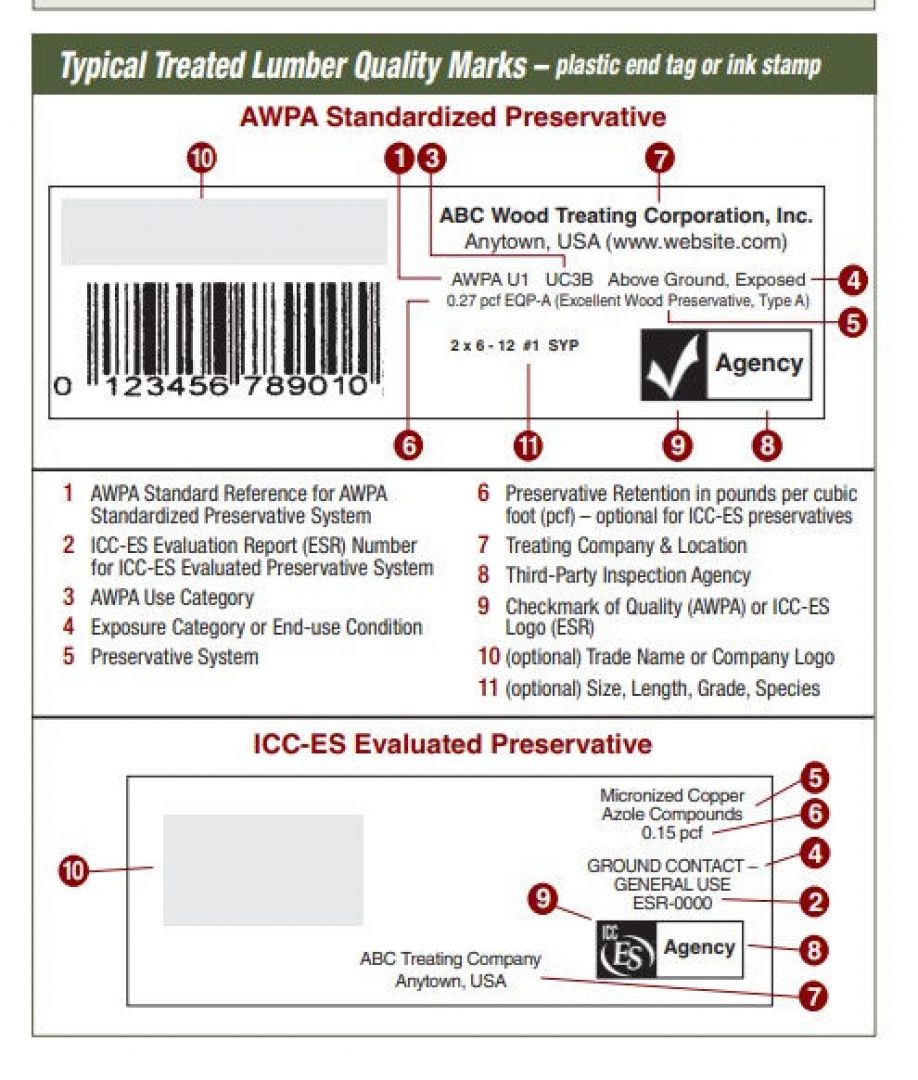
Example: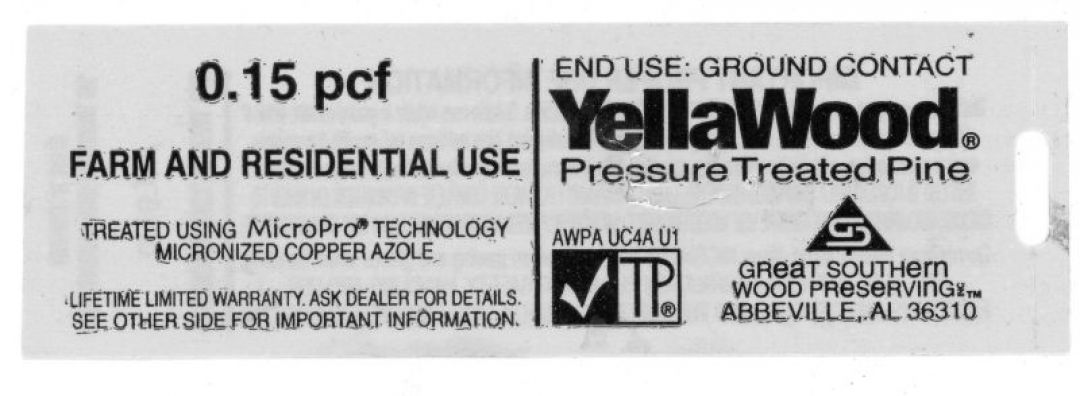
Primer on treated lumber
Posts
Re: Primer on treated lumber
#2

Thanks, Bill
Ellis Walentine
Remind me to process this post for our articles department. Good info.
Ellis
Re: Primer on treated lumber
#3Re: Primer on treated lumber
frank morgan
You did a nice concise job. Thanks!
Re: Primer on treated lumber
#4Re: Primer on treated lumber
Jesse Cloud
Thanks Bill. Very well written and useful!
Re: Primer on treated lumber
#5Much Appreciated, thanks
Re: Primer on treated lumber
#6Great! Should be in WC Articles section
Re: Primer on treated lumber
#7Now I know what kind of primer
Steve D, CT
you're not painting these...
very informative
Re: Primer on treated lumber
#8Re: Primer on treated lumber
GarthinSanDiego
Thanks, Bill. Another one that may not be used on the east coast is ACQ. Specifically, what is available from the box stores in my area is ACQ-A. Don't know how widespread it's use is. Probably just a California thing.
Re: Primer on treated lumber
#9Re: Primer on treated lumber
Bill Tindall, E.Tn.
ACQ-A employs a different fungicide, called a Quaternary ammonium salt. For some reason this class of chemicals kills fungus. I was not aware that it was still used. I would like to see a picture of the tag on the end of this lumber if you are able to provide.
Re: Primer on treated lumber
#10Re: Primer on treated lumber
Barry Irby
I was about to ask about ACQ. It was a disaster when first introduced because it was so corrosive to fasteners. As a Home Inspector I saw deck that could be taken apart with your hands because the deck nails had dissolved. A new generation of fasteners was required. I think it's still in use.
Re: Primer on treated lumber
#11Re: Primer on treated lumber
Garthfromsandiego
Will try to post some photos tomorrow.
Re: Primer on treated lumber
#12Re: Primer on treated lumber
Garthfromsandiego
Yes! Specifies hot-dipped galvanized or stainless steel fasteners.
Re: Primer on treated lumber
#13Clipped & Saved Thank you!
Re: Primer on treated lumber
#14Re: Primer on treated lumber
John Jardin
Thank you Bill.
Re: Primer on treated lumber
#15Re: Primer on treated lumber
Brad Chenoweth
Great info, Bill! Thanks very much for taking the time to provide all of this information.
Re: Primer on treated lumber
#16Thanks Bill, very timely for me.
Keith L Newton
I'm going to be replacing my floating dock the Spring, and hope it last longer than the one I built in 2006. I normally don't saw pine on my Woodmizer, but someone had a few nice pine trees removed from their yard and had the tree service drop the logs off here. I had a friend who worked at a pressure treating plant that said he would treat it as "Ground contact", but 15 years is all I got out of it.
There are a couple of things I will do differently this time. I'm planning to use Self-Adhesive flashing tape on top of all the joist, especially where two are joined side by side.
So, for your bridge framing, which treatment did you specify? And does any of the new treatment methods do a better job at penetrating heartwood?
Re: Primer on treated lumber
#17Re: Thanks Bill, very timely for me.
Bill Tindall, E.Tn.
So, for your bridge framing, which treatment did you specify? CCA at o.6 pcf for places where humans don't touch. UC4B MCA 0.32 pcf for deck and rails.
And does any of the new treatment methods do a better job at penetrating heartwood? no. To treat heartwood requires incising(all those slits one sees on ties and bridge timbers) to gain entry.
Re: Primer on treated lumber
Edited #18

@Ellis Walentine,
It may no longer be necessary to create separate article pages from forum topics, as the forum is now able to handle millions of posts with ease.


