Re: question and comment
Joe in a Cleveland suburb
Why is the rabbet 1/2 x 1/2?
It's what you suggested in a previous comment or email.
What is the back?
Frame and panel. That's the plan anyway.
Est. 1998 — 27 years of woodworking knowledge
Re: question and comment
Joe in a Cleveland suburb
Why is the rabbet 1/2 x 1/2?
It's what you suggested in a previous comment or email.
What is the back?
Frame and panel. That's the plan anyway.
lets compare apples to apples
Bill Tindall, E.Tn.
The original question involved cutting a small rabbet on the edge of a piece of lumber substantial in length, width and weight. This operation has little comparison to the various situations described, or shown to be, risky. The size of this piece enables it to be controlled with hands nowhere near the blade. The size and weight makes it improbably that the blade taking such a small cut can gain purchase to throw the piece. If anything happens it will just push the piece away from the fence.
But in the end do what you feel safe doing. If unsure try it with a 1/16 x 1/2 dado and see how it goes. I that seems unsafe, take up hand tools.
Re: question and comment
Bill Tindall, E.Tn.
for frame and panel I no longer object to the 1/2 by 1/2.
Caution
Derek Cohen (in Perth, Australia)
90% of the time I use hand tools for these rebates. 10% a router. In all cases, I stop short of the corner, and only after the glue up clean the corners. The reason is that the corner will be largely unsupported and fragile if you overcut or completely cut the rebate.
For interest, these were done with a moving filester plane (2 sides), and two sides with an azebiki and chisel ...
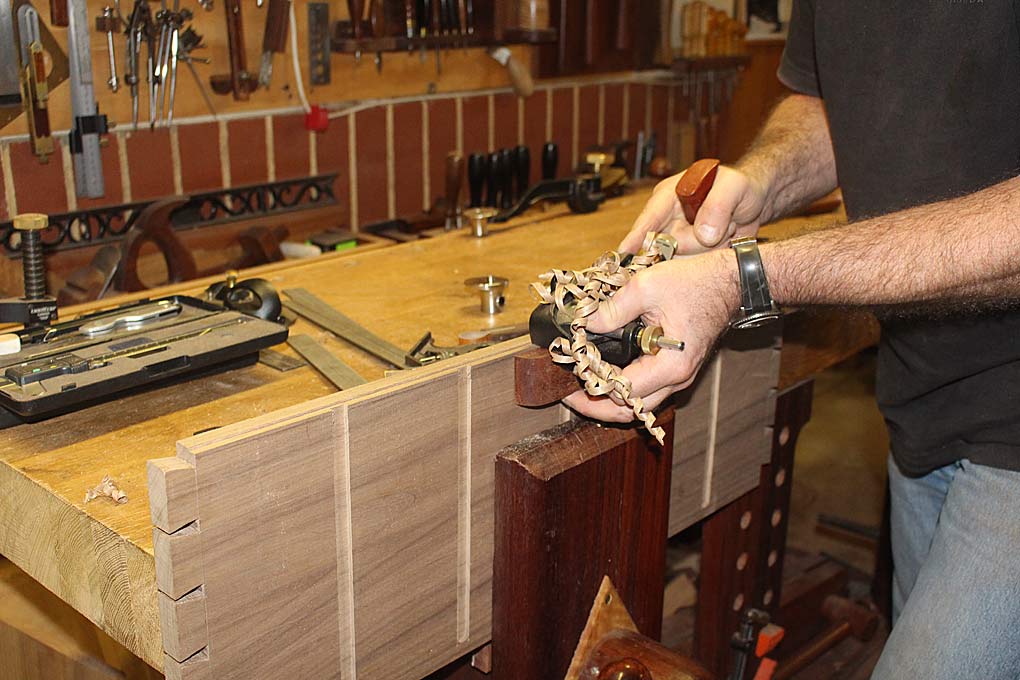
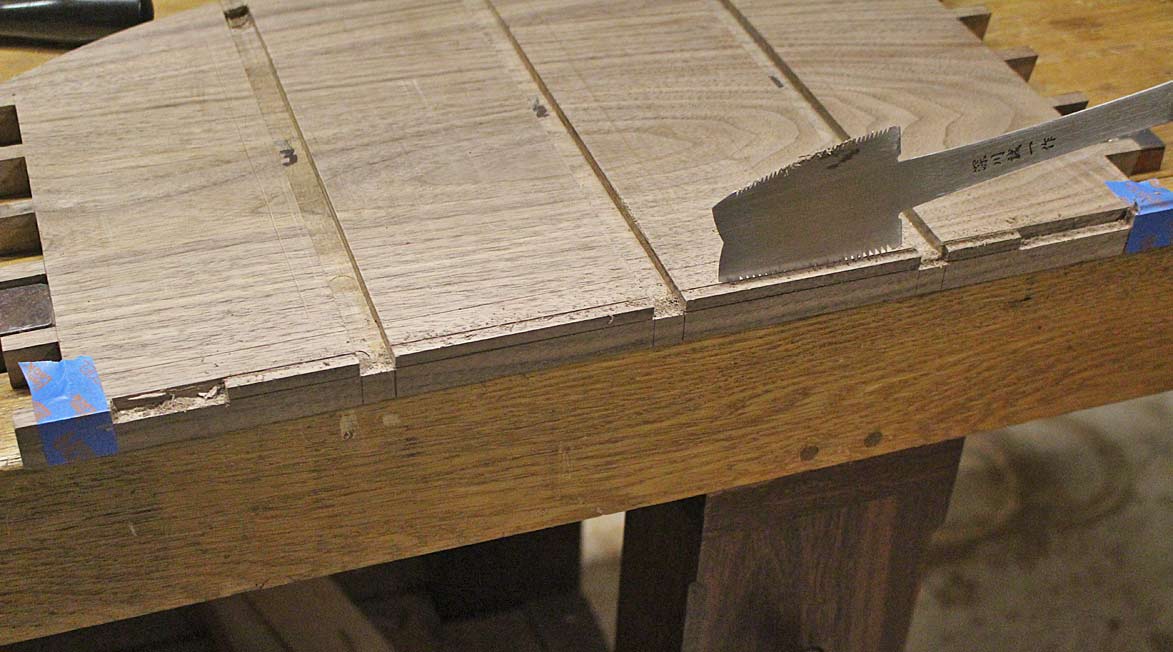
The relevant photos are these. Clean up with a chisel ...


Regards from Perth
Derek
A better way ...
Derek Cohen (in Perth, Australia)
For future reference, a better way to add rebates is to start with mitred ends. The case in question is through dovetailed with mitred corners. This enabled a through cut. No stopped cuts needed.
Here done with a moving filester ..
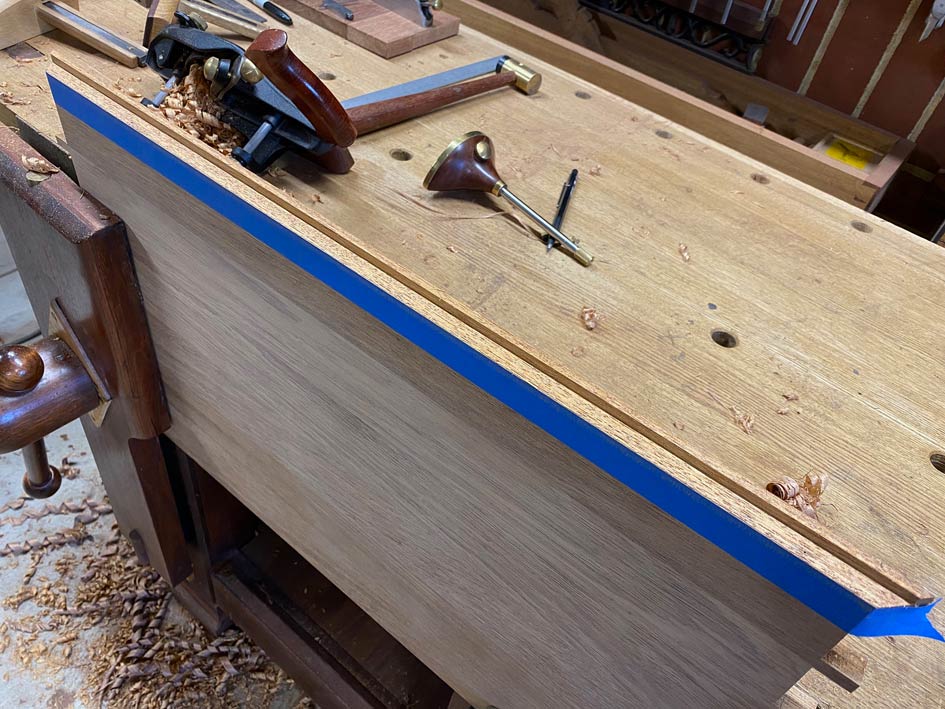
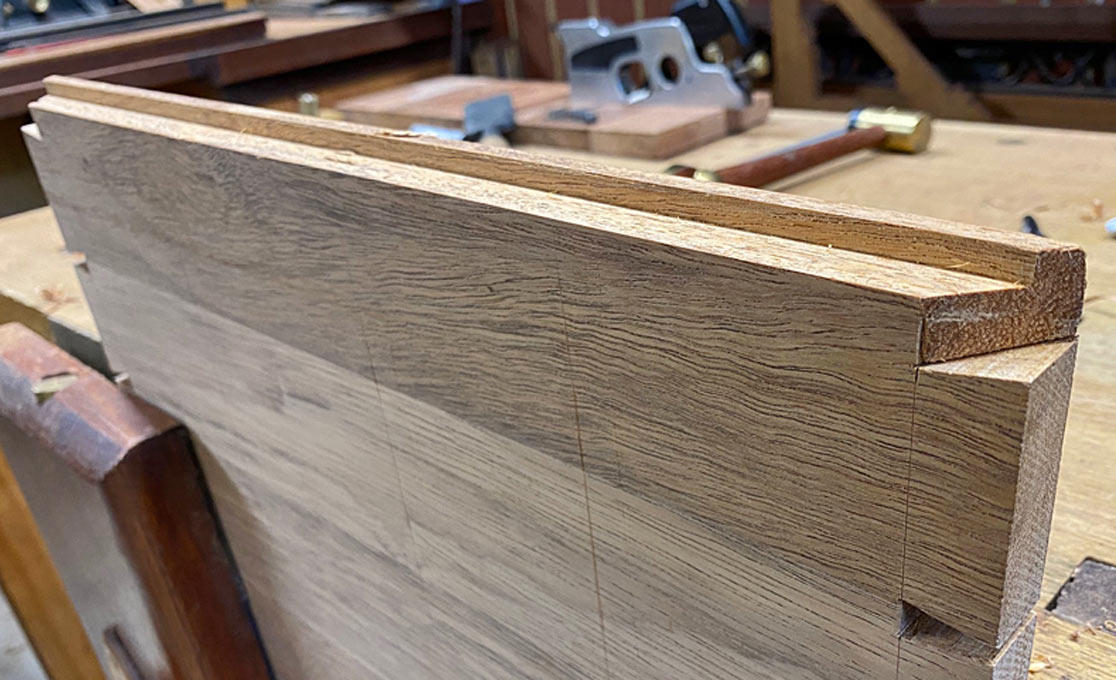
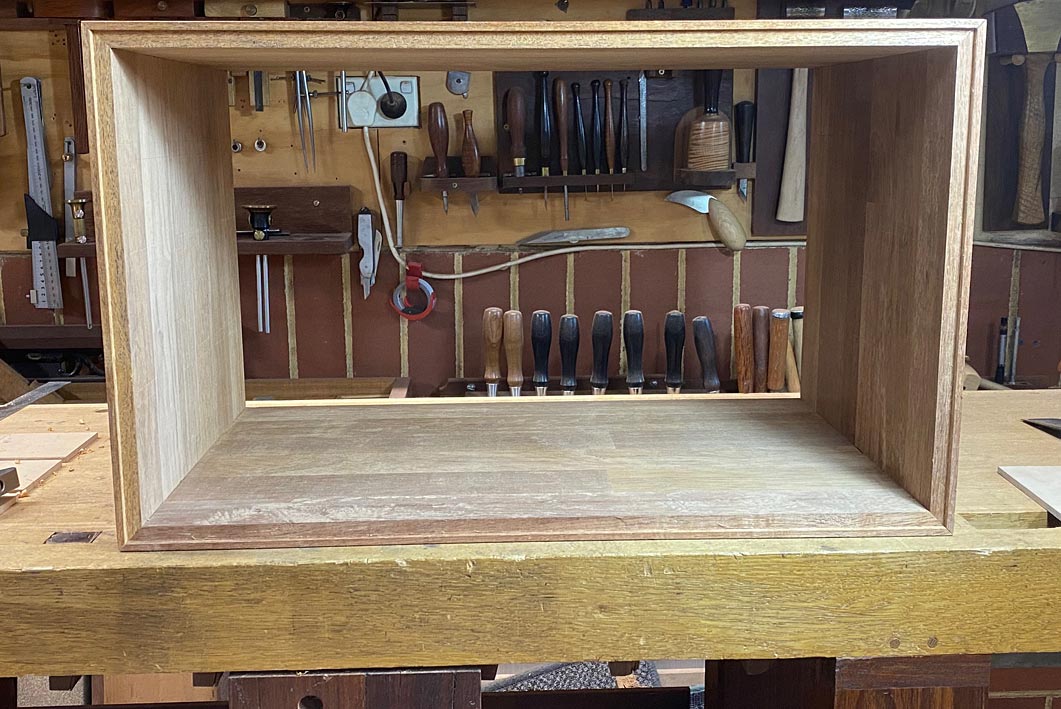

Regards from Perth
Derek
Re: A better way ...
Joe in a Cleveland suburb
I remember this. Would've been perfect. Thanks.
Re: Stopped rabbets on TS
al morgan
Why not use a dado plane....opp to buy one? Veritas makes a nice one....or use a router to hog out most of the dado? And then chisel it out?
Re: Perhaps I mis-understood
al morgan
No, he's doing a rabbit on the back of the case.
Yep, saw that after posting the last...
John in NM
Rabbet, right there in the title. I shoulda kept quiet 
Re: Good reason not to use router
AZ in Colorado Springs
If you're thinking of "chip-out" where the bit exits the dado or rabbet, the solution is simple: score the edge of the stock where the bit will exit.
If you are thinking of chip-out along the edge of the rabbet, I can't imagine why that would be a given.
A couple of things;
Mark Hennebury
That bookshelf could / should have been done with a mitered dovetail and avoided this problem.
" Dropping on" has and is done.
Is it dangerous? of course, everything is.
How dangerous is it, well that depends more on who's doing it.
A Nervous woodworker makes any operation dangerous.
People who are unsure about an operation, are stressed and straining and ready to drop and run, a recipe for disaster. You need to understand what you are doing, what to expect, and have the confidence to do the operation in a firm controlled manner. You should not to do operations unless you know what and how things can go wrong and be confident that you can control the situation. Experienced, confident people can still have accidents, but if you are nervous and jittery going in you will increase your change of getting injured in even the most simple of operations.
I have seen nervous people using table saws, small 10" blades with 1/8" blade exposed over the top of the wood, all fully armed with push sticks and grippers... they scare the hell out of me. I have also seen confident experienced people using table saws with 18" blades with 5" of blade sticking out of the table and 7.5hp motors, working with no guards and their fingers 1/8" from the saw-blade, working with complete confidence and totally relaxed.
As bill has said the larger the piece you have the easier it is to hold.
As others have said things can go south, especially in nervous hands, or unknowledgeable hands.
In general, lowering wood on a spinning blade is risky.
Smaller pieces are the most dangerous.
Stops, placed for and aft, make it a lot safer.
Pencil lines on a fence wont stop the wood from being ripped out of your hands.
Placing your fingers on the wrong side of the blade when lowering can cost you your fingers.
Moving the wood back to line up with the pencil line while lowering or after will teach you a lot about how fast wood can disappear and ( refer to the previous sentence)
I have seen someone loose two fingers cutting a 1/4" x 1/2" deep stopped groove in 2"x 2" x 36" pine with a small router slotting cutter, using pencil lines as a reference.
Mitered dovetail corner.. they look nicer as well.
good points
Bill Tindall, E.Tn.
What comes with experience is anticipating and then feeling what kinds of forces the blade is exerting on the piece to be cut, whatever the cutting operation.
Personally I would not attempt to cut a stopped dado in a short 2" stile, or short anything. Short precludes fixing a pivot point for the piece to be rabbeted at the front of the saw. No pivot point and there may be no possibility of controlling the entry of the blade to the wood. With a pivot point the entry can be as gentle as one wants, hands are miles away from the blade and they provide the "stop" that many advocated for. In my mind the pivot entry is no different from the entry for a rip cut.
I'm curious why no one has suggested...
Tim Greif - West of Chicago
Perhaps I'm just missing something. Why not just cut a normal continuous rabbet and glue in a matching piece of wood at the ends to appear as a stopped rabbet? This is the back of the piece, right? If done carefully, I doubt anyone could tell.
Certainly not as difficult or elegant as your approach, but certainly pragmatic enough to be considered as an alternative. Or maybe I'm just full of it.
Re: I'm curious why no one has suggested...
Bill Tindall, E.Tn.
I would not pursue this route because it is slower than making a stopped rabbet.

Re: A couple of things;
Ellis Walentine
I have seen someone loose two fingers cutting a 1/4" x 1/2" deep stopped groove in 2"x 2" x 36" pine with a small router slotting cutter, using pencil lines as a reference.
A friend of mine, an experienced guy who taught woodworking at a community college near me, lost all four fingers of his left hand somehow when attempting a drop cut. Don't ask me how his left hand got pulled into the blade. He must have lost concentration. He had to find the severed digits, put them in a bag and drive to the nearest hospital. They reattached them, but he only has limited use of two of them to this day.
Ellis
Re: A couple of things;
Mark Hennebury
I have had several friends and a few acquaintances that have lost multiple fingers in workshops, over the years.
It takes only a split second.
When doing drop cuts as long as you are pushing the wood forward under good control you don't usually have any problems. If when starting the cut you allow the wood to move backwards the blade can grab and rocket the wood back toward you.
To get an idea of how fast a spinning cutter can move your piece of wood. Take the number of teeth on the blade x the distance between them x the blade rpm, then divide x 12 that gets you the feet per minute.
That is the top speed that your machine is aiming to achieve when it grabs the wood and starts to move it. At top speed each tooth will stick in the wood and push it until the next tooth sticks in and pushes it. It will try to climb cut, but without any feed control, the teeth will just dig in and propel the wood.
Use continuous rabbets
Wiley Horne
Hi all,
Derek has shown a way to avoid using stopped rabbets for letting in backs to cases.
Jeffrey Greene in his book ‘American Furniture of the 18th Century’, pp. 138-139, illustrates two other methods which were in use in the 1700’s. The key is to use half-tails on the rearmost sockets of both the case side and top.
Here’s a sketch of one of Greene’s traditional methods. This one uses half blind dovetails. You can make the rabbets continuous, using your dado sets:

Wiley
you forgot a picture
Re: you forgot a picture
Wiley Horne
Hi Bill,
Wasn’t sure there’d be interest. Here are the scraps roughed out:
I’ll do the through dovetail version soon. It would be easier yet with power tools.
Wiley
Another option No one mentioned...
Barry Irby
Assemble the case and use a bearing guided rabbet bit or slot cutter on a router. Clamp a thick scrap along the edge to add stability for the router and have at it. You still have to square up the corners but you had to do that anyway.
Re: Another option No one mentioned...
Bill Tindall, E.Tn.
As noted in posts above I have done what you suggested when I forgot to make the rabbet before assembling the case. Tear-out at the edge that shows was a common occurrence.
Re: Another option No one mentioned...
Steve jenkins
This is the way I always do it except I don’t clamp on another piece. I make a light climb cut first which eliminates tear out.
Re: What Am I Missing Here???
William Duffield
Since we are cutting stopped rabbets, and not stopped grooves or stopped dados, whouldn't it be safer and just as effective to push the board into the side of the spinning dado stack, instead of trying to drop it onto the top of the stack?
Re: What Am I Missing Here???
Yonak
Depending on the depth of cut, and similar to a cove cut, cutting from the side can be quite problematic. Especially, you'll likely hit the side of the blade, not the cutting tips, as one problem, in addition to an accurate execution of the push.
Re: What Am I Missing Here???
Bill Tindall, E.Tn.
For starters one does not drop the piece onto the stack. It is levered down using the front rail of the saw as a fulcrum. Entry is slow and controlled. I don't see how I would control entry from the side.....exit, yes.