WoodCentral Forums

Est. 1998 — 27 years of woodworking knowledge

Stopped rabbets on TS

Posts

Stopped rabbets on TS

#1

Stopped rabbets on TS

Joe in a Cleveland suburb

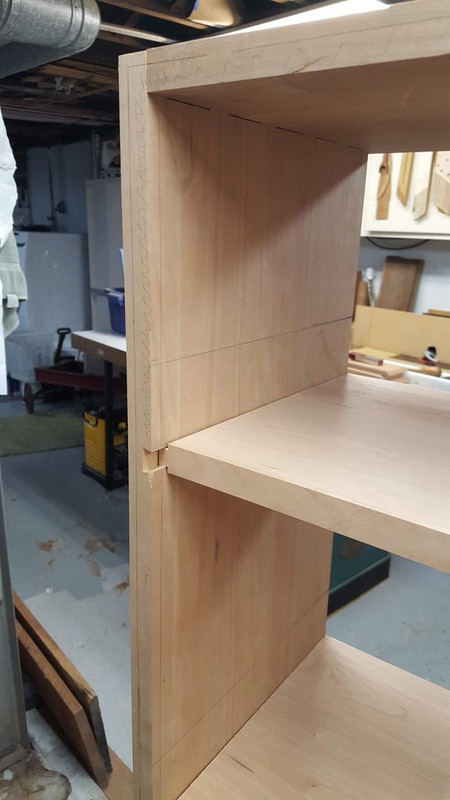
This weekend I plan to put stopped rabbets on the case sides and top of the bookcase I am making. Well, the top won't be stopped, straight across.

The rabbets are 1/2" x 1/2". I'll put my stacked stacked dado set on the TS with a sacrificial fence. I'll mark the fence with the beginning and end of the blade so I know where to stop and start. I'll square up the cuts later with chisel and so on.

I don't recall ever doing this before on the TS in the last 20+ years. I recall doing similar on the router table. I am a bit apprehensive about doing this. It seems a bit dangerous dropping the board onto the spinning blade. It took me a couple weeks to get the courage to route the dovetails into the case sides.

Any tips, advice, or suggestions on doing this? Is there something I haven't considered, or need to consider, safety-wise?

Thank you.


Re: Stopped rabbets on TS

#2

Re: not what I would do

Henry (Raleigh NC)

Well since you asked, I will tell you that I won't 'drop' a board on to a spinning anything. I did this once on a router table, and swore that I will never do that again (router or otherwise). Yes I know people do it, but that does not make it the procedure I want to follow.

Today I have a horizontal router table that makes 'easing the piece into a spinning bit' MUCH more controlled. With a horizontal bit the piece is supported on the work table the entire time, and the user gets to control the introduction to the bit without having to fight gravity.

Seems like a rabbeting or straight bit in a router table (or even handheld) might be an alternative?

I know I WOULD find an alternative that does not require introducing a piece to a moving cutter from above.

Henry

Re: Stopped rabbets on TS

#3

Re: Stopped rabbets on TS

Barry Irby

If I were gong to do this, I wouldn't. I would use a router and make a template then use a guide bushing and a spiral bit.

But if I insisted on doing this on the TS I would set up stops fore and aft. Set the blade to height and note the position of the handle that raises and lowers the blade. Lower the blade below the table with a known number of turns, lay the piece in place in a cross cut sled. Raise the blade the proper number of turns, returning to the correct position of the handle and push the sled firmly forward to the aft stop block and lower the blade. All this "known number of turns" has to take the thickness of the sled into account. Use an offset block clamped onto the fence to set the distance from the end, but do not ride the piece against the fence, too much chance of binding and a kick back.

Easier and safer to do this with a router and template. Less chiseling too.

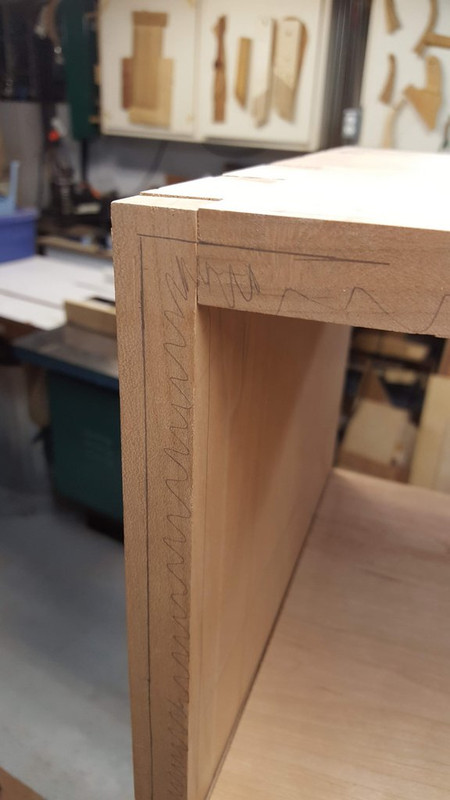
PS, from the picture It appears your dovetails are not fully seated or not deep enough. If the top is going to show you have to reduce the thickness of the top or adjust the dovetails. I think.

Re: Stopped rabbets on TS

#4

Re: Stopped rabbets on TS

Ralph Lipeles

Why aren't you using a router? I feel more comfortable when I can see where the cutter is.

Re: Stopped rabbets on TS

#5

Re: Stopped rabbets on TS

John in NM

Personally, I would probably use a router for what you describe. They sound like they are open at the back? Don't even need a plunge router for that!

I'm not sure I follow your description well, but if you are entering the cut from the back, using a big sled and lifting off the blade to stop the cut, I think I would be comfortable trying that. Lowering onto a dado blade sounds spooky to me.

I used to do closed end panel grooves in door stiles lowering onto a regular blade and lifting off at the end of the cut. That was nerve wracking enough, can't imagine lowering a panel onto a spinning dado.

Re: Stopped rabbets on TS

#6

Re: Stopped rabbets on TS

Steve Elliott

I've done stopped rabbets on the table saw many times over the years and there are ways to reduce the risk.

First, the biggest risk is that you drop the workpiece onto the spinning dado set too quickly and the force causes the piece to move backwards a little bit, which makes the cutter grab the wood. If you make the sacrificial fence long enough you can attach a stop block where the back of the workpiece should start and this will prevent the piece from slipping backwards as it meets the spinning blade. Since your case sides are long the stop block will need to project below the level of the table saw top because the piece will pivot down in back until the piece is lowered all the way.

It wouldn't be a bad idea to use a stop block for the end of the cut, too. Instead of lifting the piece off the spinning cutter you can turn the saw off and wait for the cutter to stop.

Barry's idea of raising the blade slowly is a good one. Think of the wheel as a clock and stop at 3 o'clock or 7 o'clock or whatever.

To set up the fence and stop blocks I'd use some test pieces (rips of plywood the same length as the workpieces).

Push blocks are a good idea for cuts like this. To make sure the rabbet is full depth you'll want pressure near the cutter and I never want my hand close to the cutter pushing toward it.

Re: Stopped rabbets on TS

#7

Thanks guys, I will...

Joe in a Cleveland suburb

get a 1/2" upcut spiral router bit and use the router table. I'll make a couple passes. Sounds much safer.

Seems like a better plan, correct?

Thanks.

Re: Stopped rabbets on TS

#8

Re: Stopped rabbets on TS

Jesse Cloud

I agree that the router is definitely the safer way to go. For large pieces, however, the router table can be awkward.

If you are on the Festool "slippery slope", the Festool routers have an accessory that will let them run on the track for the track-saw. You would also need an MFT table or a track guide to ensure a 90 degree cut.

If you use this method, gang together the two sides with clamps and cut the dadoes in both with the one setup - guaranteed to match that way!

Barry's method of using a template with the router is good, too. I have done tons of dados and mortises that way.

Re: Stopped rabbets on TS

#9

Re: Stopped rabbets on TS

Bill Tindall, E.Tn.

That is the way I do it, including the fence marks. Trivial

Re: Stopped rabbets on TS

#10

What you are failing to appreciate

Bill Tindall, E.Tn.

The long side of this piece has substantial mass. The dado will not have the energy to move it rapidly. Not at all like a smaller stick on a router or blade. That said, I would not and have not, had any reservations making a stopped cut with a dado on a piece of any size. There is no more force required to hold the piece in position as it is lowered onto the blade than what is required to push it across the blade.

Re: Stopped rabbets on TS

#11

Good reason not to use router

Bill Tindall, E.Tn.

Not that I personally ever forgot to ;) but I am told that some people have without thinking assembled the case, then remembered a back went in it. Now you are stuck using a router. And again I am told ;) that cutting out the rabbet with one pass will lead to chipping where it shows.

Re: Stopped rabbets on TS

#12

not how you do it

Bill Tindall, E.Tn.

Mark fence for start and stop. Lower piece according to fence mark. Push through till you reach trailing mark. Withdraw piece slightly and slide away from fence and blade.

I don't understand the angst of lowering something onto the blade. there is no more force on the piece necessary to control it than from shoving it forward. I have done this operation dozens, maybe hundreds of times. My fence has marks with various wear all over it.

Re: Stopped rabbets on TS

#13

practice

Bill Tindall, E.Tn.

Apparently I am the only one here that regards this operation as trivial. So practice and see for yourself. Instead of cutting the full 1/2 for the first time of doing this operation set for 1/16 or 1/64 or whatever you feel safe doing. When you see how trivial it is at 1/ 16th, then do 1/8. Or do 4- 1/8 increments to get 1/2 When that goes well try 2-1/4".

Re: Stopped rabbets on TS

#14

Re: Stopped rabbets on TS

Bill Tindall, E.Tn.

First, the biggest risk is that you drop the workpiece onto the spinning dado set too quickly and the force causes the piece to move backwards a little bit, agree. The risk is overcutting the leading end.

If you make the sacrificial fence long enough you can attach a stop block where the back of the workpiece should start. rarely practical and not necessary

It wouldn't be a bad idea to use a stop block for the end of the cut, too. Instead of lifting the piece off the spinning cutter It is not lifted. It is slid to the side.

Barry's idea of raising the blade slowly is a good one. Again rarely practical

To set up the fence and stop blocks I'd use some test pieces (rips of plywood the same length as the workpieces). Good grief Steve you are making something trivial hugely complicated.

Push blocks are a good idea for cuts like this. Again we disagree. This side is 12" wide 5' long (guessing). Personally I use push blocks as rarely as I can safely get by with because I have vastly better control using my hands to hold down and against the fence. However, in this wonderful of cases either error is easily corrected. They only way to screw this cut up is to let the piece drift back on starting or not stop in time pushing forward. Any other error can be corrected with a second pass.

Re: Stopped rabbets on TS

#15

Re: What you are failing to appreciate

Henry (Raleigh NC)

Actually I completely appreciate the physics Bill. No problem with that.

I still won't do this - even with a thorough and well thought explanation of the physics. I regularly appreciate your explanations and advice and have stated that here several times.

This practice requires a completely different mode of control of your work-piece - controlling the position of a work-piece above a spinning bit or blade. This is drastically different mode than pushing a work piece through a blade or bit with the work piece entirely and continuously supported by the work table. It requires thinking through hand placement and guards and etc etc - and it all falls in to the category of just not something I choose to do. I have better options.

So my statement stands: I have CHOSEN NOT to do this (ever again).

As I stated in my first post, I understand that others make different choices. Just because I do not want to 'drop' something onto a spinning bit/blade, I am not expecting everyone else to make the same decision. Yes I do discourage others from doing this, but only by saying that I CHOOSE not to do so.

The fact that others make different choices than I do is what keeps life (and message boards) interesting.

Henry

Re: Stopped rabbets on TS

#16

SOP

Clifton C

Bill, you are not the only one. This procedure is SOP in the shops I've worked in. Even over cutting a bit so as not to have to square up the corner. I would agree that dropping a board onto a spinning blade is not a good idea, but I've never had a problem pivoting the board on the table, or on longer pieces the edge, and easing it down onto a dado blade, push to mark, slide out of the cut and done... I would also agree that if someone is unsure or uncomfortable, they should explore other options.

Re: Stopped rabbets on TS

#17

good point

Bill Tindall, E.Tn.

but I've never had a problem pivoting the board on the table,

I failed to make clear this point. The wood is entering the blade in a slow and controlled fashion. It is no different than starting the rip cut and no different than ripping and stopping short, except easier because the blade is not captured in this cut. The piece can be simply slide aside.

Re: Stopped rabbets on TS

#18

I have never had a safety or performance issue doi

Yonak

I appreciate, however, that many others aren't as adventuresome or daring as I may be (perhaps, used to be sometimes) in the shop. I just try to keep my head in the game.

Whether using the table saw or router table, the initial plunge, and lifting off the table, is where care is most required to prevent any wandering.

If comfort or control is an issue, the blade (or router bit) could be raised into the piece.

Re: Stopped rabbets on TS

#19

It's very important to use start and stop blocks

Yonak

...including start blocks on both trailing sides of the panel

Re: Stopped rabbets on TS

#20

Perhaps I mis-understood

John in NM

I thought he was cutting a series of dados in the case side for shelves.

I know what you are saying about the forces from doing this on cabinet door stiles, I just don't like it. Feels grabby entering the cut in particular and the way I was doing it required my fingers to be closer to the blade than I liked Even though the blade was surrounded by wood I still didn't like it.

The way I figure it, the way you are comfortable doing something is probably the better way to do it. I don't like turning either. Catches don't hurt, but I just don't like them, and just never got really comfortable turning. Mental block no doubt.

Re: Stopped rabbets on TS

#21

question and comment

Bill Tindall, E.Tn.

Why is the rabbet 1/2 x 1/2? I never use more than 1/2 a case side thickness for the rabbet, in this case about 3/8". What is the back? If plywood, 1/4" is fine. If a panel, can't get by with less than 1/2.

Re: Stopped rabbets on TS

#22

Re: Perhaps I mis-understood

Bill Tindall, E.Tn.

There is a world of difference between cutting a door stile panel lip on something 2" wide and the case side pictured. I could make that required cut with my hands no closer than ripping 1/2' off the edge. In fact I regard the dado cut easier because there is no cut-off to contend with.

Re: Stopped rabbets on TS

#23

Not how I did them...

John in NM

It was a 1/4" x 1/4" groove that stopped in the mortises in either end. Done with two cuts that started by lowering onto the blade and finished by raising off the blade.

As I didn't like that method much after a couple years I switched to full length grooves and haunched tenons. Other guys in that shop did these in various other ways, if I had stuck with that place I might have switched to a pair of small blades on the shaper.

All that said, if it works for you have at it. I'll stick with the haunched tenons, its easier.

Re: Stopped rabbets on TS

#24

My Bad...I misunderstood...

Barry Irby

Somehow I thought we were discussing cutting dados for shelves.

If we are cutting rabbets for the back I would go with the Dado blade on the TS. Exactly as Bill has described.

Still could do it with a router and a fence on it. Easy to sneak up on it and you can see what you are doing.

Still think you need to lower the top a 1/32" or more into those DT's.

Re: Stopped rabbets on TS

#25

I did that once, it cost me 21 stitches

Lee Schierer in McKean, PA

Years ago I needed to make four short stopped dado cuts in some rails I was making for a door. I had the sacrificial fence set up marked for the start and stop points for the rabbets. The first two were no problem. The third cut caught slightly as I pushed the piece through the cut, but was successful. The fourth part Being held like all the others between my two hands as I set it down onto the spinning dado blade was suddenly jerked right out of my hand. My hand on the front of the piece came back toward me with the piece I had been holding. My little finger just flicked across the blade. It didn't even hurt at that point, but my finger looked like chopped meat on one side.

Several hours later i the emergency room a surgeon who did needlepoint as a hobby put 21 stitches in my little finger. I was lucky. No bone was touched, no tendons damaged and no nerve damage. I wore a fat puffy bandage on my pinky for three weeks while it healed up.

If you want to make these cuts, the only safe way to do it on a table saw is to have a stop block behind and in front of the piece being cut. Work out the desired height on pieces of scrap pushed through the cut with proper push sticks. Then lower the blade counting the turns to get it below the table top. With the saw off place your work piece over the blade in the start position and against the rear stop block. Then turn on the saw and slowly raise the blade back up the same number of turns while holding the piece down with a push block. Then push the piece until it touches the forward stop block. Turn off the saw while holding the wok piece in place with the push block. When the blade stops remove your work piece and lower the blade the same number of turns.

Never ever lower a piece of material down onto a moving saw blade it is extremely hazardous no matter what your skill level is.

Lee

👍 This page answered my questions

Your vote helps other woodworkers quickly find the answers and techniques that actually work in the shop.