WoodCentral Forums

Est. 1998 — 27 years of woodworking knowledge

Case construction question(s)

Posts

Case construction question(s)

#1

Case construction question(s)

Joe in a Cleveland suburb

I have some questions. I've started working on this bookcase C. Becksvoort did in a 1998 issue of FWW. The article is light on details. I tried contacting Mr. Becksvoort and FWW to see if a 'measured drawing' is available but no reposnse.

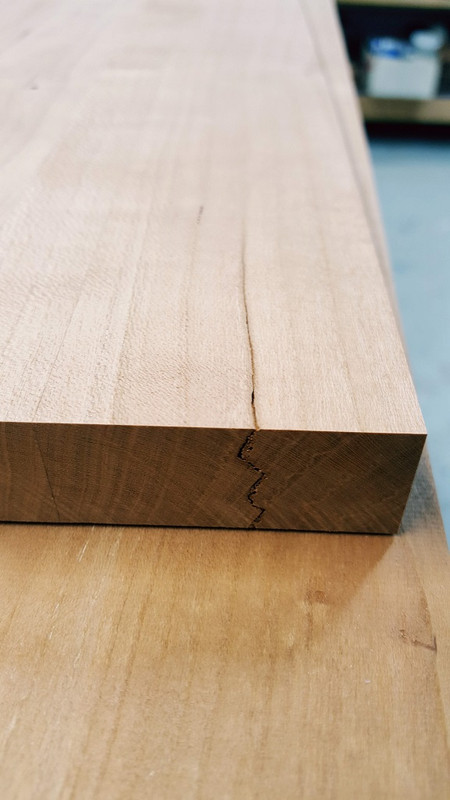
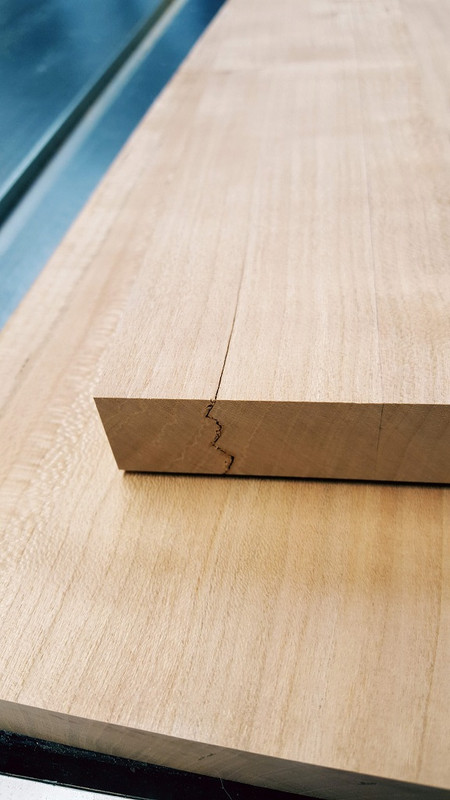
Anyway, I noticed last night after planing the sides and top almost to final thickness, one of the sides has a nice crack in it near the top. This cherry was supposedly sitting in a barn for 100 years blah blah blah.

Should I worry about the crack? I don't have more to re-do it.

Try and get some glue in there are clamp it? I'm inclined to just leave it and that it won't get worse. Looks like that crack has been there a while.

The top will be dovetailed into the sides.

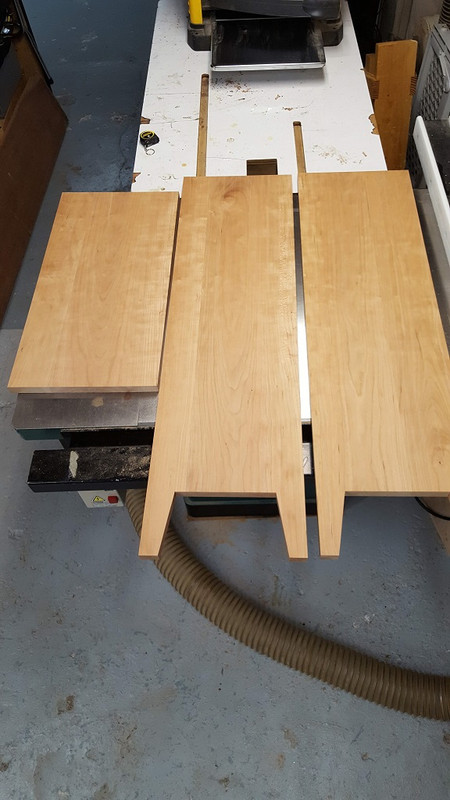
#1 Top and two sides

#2 the crack on one side

#3 the crack on the other side

Another question. I goofed up and made the side a little of 1/4" too narrow. The article calls for a 3/4" frame and panel back to be set into a rabbet. Since I am a bit narrow in width of the sides, could I get away with a 1/2" thick frame and panel back?

The sides are 3/4". How wide should the rabbet be?

Thanks for your help.

Re: Case construction question(s)

#2

Re: Case construction question(s)

Jack Dover

The crack doesn't seem to be a huge issue for structural properties. You could inject some glue with a syringe and clamp it, it should be just fine. If the crack is at the back, drilling parallel to the face from the back edge and gluing a 1/4" dowel in is extra insurance.

1/2" back panel should be ok, however it's going to be hard to make it a real frame and panel. Just think about tenons' thickness, a panel's thickness, a rebate's width, etc. But if you don't mind using plywood and making a faux frame and panel, it's going to be ok. Otherwise just make it 1/4" narrower if you don't have to fit something of a particular length inside, nobody would tell it's 1/4" shorter. Well, maybe Mr. Becksvoort will, just don't invite him to that room.

The width of the rebate should provide either sufficient glue area or be sufficient for screws or both. On bigger cases I shoot for at least half of the thickness of a side, or at least 3 diameters of a screw. For smaller cases I might leave just 1/8".

Hope this helps.

Re: Case construction question(s)

#3

Re: Case construction question(s)

Barry Irby

I agree with Jack.

However, For the cracks, I would probably soak them with thin Cyanoacrylate (CA) glue and then fill them with the medium thickness type. I think you will be surprised with how far the thin glue wicks into the crack, It will follow the crack further than you can see now. Might want to put tape next to the crack on both sides front and back to make clean up easier. once the glue has hardened sand it away until it disappears from the surface. If you get all of it off it will not interfere with stain. I spray with lacquer and it disappears under it. Once done, nobody will notice the cracks.

I would not worry about the 1/4". The dimensions are not written in stone. But if it worries you there are a number of ways to make a thinner back panel. You could sort of split the difference and make a 5/8" back panel.

Re: Case construction question(s)

#4

Re: Case construction question(s)

Virgil Johnson

I have built this same bookcase from the dimensions in the article. Use 1/2" material for the back and ship lap it. Got your 1/4" back at least in the inside...As for the crack I would do one of 2 things. Thin CA glue followed by thicker. I have read/heard that CA is not permanent but I have not had any fall out of a void yet. Or clamp a board across the end as a "seal". Use my shop vac (butt end of hose flat against back) and suck some glue into the crack. The dovetails on the top may cut out part of it. I dont think the crack will cause you any issues other than a mental debate on what amatuer advice to follow.

Re: Case construction question(s)

#5

Re: Case construction question(s)

paul in AZ

I usually fill small cracks like that with epoxy. An old credit card can be used to squeeze it in if it isn't runny enough to fill the crack on it's own. Add a drop of brown or black liquid dye to the epoxy mix and it will look like a natural feature of the wood.

Epoxy sands well and takes finishes.

Re: Case construction question(s)

#6

Re: Case construction question(s)

Derek Cohen (in Perth, Australia)


Hi Joe

Since you plan to dovetail the case sides, the top will be reinforced and unlikely to open further. What I would do, if this was mine, is add a butterfly key low down on the split on the inside of the panel as a further precaution.

Another question. I goofed up and made the side a little of 1/4" too narrow. The article calls for a 3/4" frame and panel back to be set into a rabbet. Since I am a bit narrow in width of the sides, could I get away with a 1/2" thick frame and panel back?

The sides are 3/4". How wide should the rabbet be?

Joe, I am completing a cabinet at present with 18mm (3/4") thick sides, and the rebate for the back is 7mm deep (x 12mm wide). This will accomodate a 6mm (1/4") thick solid wood panel.


A 1/2" thick frame could be made using a 1/4" thick groove with 1/8" wide shoulders each side, taking a 1/2" thick panel with a 1/4" tongue. This is easy enough to do with a router and slot cutter.

Regards from Perth

Derek

Re: Case construction question(s)

#7

Answers

Bill Tindall, E.Tn.

What exactly do you need to know that you would need to consult FWW?

The crack is a serious problem. It was apparent when you end trimmed. If you end trim and the trimming falls into pieces there was a crack. These kind of cracks are common in lumber that is not manufactured at a commercial mill. This kind of defect is often trimmed at the mill and therefore these kind of cracks will be less common. It will come and go seasonally and crack what ever finish you put on it. That is to say, it will appear as a crack forever. You might be able to glue it shut. Work glue in with dental floss, then clamp. There will be stress on the joint and it may not clamp tight everywhere to squeeze the glue out. So, leave clamp on overnight or over day to ensure a maximum strength cure.


A 3/4 back is overkill . A frame and panel back is overkill unless this shelf will be see from both sides. I just dug out a sheet of 1/4" cherry plywood I bought in 1971 that would be just what you need.

I have started putting frame and panel backs in case pieces. I use 1/2" framing and 3/8" panels. The Domino has made making these a breeze and it uses up junk.

Re: Case construction question(s)

#8

ps

Bill Tindall, E.Tn.

1/2 x 1/2 to answer your last question

Re: Case construction question(s)

#9

more PS

Bill Tindall, E.Tn.

Yellow glue is only 50% solids (approx. I don't remember the exact amount). When it dries what is left behind is 50% air, think Styrofoam, which has no gap filling strength. If you can't squeeze the excess out of a joint the glue gap will be uselessly weak.

I have no experience using epoxy in woodworking. When cured it has strength. This strength could bridge across a gap and keep it from opening under stress. Or not.....

If I could not pull the crack closed tightly with a clamp I would probably try epoxy. Someone with experience using it might know it will work and not consider any other option.

Re: Case construction question(s)

#10

Re: Case construction question(s)

Ralph Lipeles

I would try to fix it. If it is an old crack the surfaces have oxidized. I find that epoxies do best in a situation like this. Get the epoxy well into the joint and then clamp it. Use a razor blade to scrape off any epoxy that has leaked out.

Re: Case construction question(s)

#11

Regarding the splits

David Yoho

Derek beat me to it. I like the idea of using butterfly keys to prevent further widening of the splits and positioning them low enough to be out of the way of your dovetail joinery. You could also inject some thinned epoxy in the ends for an added measure but not absolutely necessary.

Re: Case construction question(s)

#12

Re: Regarding the splits

Bill Tindall, E.Tn.

In my experience that kind of split is not going to further widen. It got there from shrinkage as the end of the lumber pile dried faster than the interior. The tension has been released and there is no remaining tension to propagate the split. What it will do is come and go enough to crack the finish. If the butterfly will not keep the finish from cracking it will do nothing helpful.

Re: Case construction question(s)

#13

Re: Regarding the splits

Mark Hennebury

dark colored epoxy, no clamps, put some tape on the bottom and end to keep the epoxy from running out.

Re: Case construction question(s)

#14

Re: Case construction question(s)

William Duffield

I don't trust CA over the long term, but it should hold the crack together long enough for you to cut tight fitting dovetails that will hold the crack closed long term.

There is another technique that uses air pressure to force glue (epoxy or tite-bond) into and throughout the crack. This is probably not needed if you are using thin CA. It requires that the crack can be closed completely with clamp pressure. Apply the clamp across the clamp, closing it. Apply a bead of glue along the complete surface of the crack, front, back, and bottom. Slowly release the clamp, creating a vacuum inside the crack. Outside air pressure should force glue into the crack. If there is any place along the surface of the crack that the glue is forced completely inside (with an air gap between the two sides of the glue bead), repeat the operation, applying pressure with the clamp, applying more glue bead to the places that need more, and open the clamp again. Repeat until the crack stops taking more glue. Close the clamp, scrape off or otherwise remove the excess glue, and let the glue dry over night. If you are worried about the finish, use packing tape or even blue painters tape on the outside show surface instead of glue.

Re: Case construction question(s)

#15

advice to rough lumber users

Bill Tindall, E.Tn.

The first thing I do when I put a piece of rough lumber across the vises for sawing rough lengths is to scrutinize the ends for cracks. Commonly I add mineral spirits to a crack to see how far it runs, usually beyond what I can see. To be absolutely sure I got it all I will make a second saw cut of say 1/2". If this cut easily falls into two pieces I know I didn't get it all.

Spare no effort to not face this problem for it is not reliably fixed.

Re: Case construction question(s)

#16

Re: Case construction question(s)

Joe in a Cleveland suburb

As usual, thanks for all the advice.

Haven't decided which approach to take yet. I'm going to wait and see where the DT's lay out to be.

👍 This page answered my questions

Your vote helps other woodworkers quickly find the answers and techniques that actually work in the shop.