WoodCentral Forums

Est. 1998 — 27 years of woodworking knowledge

Drilling out a dowel

Posts

Drilling out a dowel

#1

Drilling out a dowel

Joe in a Cleveland suburb

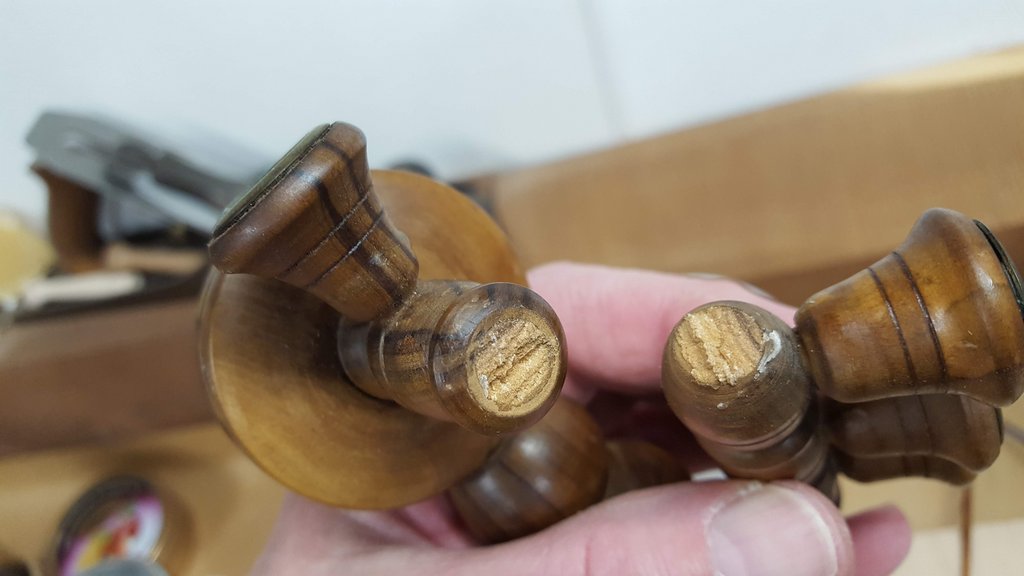
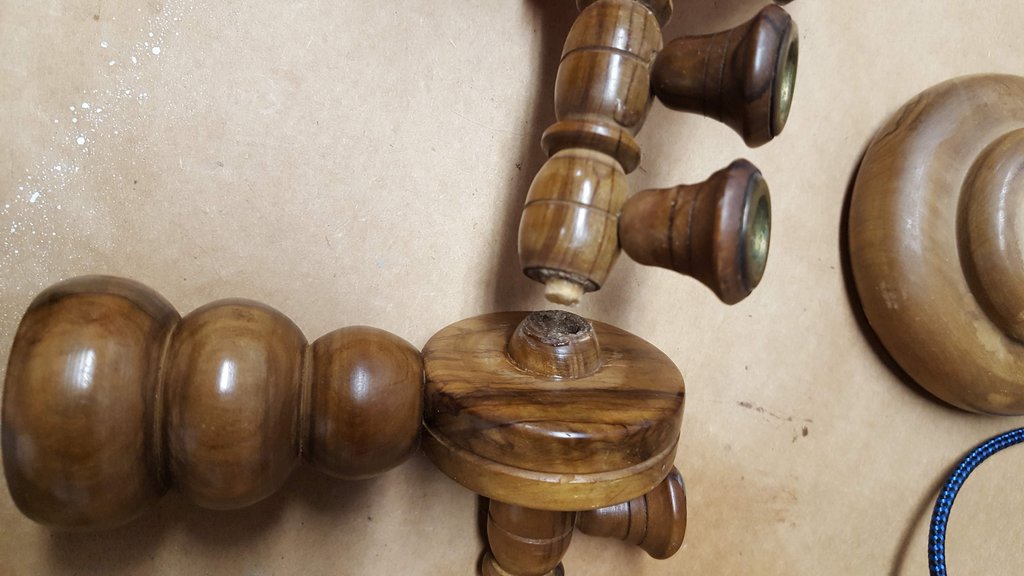
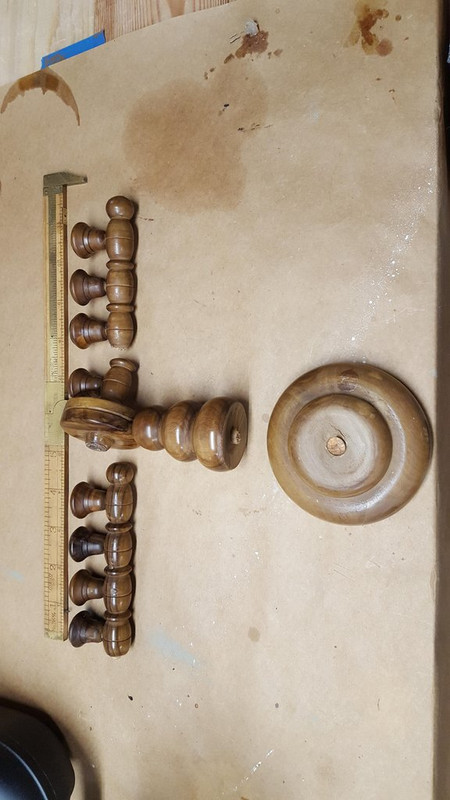
My daughter's husband asked me if I could repair his broken Menorah. It has some family history to it and he would like to keep and continue using it.

Someone has tried to repair it by just gluing it back together. Gluing end grain to end grain never seems to work so well... :b

Basically it seems I need to somehow drill out the center of essentially dowels and replace with another dowel.

Any suggestions on how I could do this accurately? I have a benchtop drillpress and a lathe. Although I don't see how I could use the lathe. I think I might be able to make some kind of v-block to hold the pieces vertically and drill them but not sure how I could get each piece exactly centered.

Looking for some ideas.

Thank you as always.

#1

#2

#3


Re: Drilling out a dowel

#2

Re: Drilling out a dowel

Ralph Lipeles

I've done quite a bit of this type of repair over the years repairing chair rungs. I first drill out a part of the broken dowel. I drill a hole quite a bit smaller then the dowel. say 1/4" drill out on a 1/2" dowel. That gives me an allowance if the drill wanders and is not centered. If it wanders, correct by redrilling with a larger size, a Dremel or a small chisel. After centering the hole, drill larger, a little bit at a time until you have a hole in the dowel a little bit smaller then the dowel OD. Remove the balance of the dowel with a small chisel, paring it by hand. Do this on both halves and then you are ready to glue it back together with a new dowel. If the hole is free from glue and the dowel fits nicely, use any wood glue. If old glue remains use an epoxy. If old glue remains and the fit is loose, wrap the new dowel first with some thread and then glue it in place with the epoxy.

Re: Drilling out a dowel

#3

Re: Drilling out a dowel

Barry Irby

Throwing out some thoughts.....

You could make a Vee block and attach it vertically to the side of a sturdy block you could clamp to your drill press table and then carefully center the two end pieces and drill them.

By using shorter pieces of Vee block you could drill some of the others, allowing some of the protuberances to tuck under the V.

The base should be easy enough.

Also, Read the stuff below on Hardware Bonding. The idea is to drill a considerably oversized hole and fill it with Epoxy and then insert the hardware. In your case you could drill a 3/8 or 7/16" hole and use a short piece of 1/4" treaded rod or even a dowel. This would give you some wiggle room to straighten everything up before the epoxy sets.

Another idea is to use a really long drill bit, like maybe 18". It gives you a much better "sight line" to see if you are straight.

This all would be easier if you can remove the candle holders, but I am guessing they are glued in with dowels and won't come out easily.

Re: Drilling out a dowel

#4

Kneale Brownson

Glue known?

kneale brownson

Maybe you could soften the glue (heat/moisture) and extract by inserting something like a drywall screw with coarse threads and pulling? I'd reglue with something like hide glue that can be undone next time.

Re: Drilling out a dowel

#5

Re: Drilling out a dowel

Bill Tindall, E.Tn.

My experience with dowels is that they are never glued in with a robust bond of dowel to hole. So.....I drill the dowel with an undersized drill and start prying at the wall of the dowel with a chisel. The dowel usually will split away from the hole.

Re: Drilling out a dowel

#6

Re: Drilling out a dowel

William Duffield

If you have one, an incanal gouge works even better than a flat clhisel.

Re: Drilling out a dowel

#7

Re: Drilling out a dowel

William Duffield

If you can manage to get a grip on the pieces with a scroll chuck, a lathe really works better than a drill press. Install the appropriately sized drill bit in a Jacob's chuck in the tail stock. A brad point bit works best for this. Install a scroll chuck in the the head stock. If necessary, remove one of the jaws to make room for the piece that sticks out the side of the piece you need to drill. Run the lathe at a very slow speed, and adjust the scroll chuck until the center of the dowel is centered on the drill bit. You already know that the other end of the piece you are drilling is centered. Slowly advance the drill bit in the tail stock, until the hole is deep enough. It helps a lot if you know how many turns per inch the tail stock advances. The lathe will do a much better job of keeping the drill bit centered on the turning piece than a drill press will..

Re: Drilling out a dowel

#8

Re: Drilling out a dowel

TomD

I drill them out on my mill with an endmill, which I am sure is not a useful suggestion.

Refer to the recent hardware bonding thread.

Use a drill to safely enlarge the holes so all the residue is gone. Cobble together a jig so that you can hold the pieces in vertical alignment. You might be able to turn candle ends on pieces of, say 3/4x1.5 inch wood. If you mount a piece of plywood vertically in a vise, you could clamp these "candle ends" so they stick out along the edge on the side of the plywood. With some adjustment, you could hold your pieces vertically maybe 2 at a time.

So now, mount one piece vertically in your jig. Take an undersized piece of threaded rod, and put a dab of hot melt on the end, and position in hole so it stands vertically in the hole. Or wedge it with toothpicks. Cast with epoxy so the rod is fused in the hole. Now flip over and set up so you can repeat with the other hole, casting the stud now mounted in the end of the adjacent piece, into it. Your drill holes do not need to be perfectly aligned in this case, and they should be oversized, so bonding the threaded rod in does not require precise drilling.

Just keep repeating the process whereby your threaded rod is mounted in one piece by casting it in with epoxy, then flip over and cast in the other end. Use some kind of jig to hold the parts steady while you cast.

Re: Drilling out a dowel

#9

ebd

Re: Drilling out a dowel

ebd

I would just use a doweling jig. That way you can get the hole perfectly centered. I have an old Stanley 59 and it would do the job in just a few minutes.

Re: Drilling out a dowel

#10

stronger method

John K Jordan

I also have used the method of drilling out at least some of the dowel and replacing it not with another dowel but with a steel rod epoxied into place. I usually use a piece of threaded bolt with the head cut off since the epoxy will hold well to the threads. (degrease the thread well first - I use brake parts cleaner from the auto parts store.) The hole should be drilled larger than the rod, perhaps at least 50% larger.

Since the hole is larger than the rod the pieces can be aligned easily during glueup without having to worry about perfect hole alignment when drilling.

Filling the loose hole with epoxy and holding the pieces in place until it cures will make a permanent fix much stronger than the original dowel.

JKJ

Re: Drilling out a dowel

#11

Re: Drilling out a dowel

Ralph Lipeles

Look at the shape of the pieces. Large diameter and irregular shape. I don't see how the Stanley jig could be used.

Re: Drilling out a dowel

#12

Re: Drilling out a dowel

Derek Cohen (in Perth, Australia)

Joe, for smaller dowels, drill into the centre, then insert a screw through the dowel. The screw will push the dowel out.

Regards from Perth

Derek

Re: Drilling out a dowel

#13

Re: Drilling out a dowel

romclark

keep us posted

👍 This page answered my questions

Your vote helps other woodworkers quickly find the answers and techniques that actually work in the shop.