Moxon Option
Mark Mandell - Gone Round In New Jersey
For those who've made one of these, do you prefer:
a. Stationary thread rod with moving handle (rods stick out the front) or
b. Fixed handle with the rods moving out the back.
Est. 1998 — 27 years of woodworking knowledge
Moxon Option
Mark Mandell - Gone Round In New Jersey
For those who've made one of these, do you prefer:
a. Stationary thread rod with moving handle (rods stick out the front) or
b. Fixed handle with the rods moving out the back.
Re: Moxon Option
David Weaver
If it's going to be deep and capable of handling more than just boards, I'd rather have the excess out the back so it's not in your way.
If the opening won't be more than 2 inches or so, I don't know that it would matter. handles on the front and rod in the back looks better, though.
Re: Moxon Option
Pat Riley
I just commented on the previous thread.
I like the threads out the back. I think it looks better, but for me it works better as well.
My normal bench is kinda crappy, so sometimes I use mine for other things, like jointing a long edge or using a plow plane. If you are using it that way in a parallel fashion and the work is long, you cant really use the right body motion because that stupid thread is in the way.
I only figured that out by taking a few dingers in the side when using my first version.
The down side is you have to move more crap around on the bench to get set up because the screws are out the back, but I have to move crap anytime I do anything, so it is a non issue for me.
Re: Moxon Option
Pat Riley
Wheels do have a benefit when you use it in a parallel configuration, because you can make them very low profile and still get good torque on them. Knobs sometimes stick way out as well.
Re: Moxon Option
roger lance
Mark....I made a Moxon with BenchCrafted hardware which means the screw rods are sticking out the front of the vise 5" to 6".
If this is an issue, there is a simple solution: the rods are held to the rear jaw of the vise with two nuts.....one on the inside of the rear jaw is held in a recess.....and the other is on the back side of the rear jaw and this nut is tightened down to hold the rod in place. All that need be done if you are going to be working on drawer sides for example for awhile is to adjust the amount of projection on the rod......just move it back 3" to 4" and problem is solved.
This is not much of an issue. There will be some who will moan about "all that unnecessary work" in adjusting the rod.....they should get some rest.
Re: Moxon Option
William Duffield
Roger's method works beautifully. IIRC, it is also the method shown in Benchcrafted's construction instructions. The purpose of the nut set into the front of the rear jaw is NOT for tightening the jaw on the work, because that work would pull it out of the jaw. It's purposes are to hold the threaded rod at the proper position to accommodate the thickness of the stock and to be tightened just enough that the threaded rod doesn't move in or out when tightening or loosening the hand wheel.
B
Virgil Johnson
Rods out the back. I'm clumsy and there is no steel rod for me to accidentally bang a chisel or saw on.
Re: Moxon Option
Derek Cohen (in Perth, Australia)
Roger describes the design well. The threaded rods can be made adjustable in length.
When I built my current Moxon, which uses Acme threads (similar to those supplied by BenchCrafted), I thought that I would do as I had previously done with my wooden threads, that is, push them out the back. BenchCrafted designed their Moxon to have the threads way out the front, about which I could not see any merit and only the danger of either poking my eye out if I (eye) bent down, or worse still, removing my manhood if I stood up (okay, I’m not that tall).
What I discovered is that the balance of the Moxon is affected by the positioning of the steel threads: too far back, or too far forward, and it is difficult to stand up on the bench top. In the end I compromised with enough out the front to ensure that there was holding space for a case thickness. 1” is plenty for that, and 2” provides a little more leeway without threatening to stab.
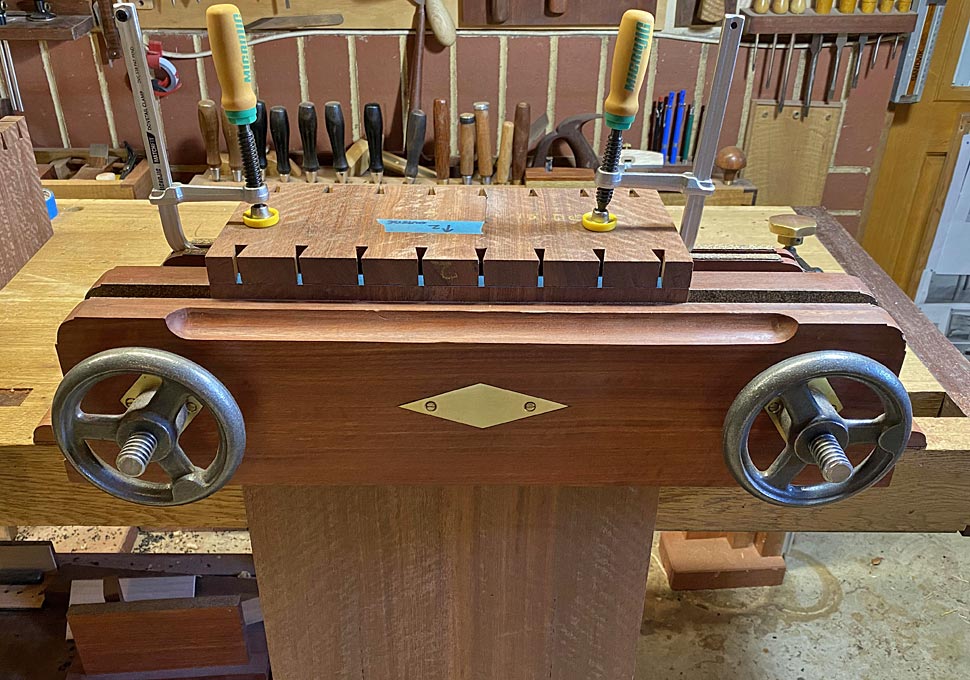
There is plenty to still adjust at the back ..
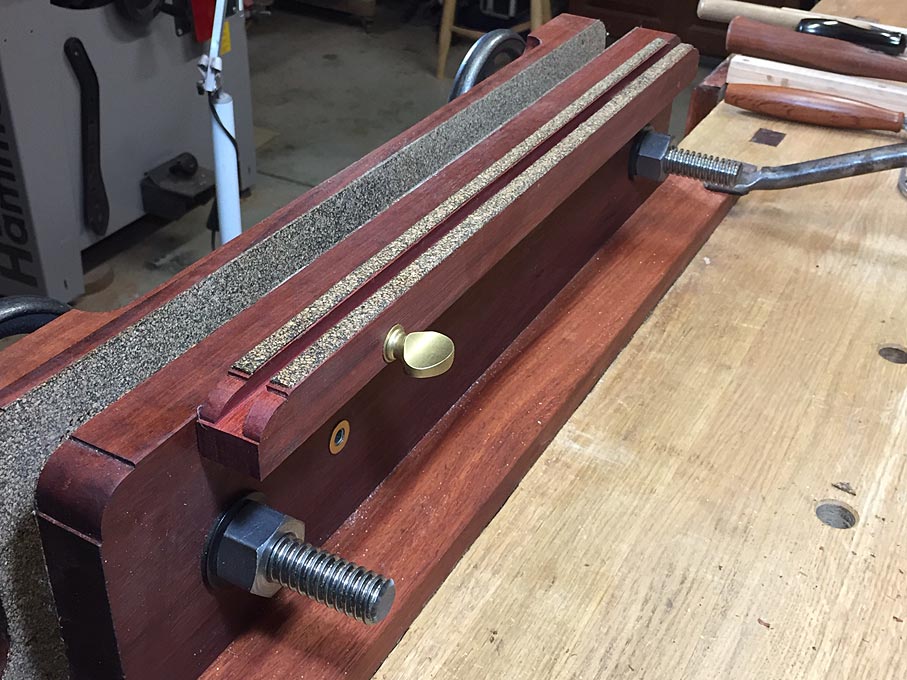
The Moxon above is my fancy-shmancy version, “The Last Moxon Vise”. The write up is here: http://www.inthewoodshop.com/ShopMadeTools/TheLastMoxon.html
The intention was to put into it all I had learned and found useful, and then not modify it further. But I am compulsive that way  There is always something helpful to come along, and so ...
... springs were added inside. These make the chop spring open, which is great as the cast iron wheels are heavy - wonderful momentum but only once moving ...
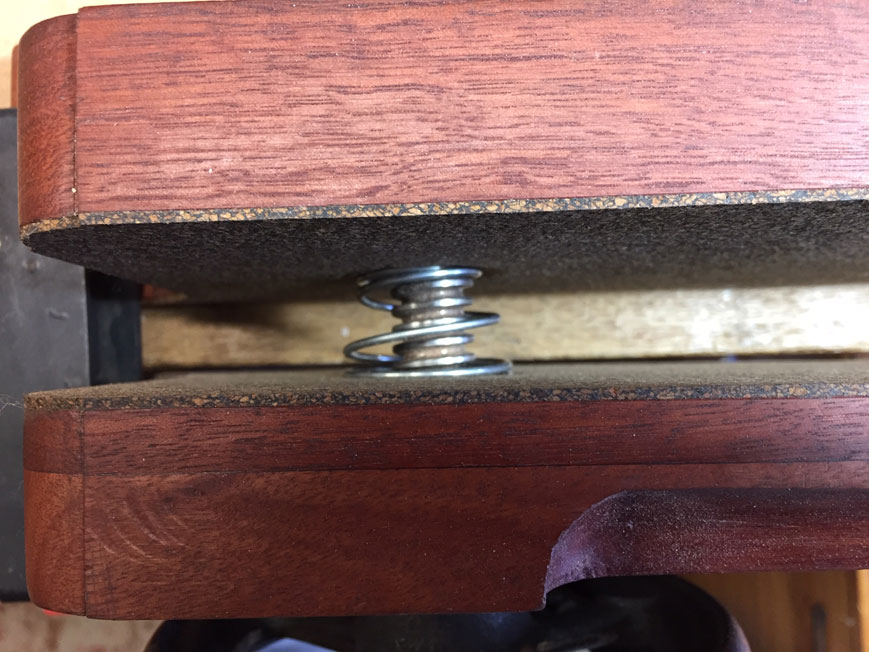
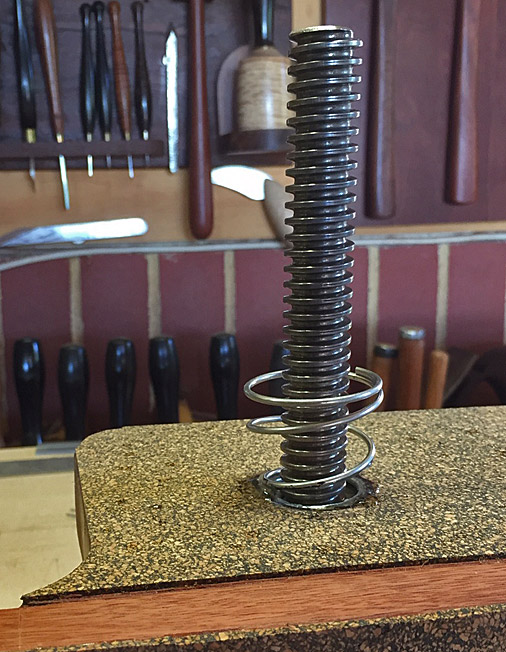
The springs collapse into themselves, and the chop closes up ...
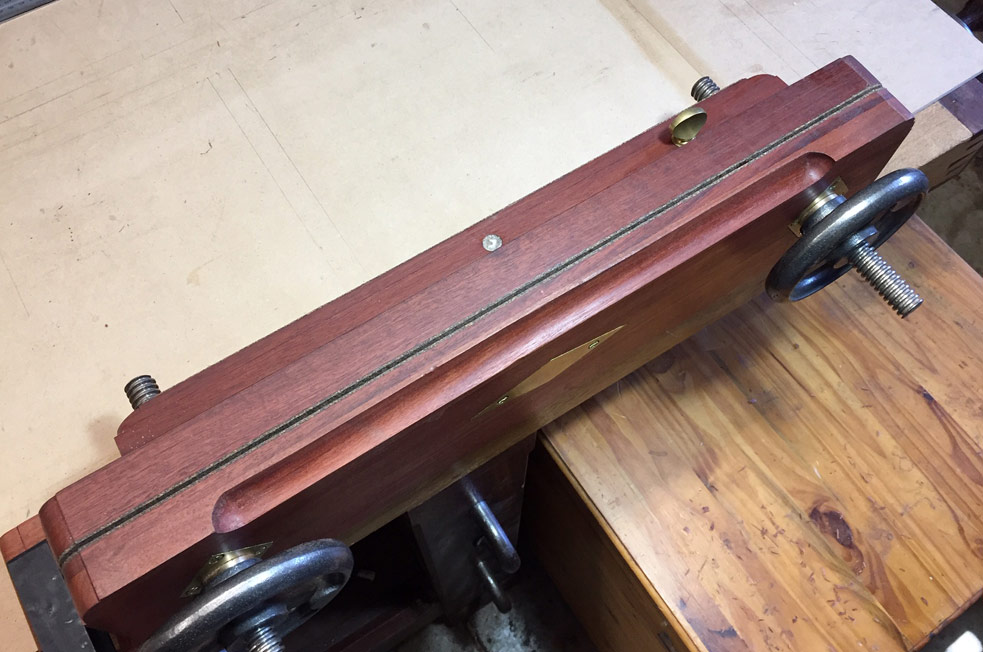
The other feature seen here is the “Crubber” lining for the vise. This is gasket material, referred to as cork-rubber. I have come to prefer it to leather. It is not as durable as leather, but grippier.
These mods and designs are not for everyone. I began simple about 25 years ago, with a thin screw vise made from threaded rods into the face of the bench top ...
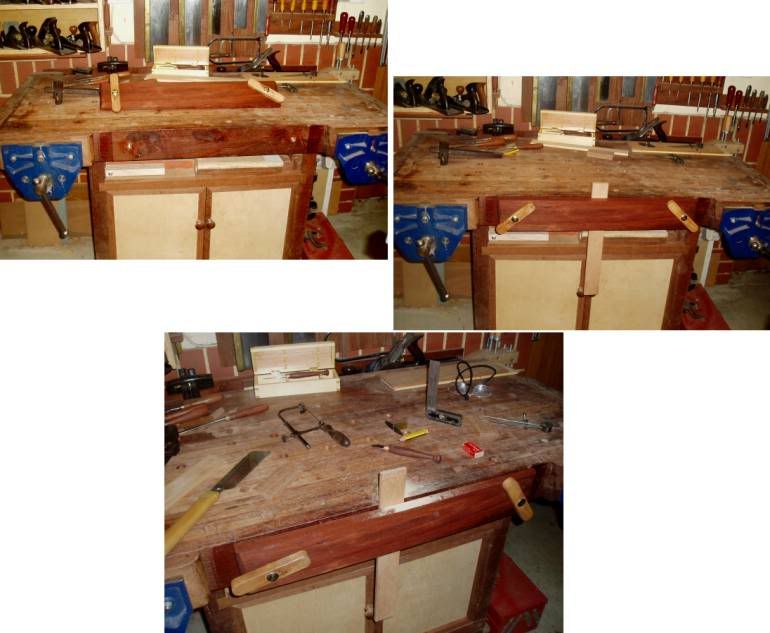
Obviously, these tools are a personal matter, and one goes as far as one wants. I am getting so much pleasure out of the new design, and am happy I went the extra mile.
Regards. from Perth
Derek